Accumulation-mode aerosol drives summer cloud droplet counts; winter also depends on Aitken particles
Over the Azores, summer cloud droplet numbers track accumulation-mode particle numbers, while in the cleaner winter air small Aitken-mode particles also matter, and decoupled boundary layers cut the aerosol that reaches cloud.
Why it matters
Surface aerosol measurements are often used to stand in for the particles that form cloud droplets. This study finds that stand-in works poorly when the marine boundary layer is decoupled. It also suggests that activation schemes and cloud brightening ideas depend on the season’s aerosol regime. These are preprint results and have not been peer reviewed.
What they did
The authors used aircraft and ground data from the ACE-ENA campaign in the Azores, from one summer and one winter period. They sorted boundary-layer profiles into coupled and decoupled states using radiosonde temperature and moisture differences. They then fed measured aerosol, hygroscopicity and updraft values into the Abdul-Razzak and Ghan activation scheme. They swapped one input at a time between seasons to see which input changed the simulated droplet number most.
Key findings
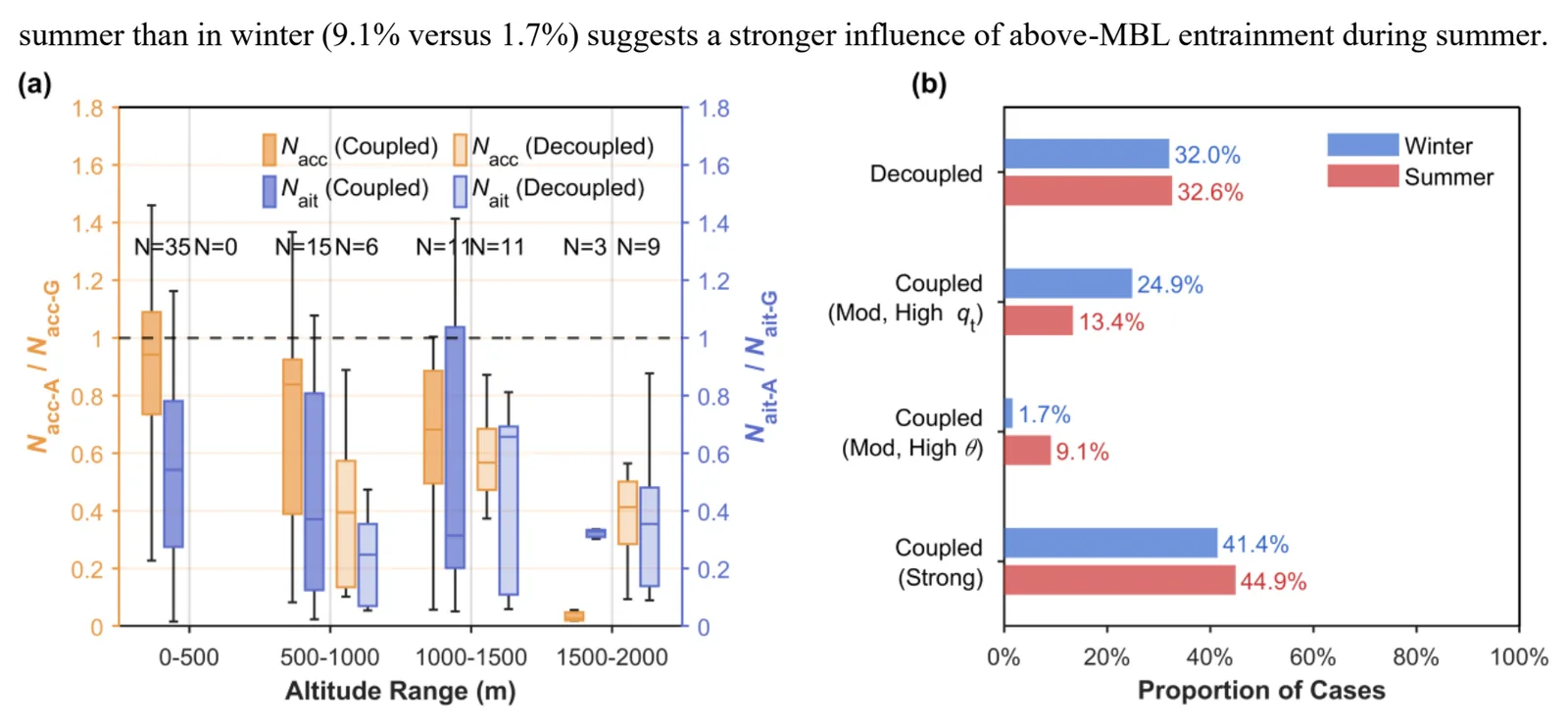
- Decoupling occurred about 32.6% of the time in summer and 32.0% in winter.
- In decoupled cases, accumulation-mode aerosol aloft fell by 60.5% and Aitken-mode by 75.1% relative to the ground.
- Summer accumulation-mode concentrations were far higher than winter ones, but measured droplet numbers differed much less, with a summer-to-winter median ratio of 1.56.
- In summer, swapping in the winter accumulation-mode concentration changed the simulation most, with a slope ratio of 1.79. Updraft, hygroscopicity and distribution width had weak effects.
- In winter, droplet numbers were also sensitive to Aitken-mode number and size, with slope ratios of 0.75 and 0.76.
Limitations
- Only 16 research flights were used, taken in daytime around local noon, so decoupled cases are likely under-sampled in the aircraft data.
- The analysis does not treat new particle formation in the upper boundary layer or entrainment from the free troposphere as separate factors.
- The simulation overestimates droplet number in summer, with an observed-to-simulated ratio of about 0.5. The authors note the scheme may be biased at high accumulation-mode concentrations.
Glossary
- Marine boundary layer decoupling: A state where a stable layer below cloud base stops surface air from mixing up to the cloud.
- Aitken and accumulation modes: Two groups of aerosol particles by size, with Aitken particles being smaller than accumulation-mode particles.
- Abdul-Razzak and Ghan (ARG) scheme: An analytical formula that estimates how many aerosol particles become cloud droplets in a rising air parcel.
- Hygroscopicity (κ): A number describing how readily particles take up water.
Original paper
Clarifying the controlling factors of the seasonal variation of droplet concentrations in marine low-level clouds
EGUsphere · 15 October 2026
This paper is a preprint. It has not been peer reviewed, and its results may change.
AI-generated summary of the original article; changes were made. Check the original before relying on it.