PACE satellite aerosol data and ModelE agree on fine aerosol but split on coarse dust and water
The first comparison of PACE SPEXone aerosol composition with a climate model finds good fine-mode agreement over land, but a large ocean mismatch in mineral dust and aerosol water that the authors trace partly to retrieval assumptions and partly to the model.
Why it matters
Aerosol effects on climate are uncertain, and global composition data have been missing to test models. This study shows where the new satellite retrievals and the model can be trusted and where each needs work. It also suggests the retrieved refractive index could help separate sea salt from dust.
What they did
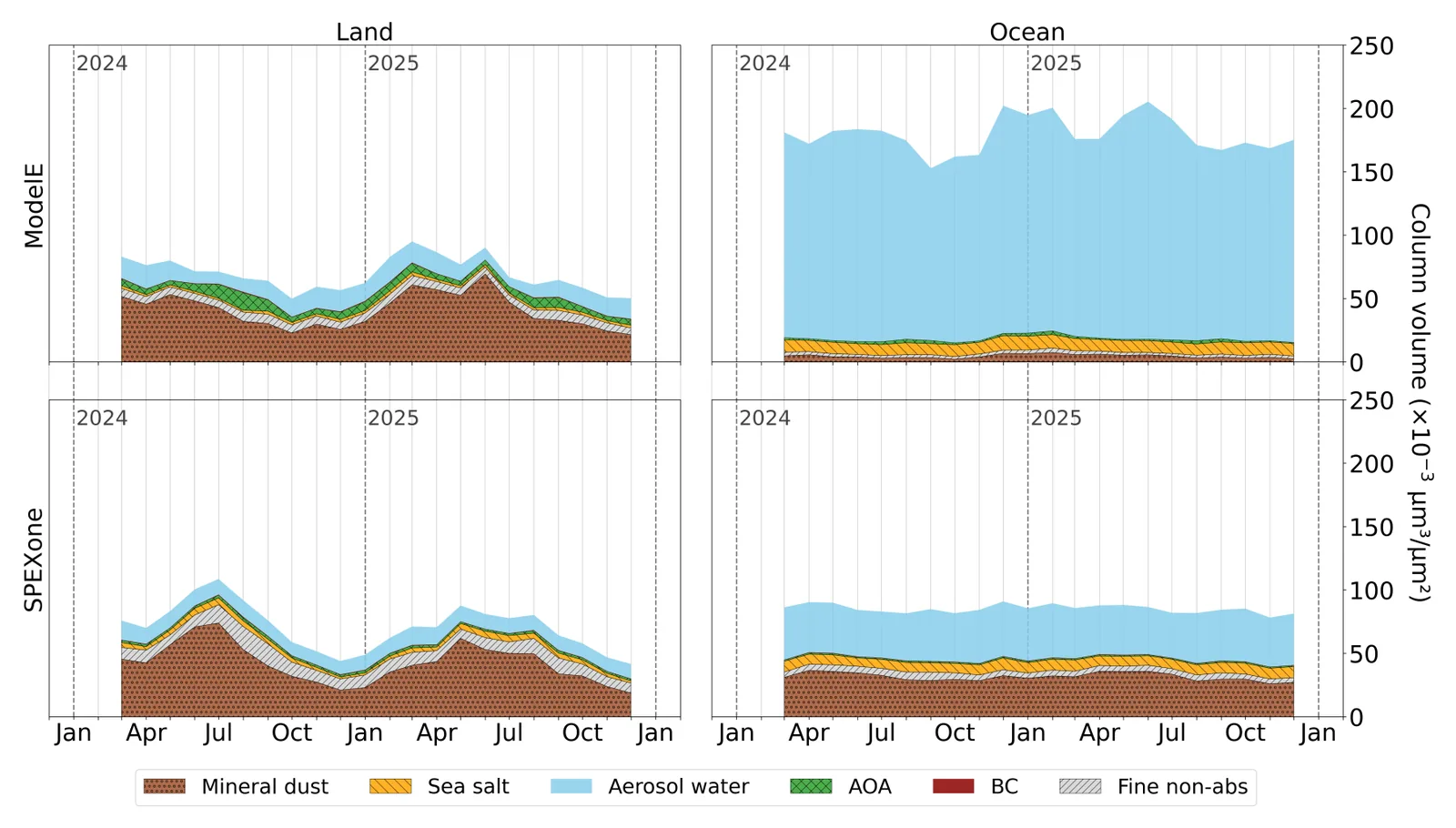
The authors matched NASA GISS ModelE clear-sky output to PACE SPEXone RemoTAP retrievals within ±15 minutes, from February 2024 to December 2025, on a 1°×1° grid. They compared column volumes of dust, sea salt, black carbon, organic aerosol, other fine aerosol and aerosol water. They also recomputed the model’s sea salt water using two reanalysis humidity fields and two water uptake schemes, and compared both products in refractive index space.
Key findings
- Fine-mode aerosol agrees well over land, within 5% when the three fine species are summed. The split between absorbing and non-absorbing organics differs because of assumptions on both sides.
- Mineral dust agrees within about 10% over land, but SPEXone exceeds ModelE by a factor of 8.4 over ocean. The excess covaries with modeled sea salt, so the authors suggest it is nonspherical sea salt reported as dust.
- Over South America, retrieved dust tracks the fine-mode smoke cycle, which hints at nonspherical smoke being labeled as dust.
- ModelE carries a median 3.6 times more water per unit dry sea salt than SPEXone infers over ocean. Reanalysis humidity and a measured hygroscopicity each reduce the gap, but together still leave a factor of about 1.4.
- The 3.6 factor corresponds to only 0.027 in effective refractive index, because the mixing rule amplifies small index differences.
Limitations
- Neither coarse-mode finding shows that the model’s coarse aerosol is right. A real deficit in modeled long-range dust transport would look the same and cannot be separated here.
- The retrieval reports no uncertainty on refractive index, and its assumed dry endmember of 1.50 may bias inferred water low. The reassignment test uses a different product version that is not co-located with ModelE, so it is only indicative.
- The comparison uses column totals and sparse clear-sky sampling, and ignores size distribution, mixing state and vertical weighting. This is a preprint that has not been peer reviewed.
Glossary
- SPEXone: A multi-angle spectropolarimeter on the PACE satellite that measures light intensity and polarization.
- RemoTAP: The inversion algorithm that turns SPEXone measurements into column aerosol amounts by species.
- Normalized mean bias (NMB): The summed model-minus-satellite difference divided by the summed satellite values. A positive value means the model is higher.
- Efflorescence relative humidity: The humidity below which a salt particle dries out and crystallizes, becoming nonspherical.
Original paper
Mutual constraints on global aerosol composition from novel PACE data and ModelE
EGUsphere · 7 October 2026
This paper is a preprint. It has not been peer reviewed, and its results may change.
AI-generated summary of the original article; changes were made. Check the original before relying on it.