Rain and falling droplet counts build up about 25 hours before stratocumulus clouds break into open cells
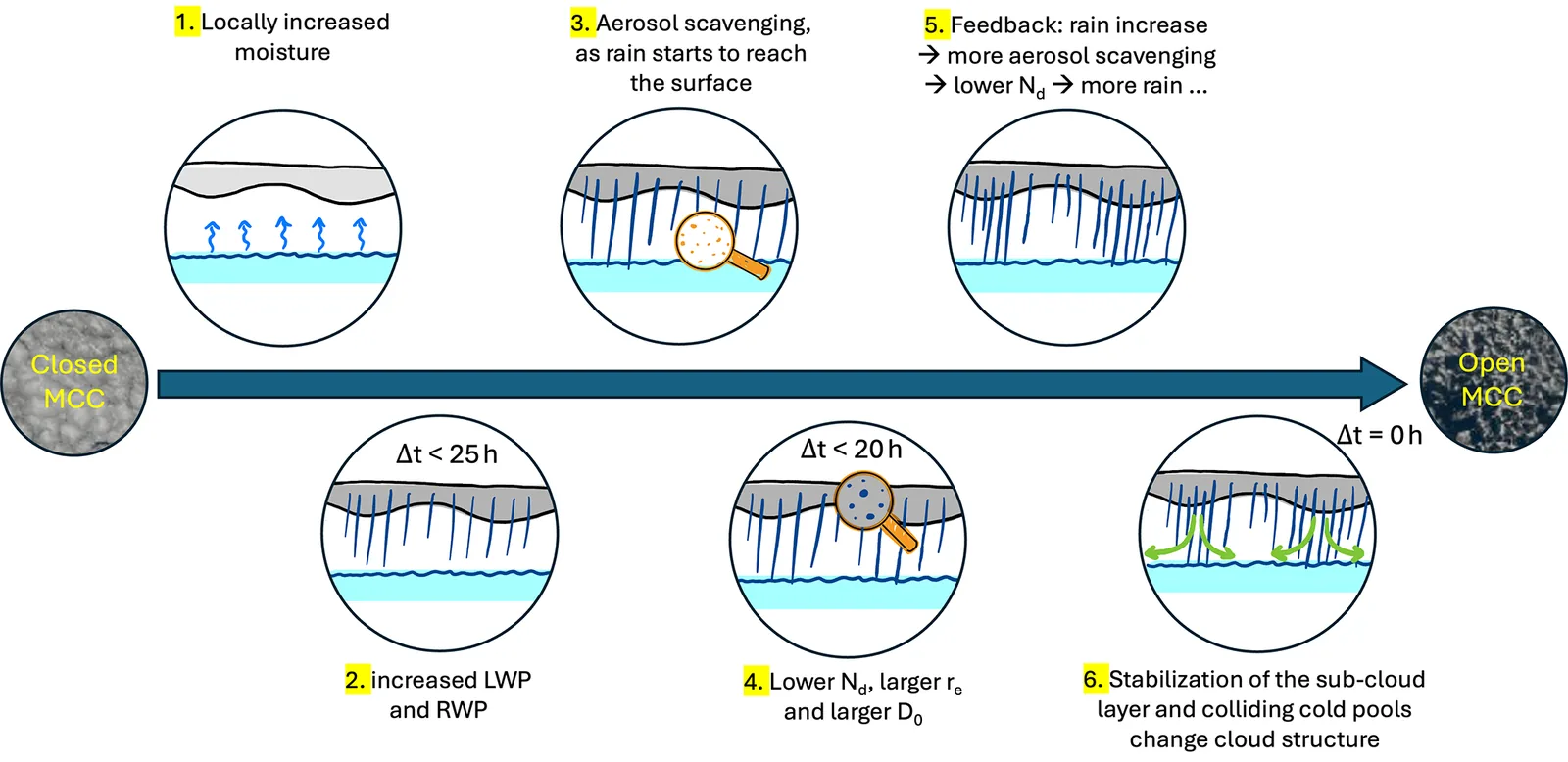
EarthCARE and GOES data show that in stratocumulus, liquid water and rain rise first, then droplet numbers fall, over about 25 hours before closed cells turn into open cells.
Why it matters
When closed stratocumulus decks break into open cells, they reflect less sunlight, so their cooling effect drops. The observed order of events supports a rain-driven pathway with an aerosol-scavenging feedback. This suggests that boundary-layer moisture and aerosol amounts may shape how much these clouds cool the climate.
What they did
The authors used a neural network to label closed and open cells in EarthCARE imager scenes over four subtropical stratocumulus regions. They linked these labels to cloud and rain retrievals that combine lidar, radar and imager data. For the Southeast Pacific, they followed 128 km scenes along ERA5 wind trajectories. They used GOES images to time each transition from closed to open cells, and found 803 transitions.
Key findings
- Open cells have much lower droplet number concentration, more variable liquid water path and droplet size, and heavier rain than closed cells.
- Closed cells also drizzle in about 60 % of scenes, though usually lightly.
- For the same liquid water path, open cells make more rain, mainly because their raindrops are larger.
- Liquid water path and rain begin to rise about 25 h before a transition. Droplet number then falls and droplet size grows, while cloud heights stay about the same.
- Most transitions happen at night (around 60 %), with a peak around dawn.
Limitations
- The neural network can misclassify scenes, especially ones that are breaking up, and the ERA5 trajectories and still-maturing EarthCARE retrievals add uncertainty.
- The analysis covers daytime overpasses and subtropical regions only, and the transition timing comes from the Southeast Pacific.
- The spread in the data is large compared with the trends, and the timing of early changes is uncertain because few cases exist at long lead times.
Glossary
- Closed and open cells: Two stratocumulus patterns: closed cells form a nearly solid, bright cloud deck, and open cells form a broken, darker field with gaps.
- Liquid water path (LWP): The total mass of cloud liquid water in a column of air, per unit ground area.
- Droplet number concentration (Nd): The number of cloud droplets in a given volume of air.
- Aerosol scavenging: The removal of airborne particles by falling rain.
Original paper
EarthCARE reveals details on the role of rain in closed-to-open cell transitions
Atmospheric Chemistry and Physics · 8 October 2026
AI-generated summary of the original article; changes were made. Check the original before relying on it.