Alaskan winter mixed-phase clouds respond to nearby sea ice loss and show multi-year cycles
Over 14 winters at Utqiaġvik, mixed-phase clouds linked to upwind sea ice by water vapour transport hold more liquid water as sea ice concentration falls, and their properties also swing in multi-year cycles.
Why it matters
Mixed-phase clouds warm the surface in polar night, so climate models need to get them right. These long-term observations give a test for models that goes beyond one winter of data. They also suggest models should include weather patterns and large-scale climate cycles, not only local sea ice effects.
What they did
The authors applied a method first built for the MOSAiC expedition to 14 winters (1 November to 30 April) of radar, lidar and radiometer data from the ARM site at Utqiaġvik, Alaska. They linked each cloud to sea ice concentration in a narrow upwind sector, found from the water vapour transport. Clouds were labelled coupled or decoupled to that transport, and sorted by high or low surface pressure. They fitted cloud properties against sea ice concentration, then fitted trends to the yearly time series with two regression methods. One method smoothed the series with a moving average. The other added a fixed-period cycle taken from ENSO, PDO and AO.
Key findings
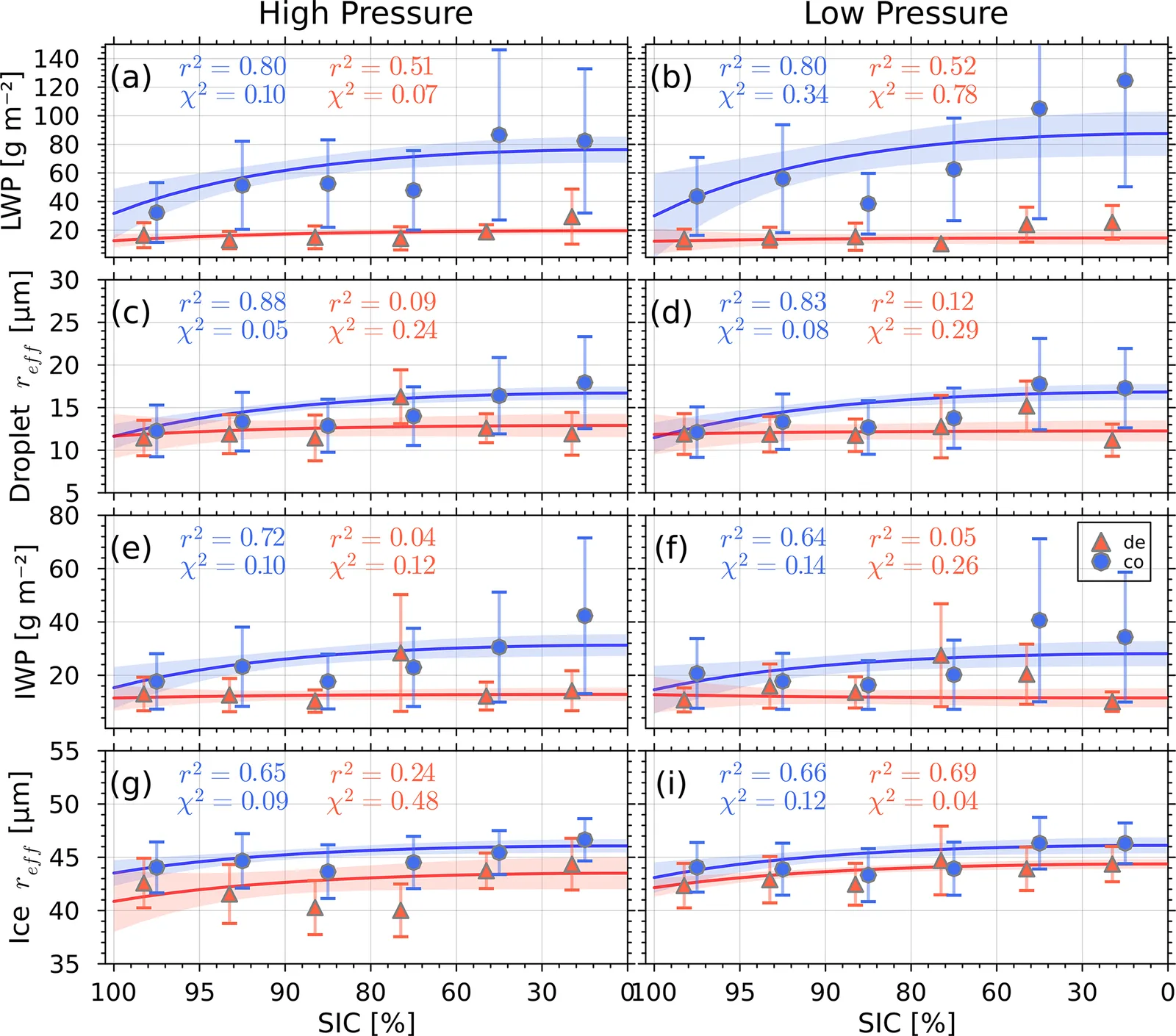
- In coupled clouds, liquid water path rises as sea ice concentration falls, and levels off at a median of about 80 to 120 g m−2 below roughly 30 % sea ice. Decoupled clouds show no clear link.
- In coupled clouds, droplet and ice particle sizes grow as sea ice shrinks. Ice water path also rises, mainly under high pressure. The MOSAiC study had not found these links.
- Under low pressure, coupled clouds show positive trends in liquid water path (+35.0±0.9 g m−2 per decade), cloud base height (+44.0±0.7 m per decade) and cloud top temperature (+2.2±0.7 K per decade).
- Trend signs and sizes depend on coupling status, pressure system and the method used. For decoupled cloud base height under high pressure, the two methods give opposite signs.
- Cloud properties vary in cycles of about 2 to 11 years. These match periods found in ENSO, PDO and AO, but the authors say a direct causal link is hard to show.
Limitations
- The cloud classification misses some supercooled liquid under low clouds that block the lidar. Liquid is therefore underestimated and ice-only clouds overestimated.
- No aerosol profiles were available, and only local surface pressure was used to define the weather system, which may not match the wider weather pattern.
- Linking the cycles to ENSO, PDO or AO is a hypothesis. Trends depend on the method, and the series covers only 14 winters.
Glossary
- Mixed-phase cloud: A cloud that holds both supercooled liquid droplets and ice crystals.
- Water vapour transport (WVT): The horizontal flow of moisture in the air, used here to link upwind sea ice to clouds.
- Coupled cloud: A cloud whose layer includes the height where the water vapour transport gradient peaks, so it is tied to the surface moisture source.
- Liquid water path (LWP): The total mass of liquid water in a column of air above a given area.
Original paper
Western Arctic wintertime mixed-phase clouds: Observed modulation by sea ice conditions, long-term variabilities and trends
Atmospheric Chemistry and Physics · 22 October 2026
AI-generated summary of the original article; changes were made. Check the original before relying on it.