AI downscaling to 1.5 km adds detail but not always accuracy over Korea
A diffusion-based downscaler for Korea added fine-scale variability and helped with the hottest events, but its added detail did not make forecasts more accurate overall.
Why it matters
Producing sharp, high-resolution maps from global AI forecasts is now feasible. But sharper fields do not by themselves mean better forecasts against observations. Users should check spatial variability, spatial agreement and event-specific skill, not only average error.
What they did
The authors trained a two-stage CorrDiff model (a regression stage plus a diffusion stage) on ERA5 inputs, with 1.5 km UM-LDAPS analyses as targets. They tested it for one year over South Korea on temperature and 10 m wind. They then fed it ECMWF AIFS forecasts, with no retraining, out to +288 h. They checked these against station observations in a July 2026 heatwave.
Key findings
- The regression stage cut temperature RMSE from 1.81 °C (ERA5) to 1.11 °C. The diffusion stage raised it to 1.30 °C, and spatial correlation fell from 0.90 to 0.86.
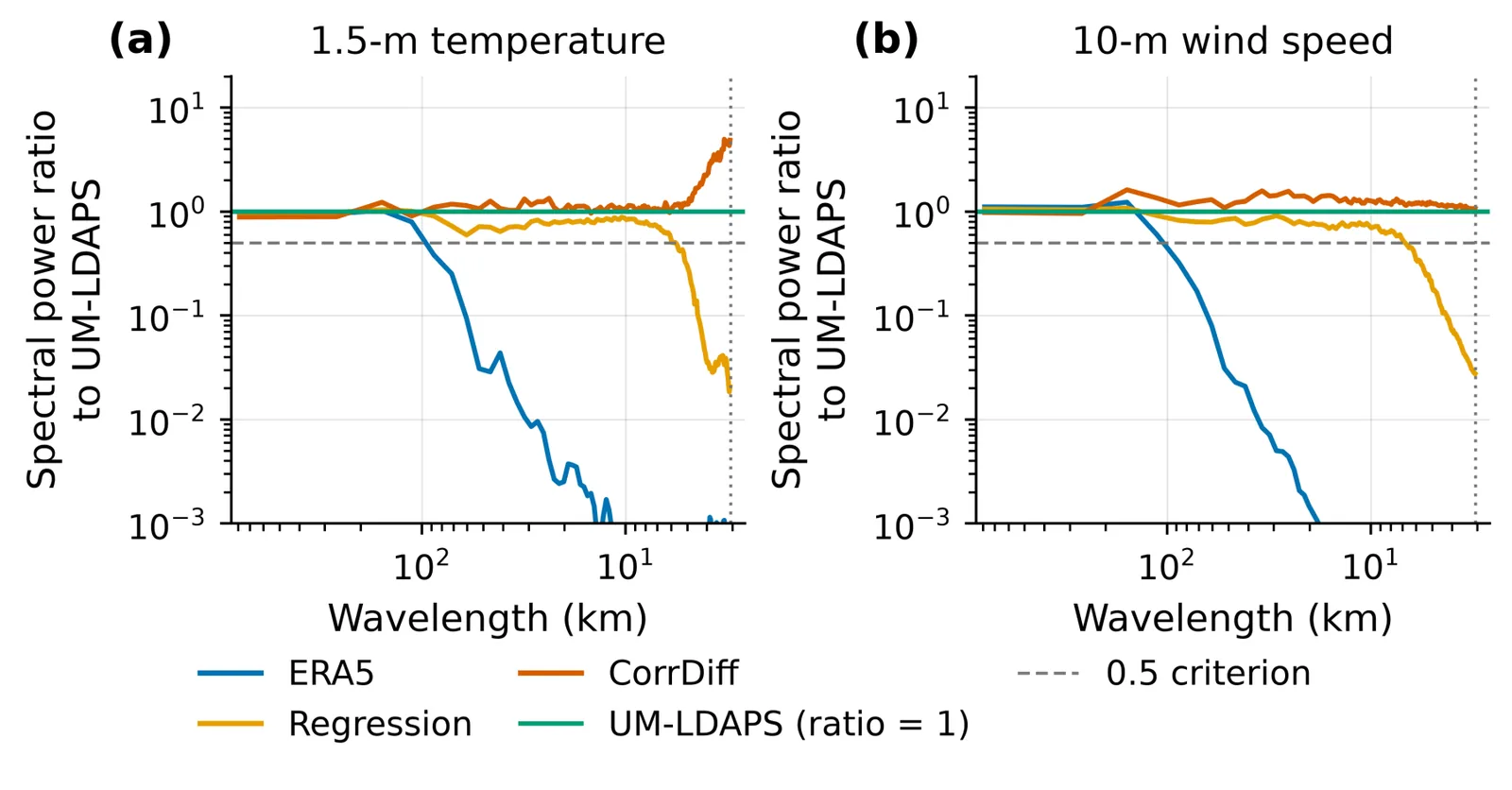
- The diffusion stage raised short-wavelength variability. For wind it came close to the target, but for temperature it far exceeded it.
- For temperatures at or above the 99th percentile, CorrDiff raised POD from 0.34 to 0.55 and CSI from 0.33 to 0.47 relative to Regression. This was its most consistent gain.
- Low-temperature events were handled better by Regression. Strong-wind results were mixed across metrics.
- In the AIFS heatwave case, CorrDiff beat the AIFS on detecting temperatures of 33 °C or more (short-lead POD 0.52 vs 0.42). Its RMSE was higher and its spatial correlation lower than the AIFS.
Limitations
- Only one generated field per time was evaluated, so ensemble spread and probabilistic reliability were not assessed.
- The target is a model analysis, not observations. The AIFS test covers a single heatwave, 47 stations, and only temperature and wind.
- The gap between ERA5 inputs and AIFS inputs was not analysed, so differences between the two evaluations cannot be attributed to it.
Glossary
- CorrDiff: A two-stage downscaling model: a regression network makes a first high-resolution field, then a diffusion model adds a generated residual.
- AIFS: The AI Forecasting System of ECMWF, a global machine-learning weather forecast model.
- POD and CSI: Event scores: POD is the share of real events that were caught, and CSI is the share of hits among all cases where the event was observed or forecast.
- Spectral power ratio: A comparison of how much variability a dataset has at each spatial scale, relative to the target.
Original paper
Development and Evaluation of a 1.5 km CorrDiff Downscaling System for the Korean Peninsula
Atmosphere · 22 October 2026
AI-generated summary of the original article; changes were made. Check the original before relying on it.