Forecasting · AI and machine learning
New weather and climate research on forecasting with AI and machine learning as the main approach, one page per paper.
All summaries
-
 Forecasting
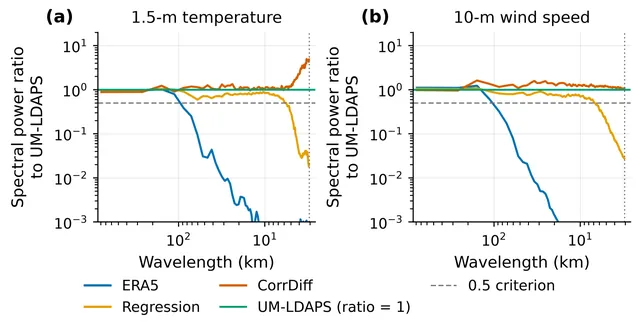
AI downscaling to 1.5 km adds detail but not always accuracy over Korea
A diffusion-based downscaler for Korea added fine-scale variability and helped with the hottest events, but its added detail did not make forecasts more accurate overall.
-
 Forecasting
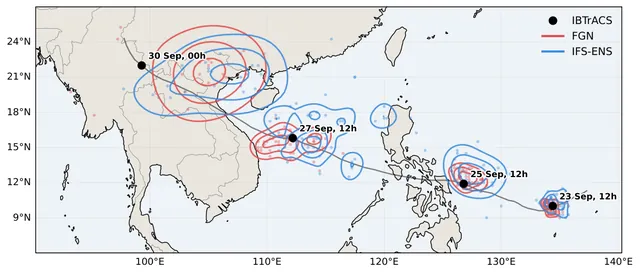
AI ensemble models track tropical cyclones better than IFS-ENS but still miss intensity
In this retrospective test, leading probabilistic AI weather models placed tropical cyclones more accurately than ECMWF's ensemble, yet they still underestimate winds and have poorly calibrated spread.
-
 Forecasting
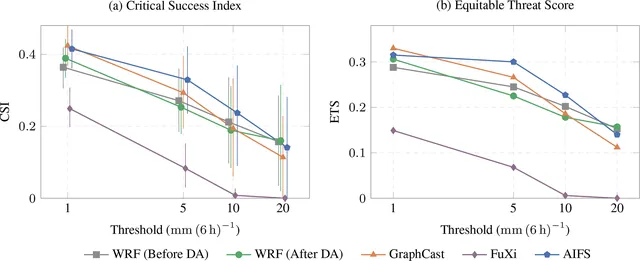
AI weather models beat WRF on light rain but lose to it at 20 mm per 6 h
In three flood events, GraphCast and AIFS forecast light rain and temperature better than an observation-corrected WRF, but WRF leads at the heaviest rainfall rate.
-
 Forecasting
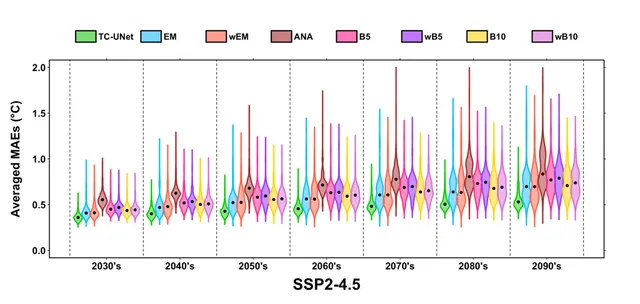
Deep learning forecasts local decadal climate from the recent observed temperature trajectory
A neural network trained on 290 climate-model runs can forecast local future decadal temperatures from the 1980–2025 record, keeping internal variability in its uncertainty, and the authors report skill beyond ensemble averaging.
-
 Forecasting
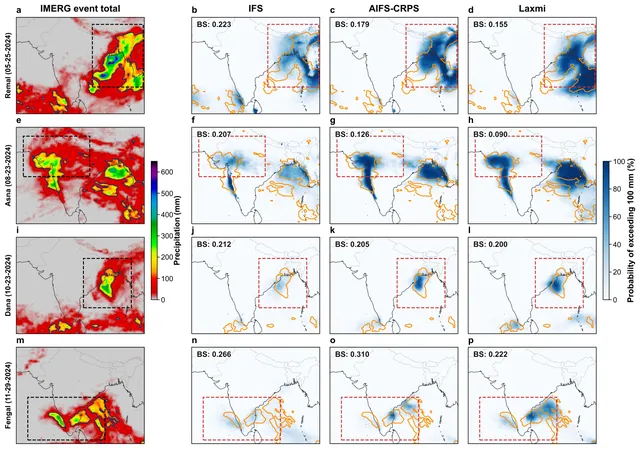
AI weather model trained on satellite rain data beats its ERA5-trained twin and IFS
Retraining ECMWF's AI weather model on satellite precipitation (IMERG) instead of reanalysis cut drizzle overprediction, improved heavy-rain forecasts and gave better-calibrated ensembles, though the physics-based IFS stayed better at the most extreme totals.
-
 Forecasting
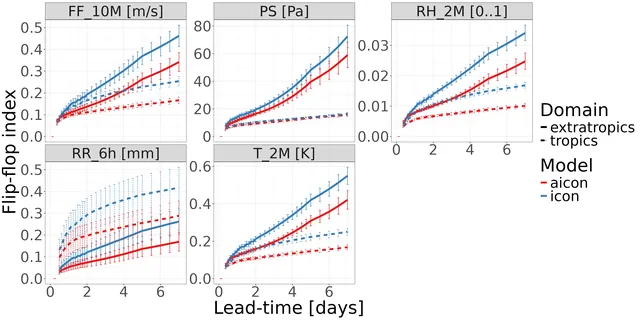
A 13 km machine learning weather model matches ICON on near-surface forecasts
AICON, a graph neural network trained on high-resolution ICON data without multi-step rollout, is now operational at DWD and competes with ICON near the surface, but it smooths fine scales and underestimates cyclone intensity.
-
 Forecasting
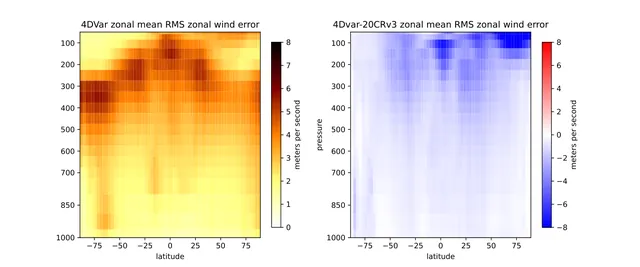
Long-window 4D-Var with NeuralGCM beats 20CRv3 using only surface pressure
A differentiable weather model lets a simple long-window 4D-Var, with no background-error term, fit surface-pressure observations and give analyses closer to ERA5 than 20CRv3 over three months.
-
 Forecasting
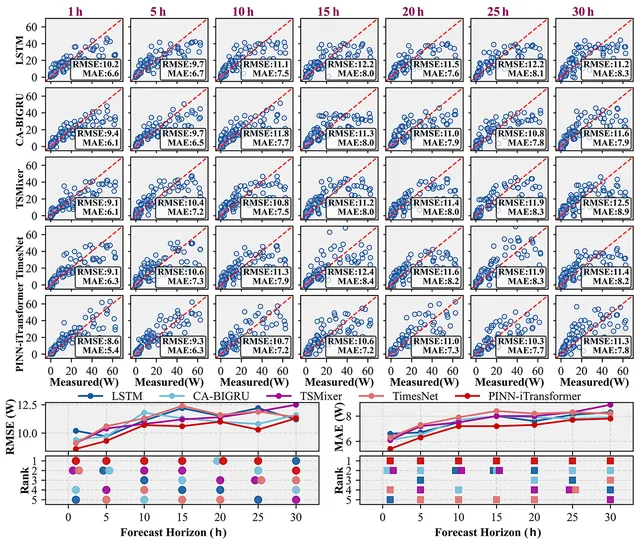
Physics-informed network and corrected weather forecasts improve solar power forecasts up to 5 days
Correcting weather-model sunlight forecasts and adding a physics rule to the training loss cut solar power forecast errors at one station in northwest China.
-
 Forecasting
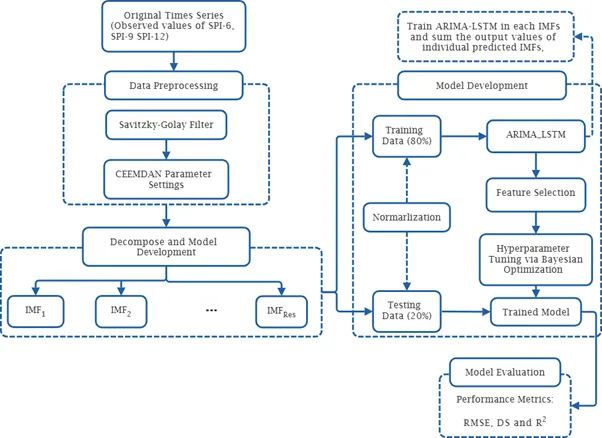
Smoothing and decomposing rainfall drought index data improves SPI forecasts in a South African district
Cleaning the drought index with a smoothing filter and splitting it into components before forecasting gave the lowest errors in uMkhanyakude, where five of six stations show drying trends.