Physics-informed network and corrected weather forecasts improve solar power forecasts up to 5 days
Correcting weather-model sunlight forecasts and adding a physics rule to the training loss cut solar power forecast errors at one station in northwest China.
Why it matters
Solar power forecasts that start from weather forecasts inherit the weather model’s irradiance bias. Fixing that bias and keeping predictions physically plausible may make grid integration safer. The authors note the power results come from a single station, so wider testing is still needed.
What they did
They ran a four-level nested WRF weather model at 1 km resolution to forecast 6 h, 1, 3 and 5 d ahead for a PV station in Zhongwei, Ningxia, using data from 1 June to 31 July 2020. They corrected the sunlight (GHI) forecasts with quantile mapping followed by an attention-based LSTM. They then converted irradiance to the tilted-panel plane and fed it to an iTransformer whose loss includes a physics term from a semi-empirical PV model. They compared it with other physics-linked and standard models.
Key findings
- Raw WRF forecasts overestimated GHI, with errors up to an RMSE of 231.5 W m−2 and an MAE of 159.3 W m−2.
- The QM-TPA-LSTM correction cut GHI RMSE and MAE by more than 23 % on average, and by 33 % and 36 % at the 6 h horizon.
- The correction beat Kalman filter, LSTM and Transformer baselines, and reduced errors at six other NSRDB sites and in a 2025 test.
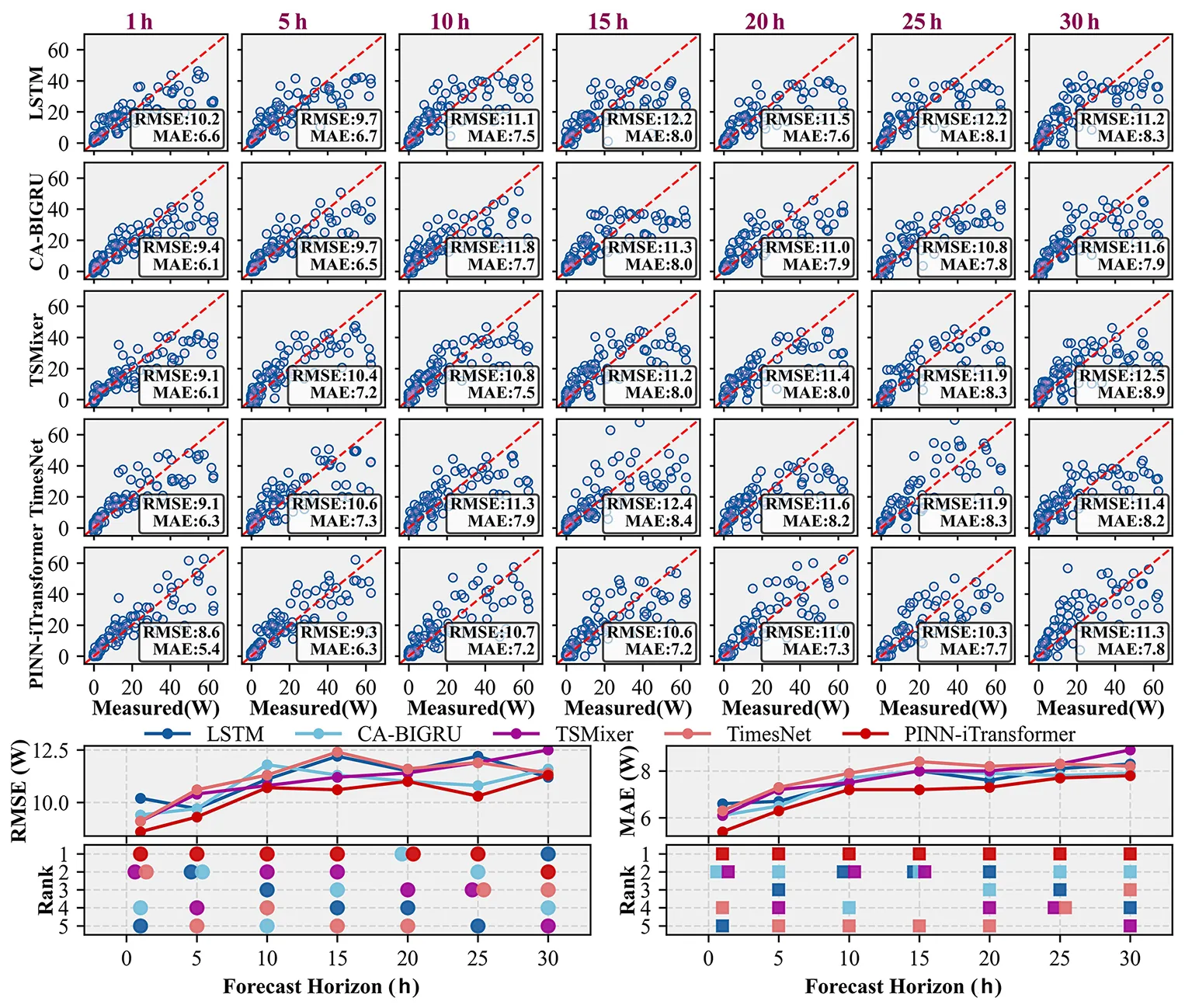
- The PINNs-iTransformer had the lowest errors at all horizons, cutting RMSE by up to 15.5 % and MAE by up to 12.44 % against benchmarks.
- A plain iTransformer sometimes produced negative power, while the physics-informed models did not. Errors for all models grew with lead time.
Limitations
- Power forecasting was tested at a single station in a semi-arid, high-sun setting. Performance under highly variable cloud is untested.
- The data cover only about 60 days, which limits learning for long lead times. Accuracy of all models declined at longer horizons.
- The GHI correction is purely statistical, with no aerosol or cloud inputs. It was not checked against independent satellite products.
Glossary
- GHI: Global horizontal irradiance: total sunlight reaching a flat horizontal surface.
- Quantile mapping: A bias correction that matches the distribution of forecast values to the distribution of observed values.
- PINN: Physics-informed neural network: a network trained with a loss term that penalises breaking a physical equation.
- GPOA: Plane-of-array irradiance: sunlight actually falling on the tilted PV module surface.
Original paper
MIPV-NWP-PINNs V1.0: development of a multi-scale photovoltaic power forecasting framework integrating numerical weather prediction with physics-informed neural networks
Geoscientific Model Development · 12 June 2026
AI-generated summary of the original article; changes were made. Check the original before relying on it.