Hydrology · AI and machine learning
New weather and climate research on hydrology with AI and machine learning as the main approach, one page per paper.
All summaries
-
 Hydrology
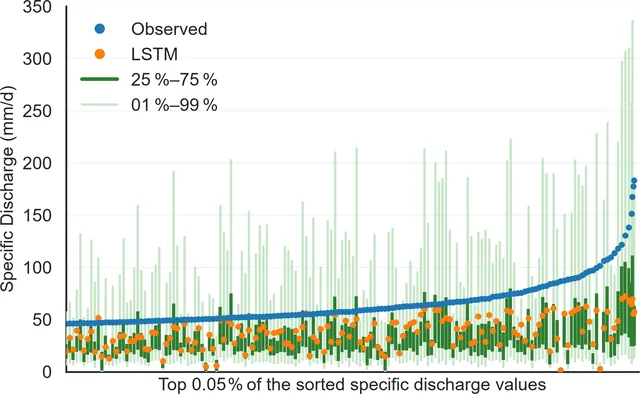
Probabilistic LSTMs capture extreme Swiss floods that a deterministic LSTM underestimates
Letting an LSTM predict a full range of possible river discharges, not one value, puts most extreme floods inside its prediction range, and a learned agent can turn that range into warnings.
-
 Hydrology
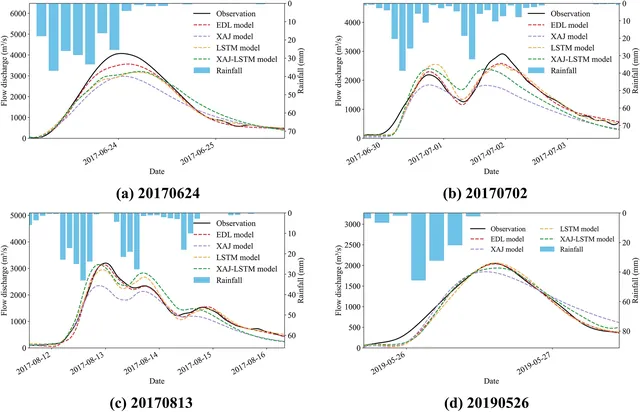
Deep learning model built on Xinanjiang physics simulates floods well in two Chinese basins
Building a conceptual hydrological model's equations into a recurrent neural network layer, then adding an LSTM layer, gave more accurate flood simulation than the physical model alone, a plain LSTM, or a physical model followed by an LSTM.
-
 Hydrology
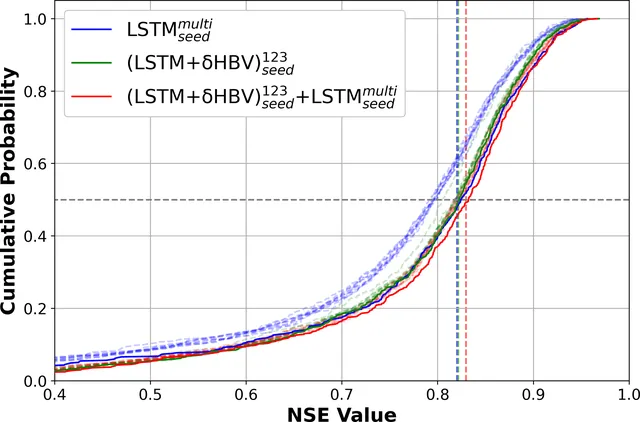
Combining an LSTM and a differentiable HBV model improves streamflow simulation in US basins
Averaging a data-driven LSTM with a physics-informed differentiable HBV model, each run on separate weather datasets, beats LSTM-only ensembles, most of all in places with no training data.
-
 Hydrology
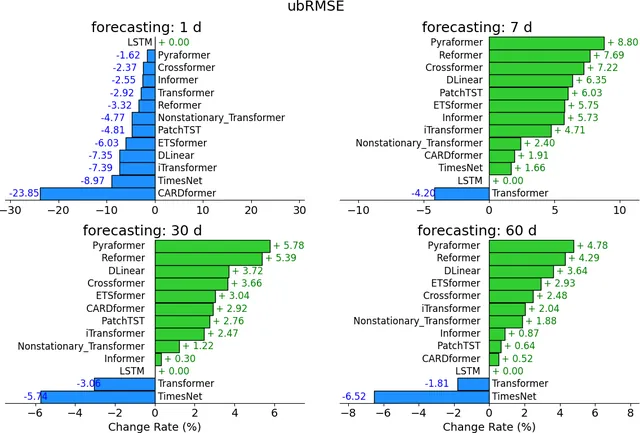
LSTM beats Transformers on standard hydrology tasks, but attention models win on harder ones
In a benchmark of 11 Transformer-type models against an LSTM, the LSTM was best at regression and short forecasts, while attention-based models did better at long-horizon autoregression and zero-shot forecasting.
-
 Hydrology
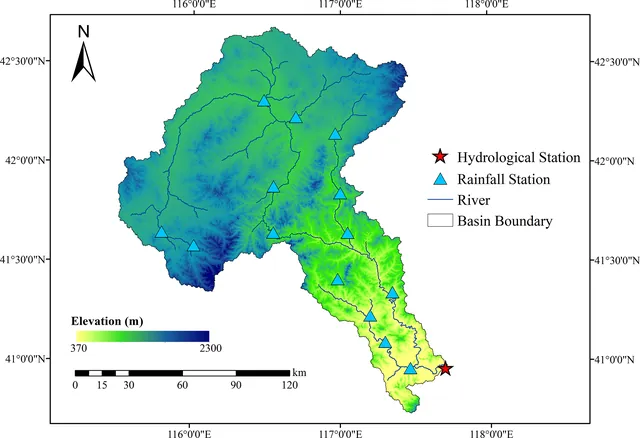
Attention and physical rules improve LSTM flood forecasts 1–6 h ahead in the Luan River
Adding feature-time attention and monotonic physical constraints to an LSTM gave more accurate 1–6 h flood forecasts in one Chinese basin, and showed which inputs the model relied on.
-
 Hydrology
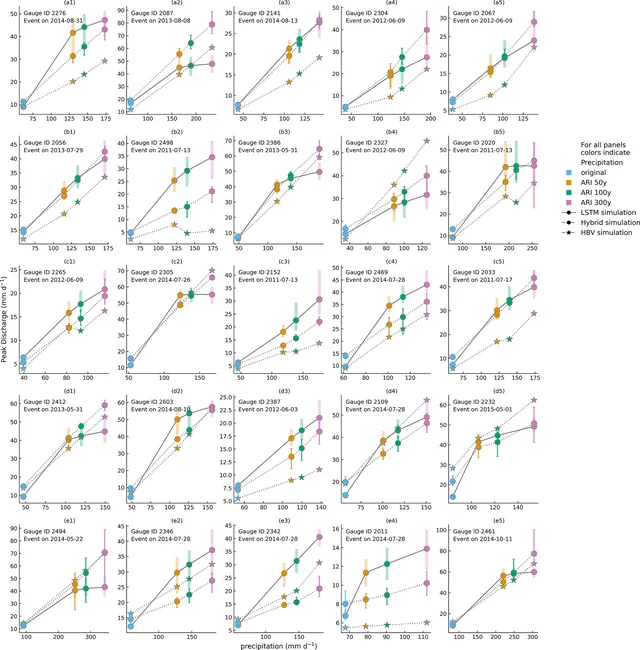
Stand-alone LSTMs cannot predict river flows above a limit set below their training peak
When fed extreme design rainfall, a stand-alone LSTM runoff model hits a ceiling well below flows it saw in training, and its runoff share falls as rain rises, while a hybrid model scales more sensibly.
-
 Hydrology
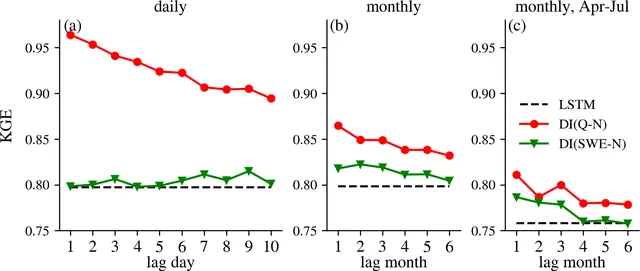
Feeding past streamflow into an LSTM sharply improves Western U.S. streamflow estimates
Giving an LSTM recent streamflow observations raises its accuracy most at the daily scale, while snow observations help only at the monthly scale, mainly in snow-dominated basins.