Combining an LSTM and a differentiable HBV model improves streamflow simulation in US basins
Averaging a data-driven LSTM with a physics-informed differentiable HBV model, each run on separate weather datasets, beats LSTM-only ensembles, most of all in places with no training data.
Why it matters
Predicting streamflow in basins with no gauges is hard, and LSTM models lose skill there. Adding a model with built-in water-balance structure reduces that risk. The results also question the habit of feeding every available input dataset into one data-driven model.
What they did
The authors trained an LSTM and a differentiable HBV model (δHBV) separately on each of three weather datasets (Daymet, NLDAS, Maurer). They used 531 US CAMELS basins and averaged the six simulations. They tested three cases: new time periods, ungauged basins (PUB) and ungauged regions (PUR). They compared the results with one LSTM fed all three datasets at once (LSTMmulti). Each setup was repeated with three random seeds.
Key findings
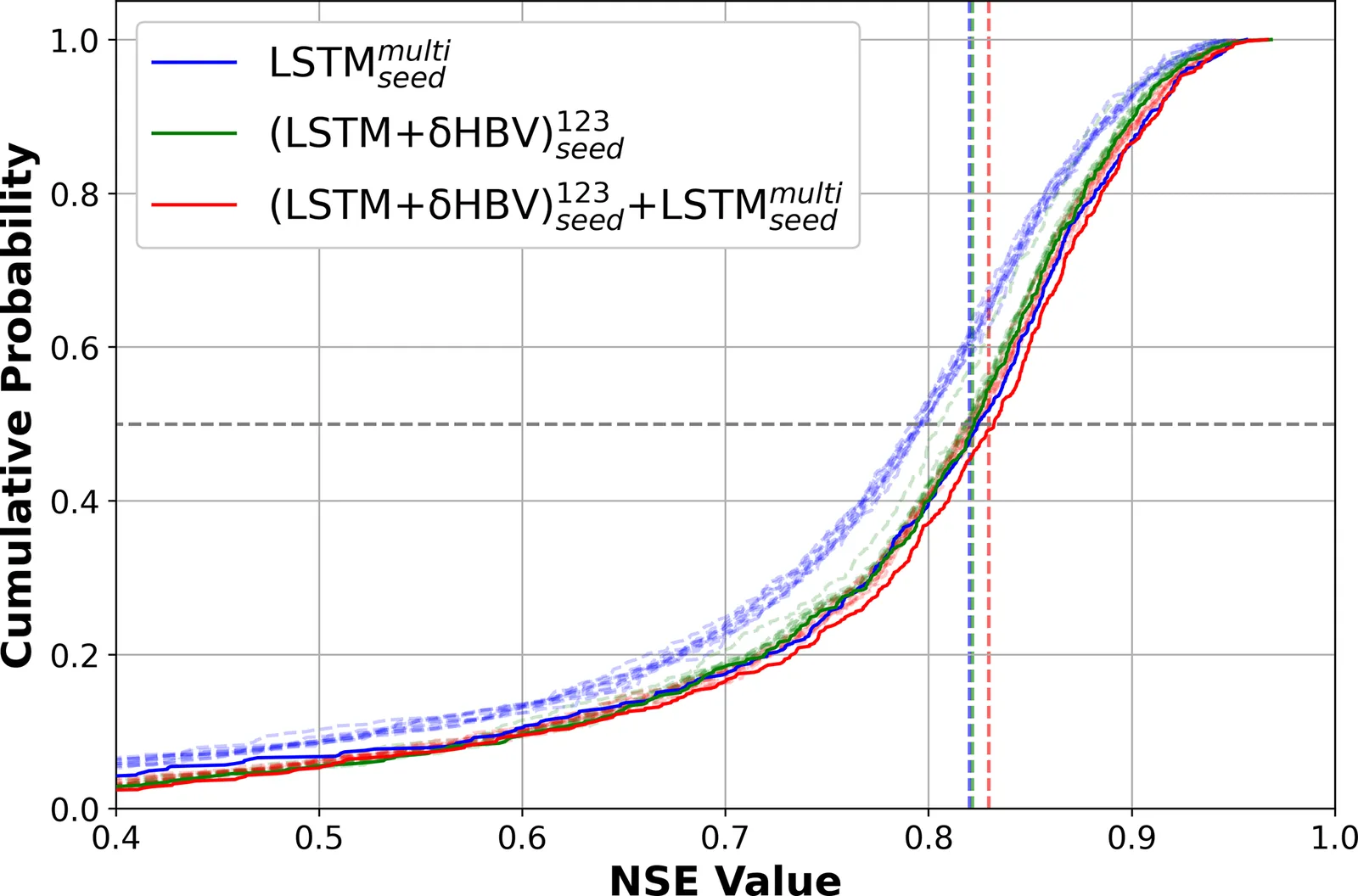
- Adding δHBV to LSTM ensembles raised median NSE in the temporal test, from about 0.808 to about 0.818 when all three forcings were used.
- Averaging LSTMs trained on one forcing each (NSE 0.8082) beat one LSTM given all three forcings (0.7974).
- In the PUR test, adding δHBV raised median NSE by 0.04–0.07, for example from about 0.656 to about 0.701.
- The most diverse ensemble reached a median NSE of about 0.83 in the temporal test, with about 0.79 for PUB and about 0.70 for PUR.
- The LSTM+δHBV pair had larger spread than either model type alone, which fits the idea that their errors partly offset.
Limitations
- Both model types still did poorly in basins with many dams, dry climates or complex geology, and in parts of the Great Plains.
- Equal-weight averaging was used; the authors say better weighting could help but did not develop it. Training several members is costly.
- δHBV depended more on forcing quality than LSTM, and no strongly warmed dataset was available to test climate drift.
Glossary
- δHBV: A simple bucket-style water balance model (HBV) written so that neural networks can set its parameters and be trained with it.
- NSE: Nash-Sutcliffe efficiency, a score for how well simulated streamflow matches observations; 1 is a perfect match.
- PUB / PUR: Prediction in ungauged basins, and prediction in ungauged regions, where whole areas are left out of training.
- Forcing: Weather input data, such as rain and temperature, that drives a hydrological model.
Original paper
Ensembling differentiable process-based and data-driven models with diverse meteorological forcing datasets to advance streamflow simulation
Hydrology and Earth System Sciences · 1 December 2025
AI-generated summary of the original article; changes were made. Check the original before relying on it.