Deep learning model built on Xinanjiang physics simulates floods well in two Chinese basins
Building a conceptual hydrological model's equations into a recurrent neural network layer, then adding an LSTM layer, gave more accurate flood simulation than the physical model alone, a plain LSTM, or a physical model followed by an LSTM.
Why it matters
Deep learning models often fit river flow well but are hard to explain. This work shows one way to place a fairly complex physical model inside a neural network and train both together. That may give flood forecasters a model that is both accurate and easier to interpret.
What they did
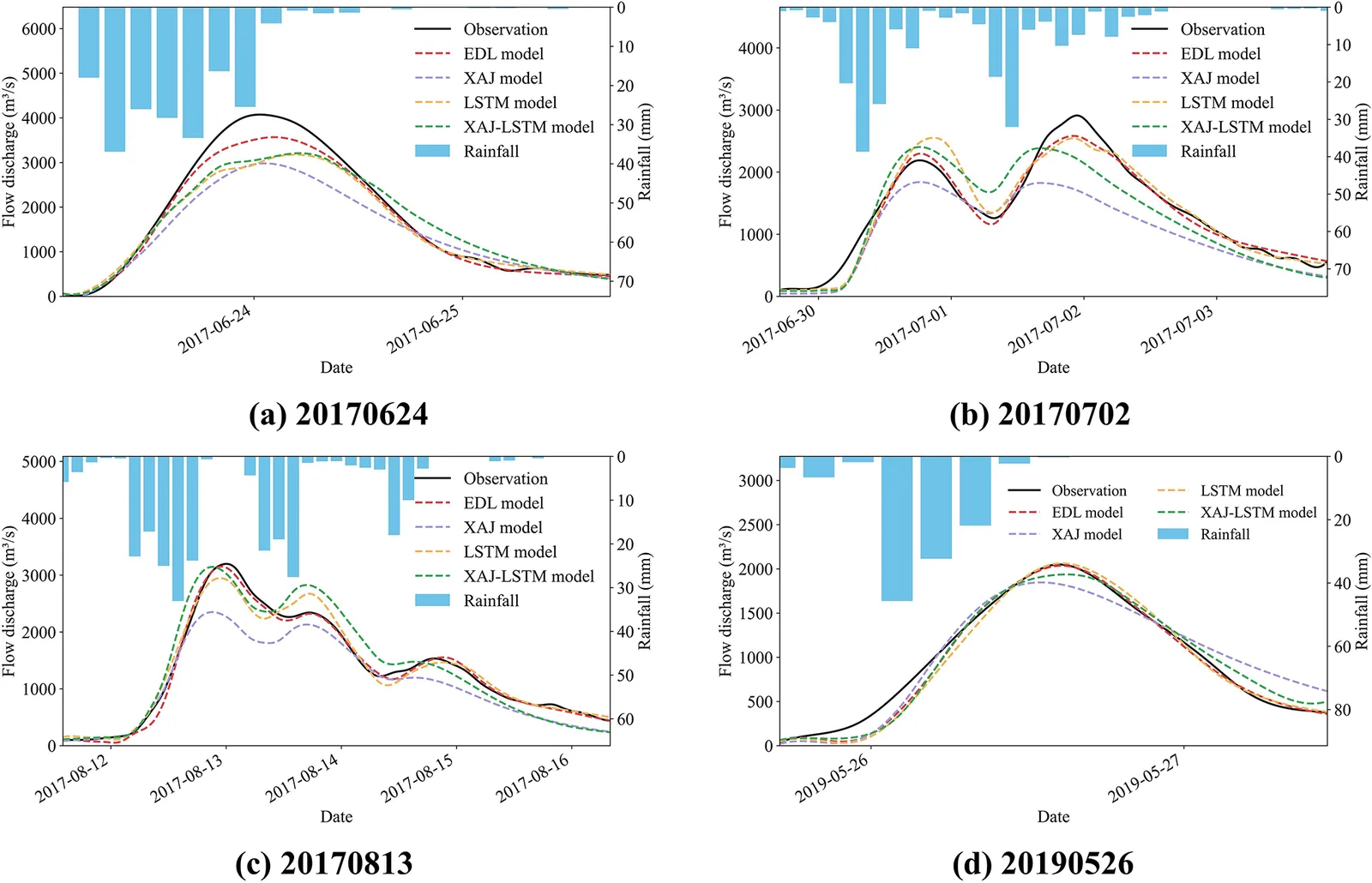
The authors turned the runoff generation and flow routing equations of the Xinanjiang (XAJ) model into a recurrent layer called XAJRNN. They joined it to a normalization layer and an LSTM layer to form the explainable deep learning (EDL) model. They trained a separate model for each of two basins, the Lushui River and the Qingjiang River, using 3 h and 6 h data on rainfall, pan evaporation and inflow. They compared it with the XAJ model, an LSTM, and an XAJ-LSTM hybrid, using data from 2012 to 2016 for training and later years for testing.
Key findings
- In the Lushui basin test period, EDL reached an NSE of 0.98 and an RMSE of 43.71 m3 s−1, against 0.96 and 54.27 m3 s−1 for LSTM and 0.90 and 89.60 m3 s−1 for XAJ.
- The EDL model’s average NSE was 0.98 for Lushui and 0.94 for Qingjiang.
- In Qingjiang, the plain LSTM had a lower test-period RMSE (155.71 m3 s−1) than EDL (167.94 m3 s−1).
- The XAJRNN layer alone beat the standard XAJ model but was less accurate than the full EDL model.
- All models did worse in the Qingjiang basin, especially in the 20200726 flood, where all underestimated the peak and timed it late.
Limitations
- Parameters were fitted separately for each basin, so the model works much like traditional calibration and is not a general multi-basin model.
- Areal average rainfall ignores where the rain falls, and reservoir operation upstream affected some Qingjiang floods, which hurt accuracy there.
- Only two basins were tested, and for very high flows the simulated values mostly fell below observations.
Glossary
- Xinanjiang (XAJ) model: A conceptual rainfall-runoff model, widely used in China, that makes runoff only once soil storage is full.
- LSTM: A type of recurrent neural network with gates that lets it remember information over long sequences.
- NSE (Nash-Sutcliffe efficiency): A score of how well simulated flow matches observed flow, where 1 is a perfect match.
- PRE: Flood peak relative error, the percentage difference between simulated and observed peak flow.
Original paper
An explainable deep learning model based on hydrological principles for flood simulation and forecasting
Hydrology and Earth System Sciences · 19 December 2025
AI-generated summary of the original article; changes were made. Check the original before relying on it.