Attention and physical rules improve LSTM flood forecasts 1–6 h ahead in the Luan River
Adding feature-time attention and monotonic physical constraints to an LSTM gave more accurate 1–6 h flood forecasts in one Chinese basin, and showed which inputs the model relied on.
Why it matters
Deep learning flood models are accurate but hard to interpret and may ignore basic water physics. This work shows one way to make them more transparent and more physically consistent while also improving accuracy. Such a design could help short-term flood warning in flashy basins like this one.
What they did
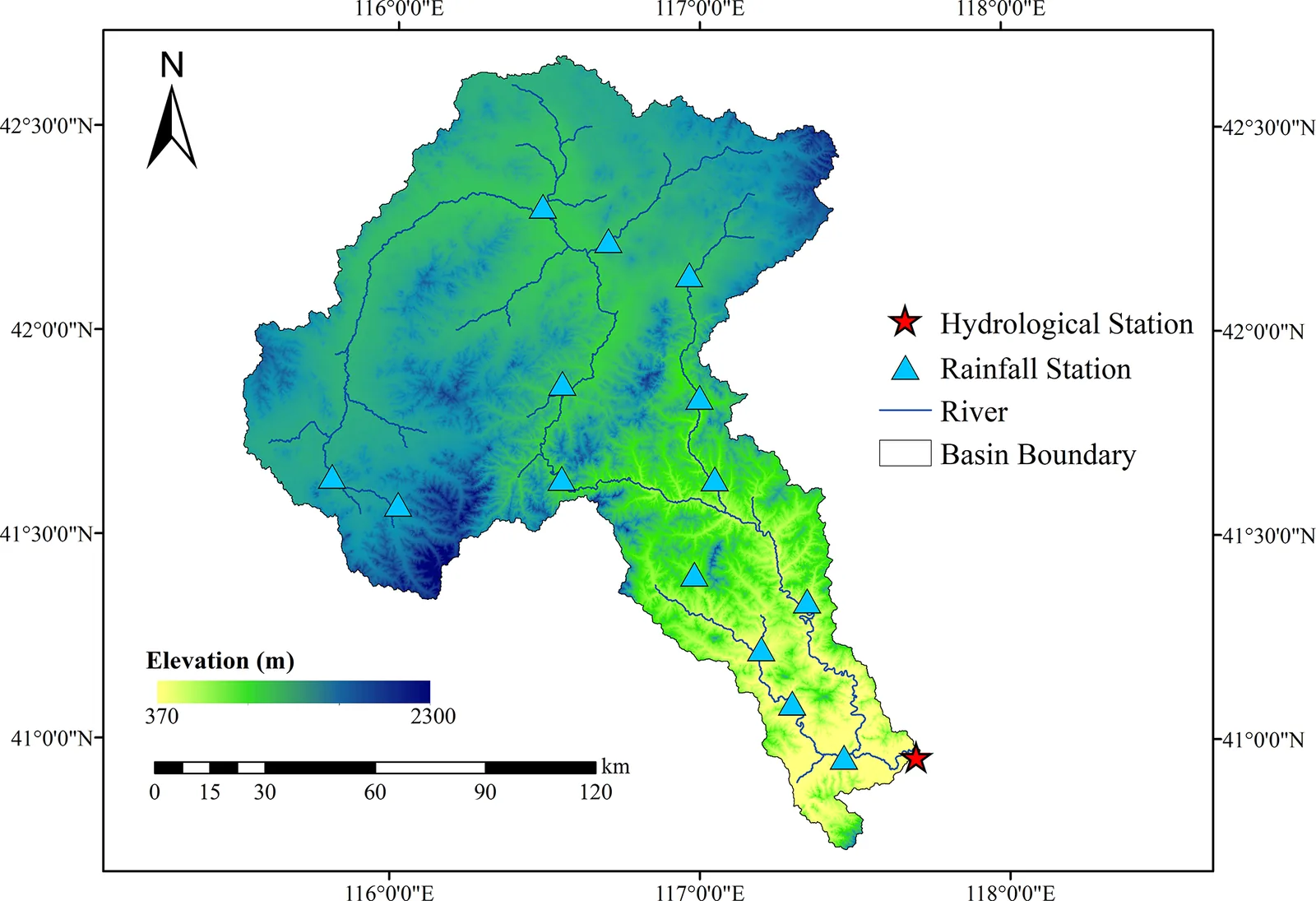
The authors built an LSTM with attention over input features and past time steps, plus a loss penalty. The penalty pushes runoff to rise with rainfall and initial soil moisture, and to fall with evapotranspiration. They tested it on 30 flood events at the Sandaohezi station in the Luan River Basin, using 20 events for training and 10 for validation. They compared it with a plain LSTM and two attention-only versions at lead times of 1 to 6 h.
Key findings
- The full model (PHY-FTMA-LSTM) had NSE of 0.988 at t+1 and 0.908 at t+6.
- Against the plain LSTM at t+1, NSE rose from 0.977 to 0.988, and RMSE and MAE fell by 27.4 % and 49.6 %.
- From 1 to 6 h, validation NSE dropped by 0.080 for the full model and by 0.112 for the plain LSTM.
- Attention weights ranked runoff first, then rainfall, then initial soil moisture and evapotranspiration. Weights moved toward recent time steps at longer lead times.
- Multi-head attention usually beat single-head attention, and all attention models beat the plain LSTM.
Limitations
- Only 30 flood events from one basin were used, with no separate test set. Results depend on the one chosen training and validation split.
- High flows were underestimated at longer lead times, and the 6 h forecast of one double-peak event showed anomalous fluctuations. The authors link this to extreme events missing from training data.
- The model cannot go beyond 6 h because it has no weather forecast inputs and recurrent units lose memory.
Glossary
- LSTM: Long short-term memory network, a neural network built to learn from time sequences.
- Attention mechanism: A model part that learns weights showing which inputs and past time steps matter most.
- Monotonic constraint: A rule that an output must always move in one direction when an input increases, such as more rain meaning more runoff.
- NSE: Nash-Sutcliffe efficiency, a score where 1 means a perfect match between forecast and observed flow.
Original paper
Deep learning of flood forecasting by considering interpretability and physical constraints
Hydrology and Earth System Sciences · 4 November 2025
AI-generated summary of the original article; changes were made. Check the original before relying on it.