Smoothing and decomposing rainfall drought index data improves SPI forecasts in a South African district
Cleaning the drought index with a smoothing filter and splitting it into components before forecasting gave the lowest errors in uMkhanyakude, where five of six stations show drying trends.
Why it matters
Drought forecasts that are more accurate can support early warning and water planning in rain-dependent regions. The study shows that noise handling before modelling can matter for drought index forecasts. The trend results also point to growing dryness at most stations in this district.
What they did
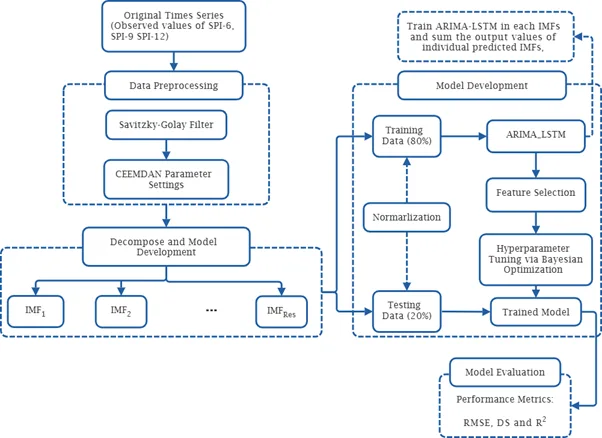
The authors used monthly rainfall from 1980 to 2023 at six stations in uMkhanyakude District, South Africa, and computed the Standardized Precipitation Index (SPI) over 6, 9 and 12 months. They tested trends with Mann–Kendall, Modified Mann–Kendall and Innovative Trend Analysis. For forecasting, they smoothed the SPI with a Savitzky–Golay filter, split it with CEEMDAN, and modelled each piece with a combined ARIMA and LSTM approach. They trained on 80 % of the data and tested on 20 %. They compared it with ARIMA, LSTM, ARIMA-LSTM, SG-ARIMA-LSTM and CEEMDAN-ARIMA-LSTM using RMSE, R2 and directional symmetry.
Key findings
- Mann–Kendall and Modified Mann–Kendall tests showed significant decreasing SPI trends at five stations on all three timescales.
- Riverview, the sixth station, showed an increasing trend. The authors link this to its coastal location.
- The SG-CEEMDAN-ARIMA-LSTM model had the lowest RMSE across all indices and timescales.
- Its best R2 values were 0.9839 for SPI-6, 0.9892 for SPI-9 and 0.9990 for SPI-12.
- Accuracy improved on longer timescales, which the authors tentatively link to lower noise.
Limitations
- The model uses only past SPI values and leaves out outside variables such as temperature, soil moisture, vegetation and land use.
- SPI depends on precipitation alone, which the authors call a methodological limitation.
- The authors suggest trying other decomposition methods such as improved CEEMDAN in future work.
Glossary
- SPI: Standardized Precipitation Index, a score of how wet or dry a period is compared with normal rainfall.
- CEEMDAN: A method that splits a noisy, changing time series into several components from fast to slow variation, plus a residual.
- Savitzky–Golay filter: A smoothing filter that fits a low-order polynomial in a sliding window to reduce noise while keeping peak shapes.
- Innovative Trend Analysis: A trend test that plots the second half of a series against the first half and checks whether points lie above or below the 1:1 line.
Original paper
Meteorological Drought Trend Analysis and Forecasting Using a Hybrid SG-CEEMDAN-ARIMA-LSTM Model Based on SPI from Rain Gauge Data
Natural Hazards and Earth System Sciences · 20 January 2026
AI-generated summary of the original article; changes were made. Check the original before relying on it.