Deep learning forecasts local decadal climate from the recent observed temperature trajectory
A neural network trained on 290 climate-model runs can forecast local future decadal temperatures from the 1980–2025 record, keeping internal variability in its uncertainty, and the authors report skill beyond ensemble averaging.
Why it matters
Standard observational constraints sharpen the forced response but filter out internal variability, which dominates uncertainty at many local scales. This approach aims at the single realised future that places will experience. The authors say it extends constrained projection toward local, seasonal predictions. As a preprint, these results have not been peer reviewed.
What they did
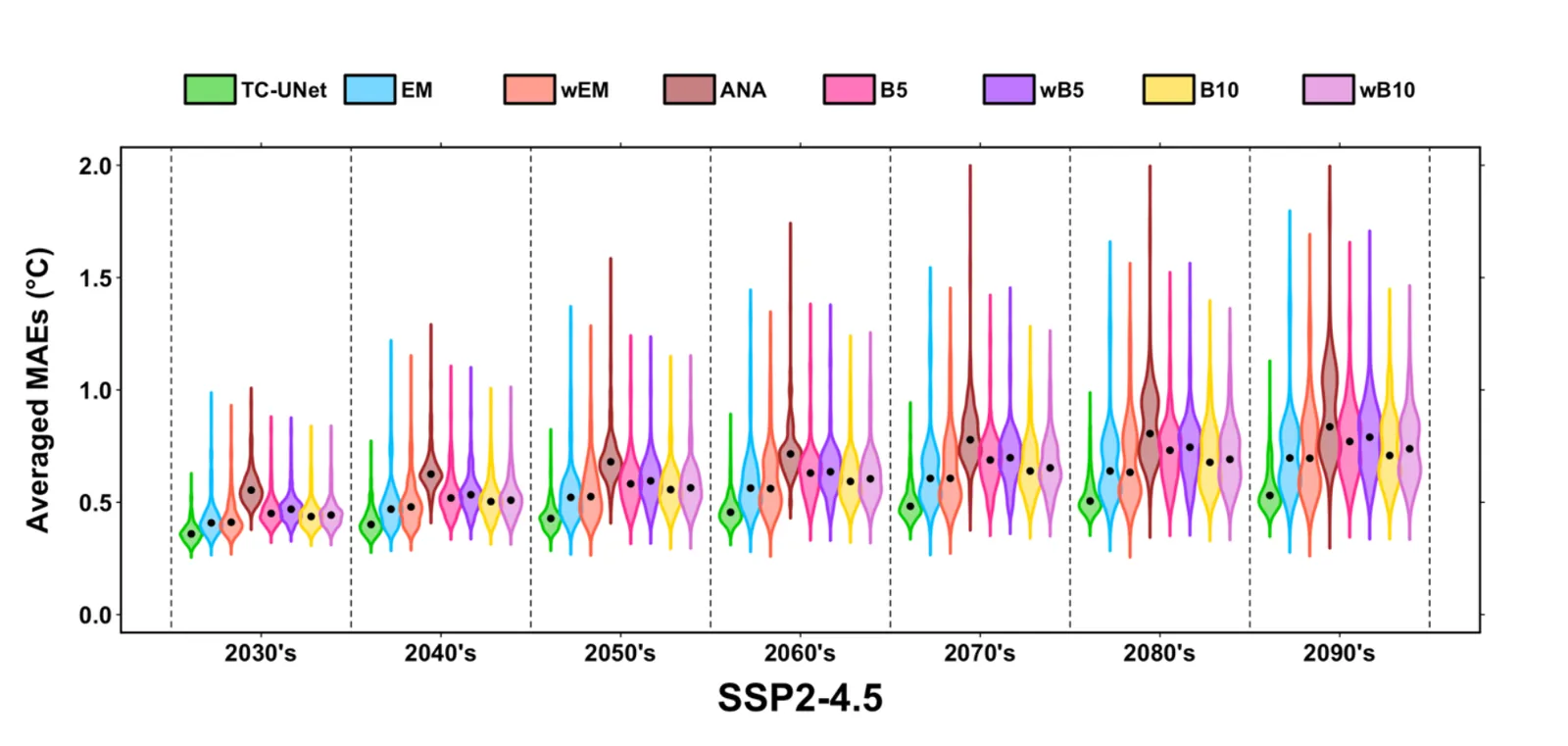
The authors trained a U-Net with dilated temporal convolutions on 290 historical plus SSP2-4.5 simulations from 40 CMIP6 models. The network maps monthly temperature anomalies for 1980–2025 onto decadal-mean monthly climatologies for the 2030s to the 2090s. They tested it by withholding whole model families and built uncertainty ranges from the resulting out-of-sample errors. They also tested it on HadGEM3-GC5 simulations at three resolutions and applied it to ERA5 and BEST observations.
Key findings
- On withheld model families, the network had the lowest error of all methods at every target decade, and lower error than the baselines for 22 of 23 families.
- Among the 12 models with more than five members, forecasts were closer to the future of the member they were given than to other members’ futures, for every decade. Globally the gain was modest, typically 3 to 7% in the 2030s and 1 to 3% by century’s end, excluding GISS-E2-1-G.
- This member-specific skill was strongest over the subpolar North Atlantic and was reported at 10% to 15% across future decades. The Southern Ocean also kept significant gains at all lead times.
- On HadGEM3-GC5, the simulated global-mean trajectories stayed inside the uncertainty ranges, with GC5-LL touching the lower bound in the 2040s. For GC5-HH, 93.3% to 99% of global area fell within local ranges.
- Applied to BEST, the 2080–2099 warming forecast was 2.64°C (2.06 to 3.35°C), with a range of 1.29°C versus 1.22°C in Ribes et al. (2021). Local ranges were narrower than the raw ensemble almost everywhere, with median reductions of 39%, 31% and 22% for short, medium and long range.
Limitations
- Ensemble sizes range from one to fifty members across the 40 models, so internal variability is sampled unevenly. The resampling used to balance models is a pragmatic correction.
- Each GC5 configuration has only one member, so the cross-resolution agreement reflects one realisation of internal variability.
- BEST mixes sea surface and air temperature, which is inconsistent with the training data, so it is a sensitivity test. Only SSP2-4.5 and temperature were tested; precipitation and extremes remain untested.
Glossary
- Internal variability: Natural climate fluctuations that arise without any change in external forcing.
- Forced response: The climate change driven by external factors such as greenhouse gases.
- Leave-one-model-family-out cross-validation: Testing on all runs from one group of related models after training on the rest, repeated for every group.
- Signal-to-noise ratio: How large the forced climate change is compared with natural variability.
Original paper
From climate projections to trajectory-conditioned local predictions
EGUsphere · 21 September 2026
This paper is a preprint. It has not been peer reviewed, and its results may change.
AI-generated summary of the original article; changes were made. Check the original before relying on it.