AI weather model trained on satellite rain data beats its ERA5-trained twin and IFS
Retraining ECMWF's AI weather model on satellite precipitation (IMERG) instead of reanalysis cut drizzle overprediction, improved heavy-rain forecasts and gave better-calibrated ensembles, though the physics-based IFS stayed better at the most extreme totals.
Why it matters
Most AI weather models learn from ERA5, which overpredicts drizzle and underpredicts heavy rain. These errors matter for flood warnings and for farm work that needs dry windows. The results suggest that training on observation-based precipitation data can fix part of this. The authors report these findings in a preprint that has not been peer reviewed.
What they did
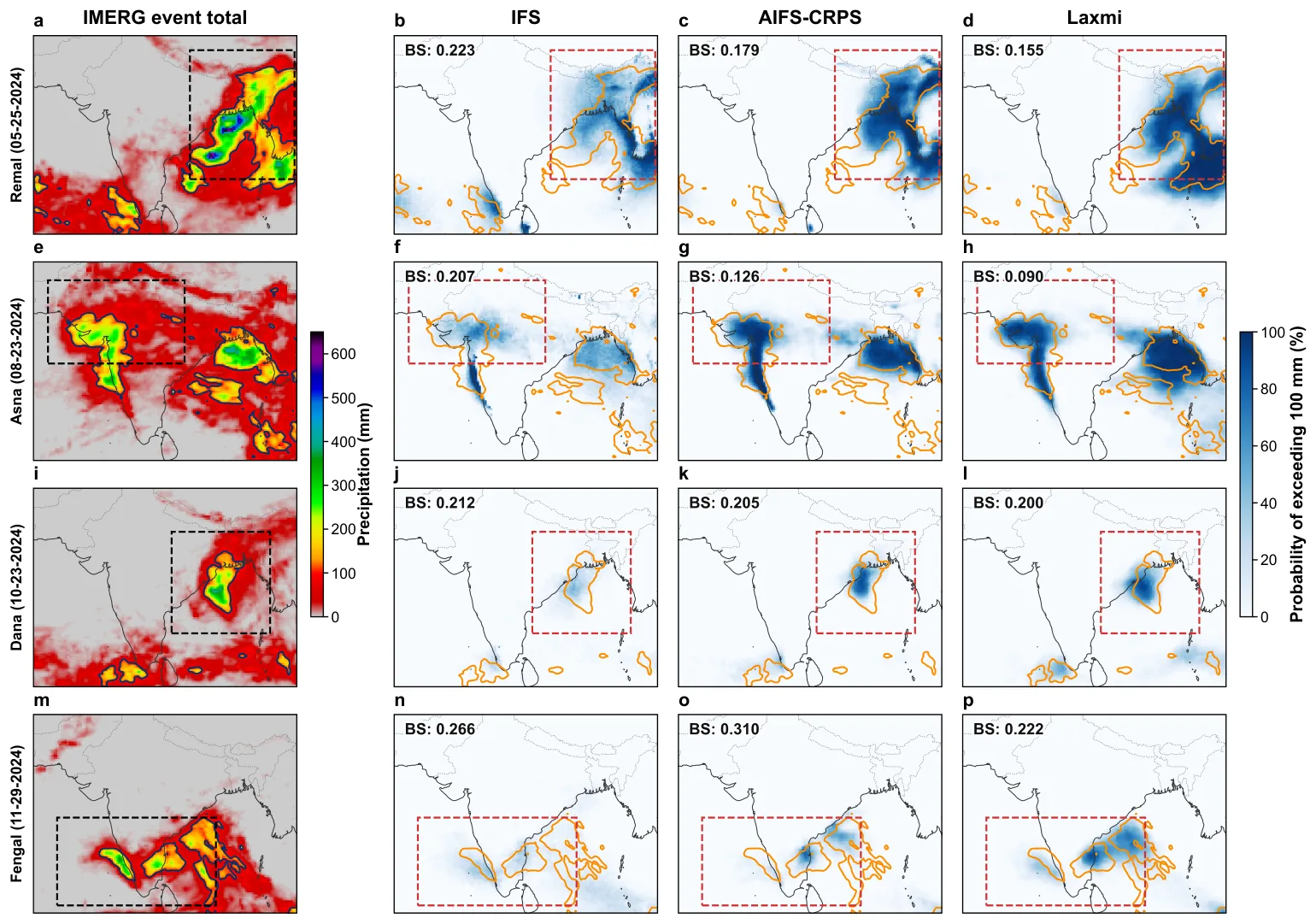
The authors retrained ECMWF’s AIFS-CRPS, a probabilistic graph-transformer model at 0.25°, so that its precipitation target was IMERG satellite data rather than ERA5. The architecture, loss function and ERA5 atmospheric inputs stayed the same. They called the new model Laxmi. They trained on June 2000 through December 2023 and tested on 2024, using 94 ensemble forecasts over 60°S–60°N. They also ran case studies of 10 Indian tropical storms and of US hurricanes.
Key findings
- At a 1-day lead time, Laxmi cut 24-hour precipitation CRPS by 19.3% versus AIFS-CRPS and 20.1% versus IFS.
- Brier Skill Score at the 95th percentile improved by 57.2% over AIFS-CRPS and 54.4% over IFS at 1 day, and Laxmi was more skillful than both across all 15 days.
- Laxmi captured 68% of observed events above 50 mm day-1, versus about 30% for both AIFS-CRPS and IFS. Above 100 mm day-1 it captured 38%, versus 17% for IFS.
- Ensemble spread-skill ratio was 0.83 at day 1, versus 0.50 for AIFS-CRPS and 0.66 for IFS.
- In the Indian storm case study, Laxmi had the highest detection rate and CSI. At the 250 mm threshold, IFS and Laxmi each gave the best forecast 5 of 10 times.
Limitations
- IMERG has its own retrieval and calibration biases, and the model still fails at extreme intensities above 300 mm day-1, where IFS still produces some events.
- Satellite precipitation does not always match the ERA5 atmospheric state used as input, and the evaluation covers only 60°S–60°N. Real-time use would need fine-tuning on operational analyses.
- Case studies are small: 10 Indian storms and 5 US hurricanes.
Glossary
- IMERG: A NASA product that combines multiple satellites to estimate global precipitation.
- ERA5: ECMWF’s reanalysis, a physics-model-based reconstruction of past weather that most AI weather models train on.
- CRPS: Continuous Ranked Probability Score, a measure of how well a probabilistic forecast matches what happened. Lower is better.
- Spread-skill ratio: Compares ensemble spread to forecast error. A value of 1 means well calibrated, and below 1 means overconfident.
Original paper
Improving global precipitation forecasts with an AI weather model trained on satellite observations
arXiv · 2 September 2026
This paper is a preprint. It has not been peer reviewed, and its results may change.
AI-generated summary of the original article; changes were made. Check the original before relying on it.