Assimilating sea ice concentration improves subseasonal Antarctic sea ice forecasts
Feeding satellite sea ice concentration into the starting state of GFDL's SPEAR forecast system gives better Antarctic sea ice forecasts out to 45 days, with bigger gains than in the Arctic.
Why it matters
Shipping, fishing and tourism around Antarctica are growing, and they need better short-range sea ice forecasts. The study shows that better starting conditions matter a lot in the Antarctic. It also warns that adjusting only some coupled fields can cause problems later in a forecast.
What they did
The authors assimilated satellite sea ice concentration (SIC) into the GFDL ice-ocean model with an ensemble Kalman filter. They used it to start the SPEAR_MED forecast system and compared it with the standard start. Each experiment had 15 ensemble members, started on the first day of every month from 1992 to 2017, and was analysed for the first 45 days. Results were checked against NSIDC observations and a damped persistence benchmark. Bootstrap tests were used for significance.
Key findings
- Assimilation cut sea ice extent and concentration biases and error, and improved correlation with observations. The gain was largest in spring and winter and smallest in autumn.
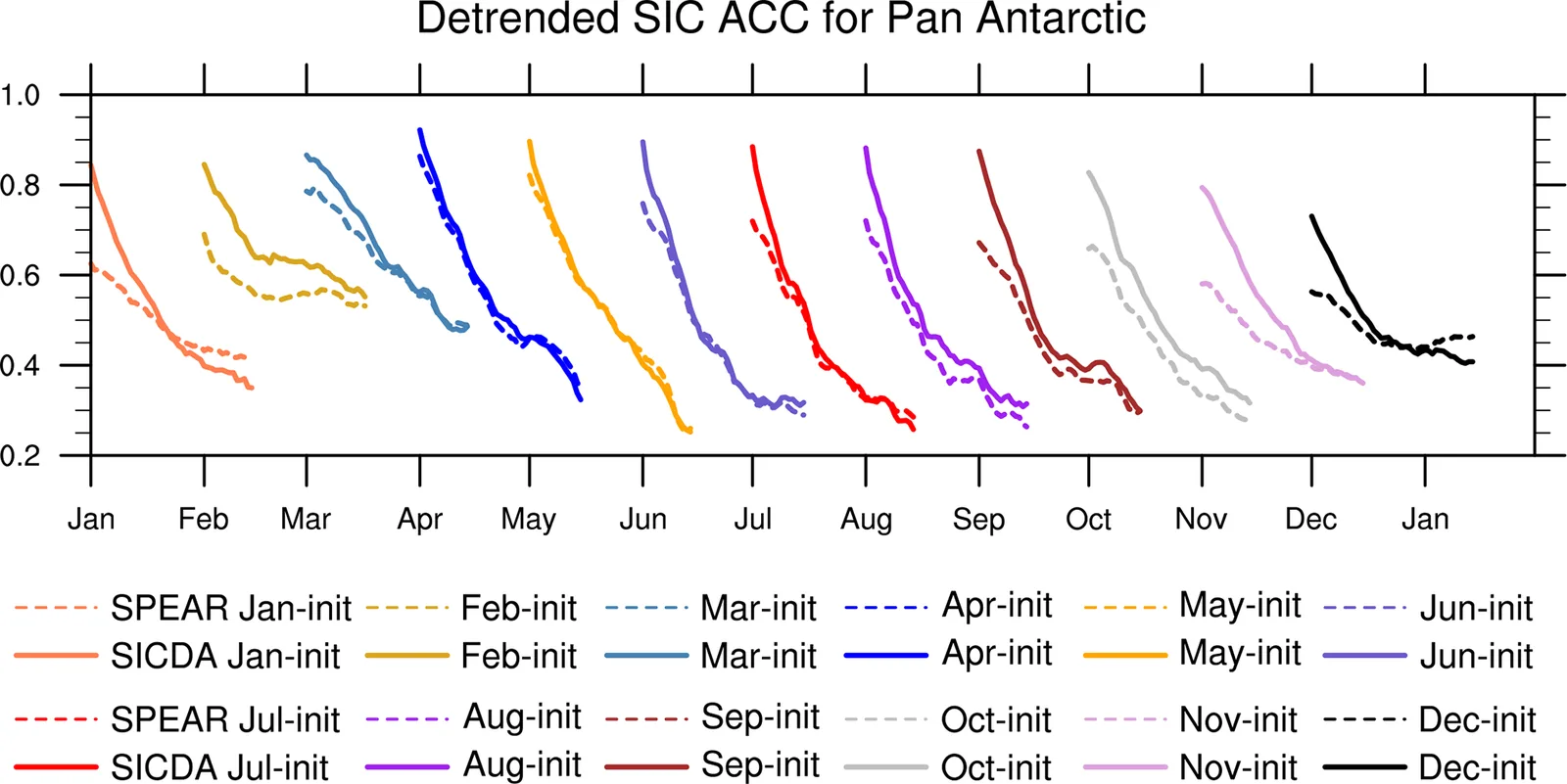
- Forecasts of SIC anomalies improved in nearly all start months, most in spring. December and January were the exceptions.
- Sea ice edge forecasts improved too. The improvement was statistically significant for 35 days in the Antarctic versus 22 days in the Arctic.
- Without assimilation, SPEAR could not beat damped persistence on ice edge skill in the Antarctic within 45 days. With assimilation it did so after day 10.
- Assimilation made sea ice thinner in most places, and ice volume was the lowest of all datasets compared.
Limitations
- In December and January starts, the assimilated forecasts lost skill after about 20 days. The authors link this to thin ice, albedo feedback and slow melt in the model interior.
- There is no ground truth for sea ice volume, so the authors cannot confirm that assimilation adjusts thickness in the right direction.
- Only concentration is updated, so concentration and thickness may become inconsistent, which can cause errors at longer lead times.
Glossary
- Data assimilation: Blending observations into a model to build a better starting state for a forecast.
- Detrended anomaly correlation coefficient (ACC): A score of how well forecast departures from normal match observed ones, after removing the long-term trend.
- Spatial Probability Score (SPS): A score of how well forecast ice-edge probabilities match where ice is observed. Lower is better.
- Damped persistence: A simple benchmark forecast that keeps today’s anomaly and lets it fade toward the trend climate.
Original paper
Subseasonal forecast improvements from sea ice concentration data assimilation in the Antarctic
The Cryosphere · 13 October 2026
AI-generated summary of the original article; changes were made. Check the original before relying on it.