Earth system models disagree widely on how much sea salt spray is needed to brighten clouds
In this preprint, ten model setups need very different amounts of injected sea salt to reach -2 Wm-2, and the gap comes mostly from particle size, droplet activation and cloud adjustments.
Why it matters
Marine cloud brightening can only be assessed with climate models, so large model disagreement makes it hard to say how much spray a deployment would need. The authors argue that much of the spread comes from fixable choices, such as the injected particle size and the droplet activation scheme. Cloud adjustments would still leave real differences between models.
What they did
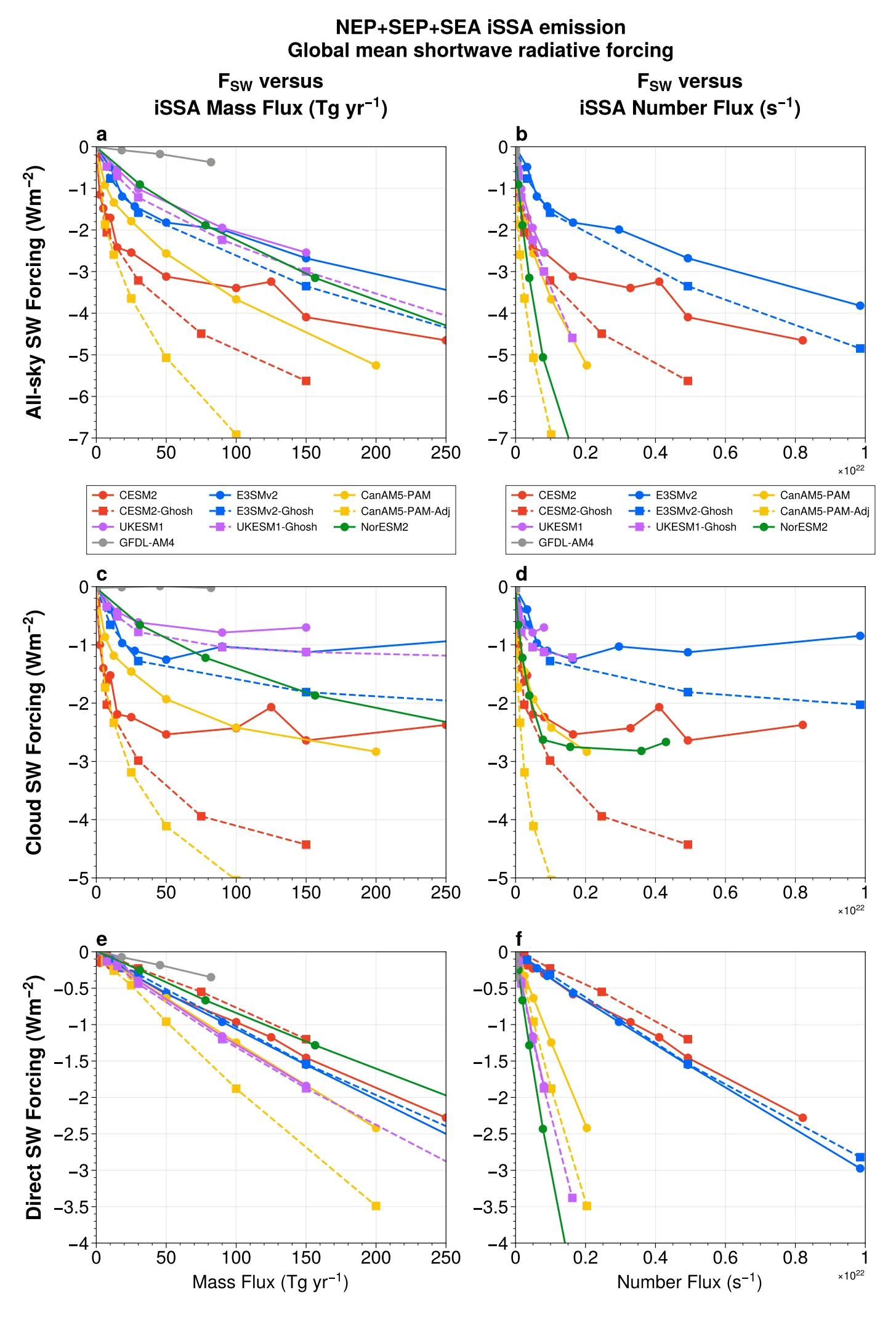
The authors ran fixed-sea-surface-temperature simulations in six Earth system models, plus four versions with modified parameterizations. Each model injected sea salt particles over three subtropical ocean regions at many emission rates. They split the total effective radiative forcing into an aerosol-cloud part and a direct aerosol part using a radiative perturbation method. They then compared forcing against emitted mass and against emitted particle number.
Key findings
- Interpolated emission needed for -2 Wm-2 of global forcing ranges from 7.21 Tg yr-1 (CESM2-Ghosh) to 95.7 Tg yr-1 (UKESM1).
- Models emit different particle sizes, with median radii from 28.1nm to 72.5nm. Comparing forcing per particle number rather than per mass reduces the spread, especially at low emission rates.
- Models using the standard Abdul-Razzak and Ghan activation scheme saturate strongly at high aerosol levels, and droplet number can even fall. Re-tuned versions keep raising droplet number and give much larger aerosol-cloud forcing.
- Aerosol-cloud forcing is the main part of total forcing up to about -2 Wm-2 in seven of ten models, and up to -1 Wm-2 in nine of ten. GFDL-AM4 is the only model where direct aerosol forcing dominates at every rate tested.
- Total forcing keeps getting stronger as emissions rise, even where aerosol-cloud forcing declines, so no model shows a regime where more emission causes warming. The efficiency of added emissions drops as aerosol-cloud forcing saturates.
- Cloud adjustments differ a lot. E3SMv2 and CanAM5-PAM versus CESM2 and CanAM5-PAM-Adj differ by about 2x in aerosol-cloud forcing.
Limitations
- Emitted particle size differs between models by implementation, so part of the spread is not true model structural uncertainty. GFDL-AM4 handles the injected particles poorly and is left out of later analysis.
- Only three subtropical regions were tested. The authors assume the findings carry over to midlatitude regions, and deep convective cloud effects were not assessed.
- The analysis uses monthly mean fields and fitted curves, and the logarithmic fit tends to overestimate aerosol-cloud forcing at high emission rates. This is a preprint and has not been peer reviewed.
Glossary
- Effective radiative forcing (ERF): The change in Earth’s energy balance caused by a perturbation after fast atmospheric adjustments, with sea surface temperature held fixed.
- Cloud adjustments: Changes in cloud amount or water content that follow from more cloud droplets, such as less rain and longer-lived clouds.
- Aerosol activation: The process by which aerosol particles take up water and become cloud droplets.
- Cloud condensation nuclei (CCN): Aerosol particles large enough to seed cloud droplets at a given supersaturation.
Original paper
On the Range of Marine Cloud Brightening Radiative Forcing across Earth System Models
EGUsphere · 21 September 2026
This paper is a preprint. It has not been peer reviewed, and its results may change.
AI-generated summary of the original article; changes were made. Check the original before relying on it.