Faster black carbon aging in a regional model shifts East Asian summer climate effects
Letting black carbon aging speed vary with local pollution, instead of fixing it at 1.15 days, lowers BC column burden, raises near-surface BC in parts of eastern China, and changes the simulated radiative forcing and the summer north-dry, south-wet pattern.
Why it matters
Black carbon aging is a major source of uncertainty in climate models. This study shows that a simple fixed aging time can misrepresent where BC is removed and how strongly it affects radiation, clouds and rainfall in polluted, monsoon-dominated regions. It also shows that the direct and cloud pathways cannot simply be added together.
What they did
The authors added a dynamic aging scheme, based on condensation and coagulation, to the regional climate–chemistry model RegCM-Chem. They replaced the fixed 1.15-day aging timescale. They ran eight experiments for 2008–2021 and analyzed summer (June–August). The runs isolated BC–radiation, BC–cloud and combined effects under both the default and dynamic schemes. Results were checked against reanalysis, satellite data and BC observations at 33 sites.
Key findings
- Aging timescales fall below 10 h over the North China Plain and Sichuan Basin, with a minimum monthly mean of 2.84 h. Remote regions such as the Qinghai–Tibet region and oceans take more than a day.
- Faster aging boosts wet removal of hydrophilic BC and cuts the BC column burden over East Asia by an average of 0.12 mg m−2. Reduced dry deposition raises surface BC and BC optical depth over eastern China.
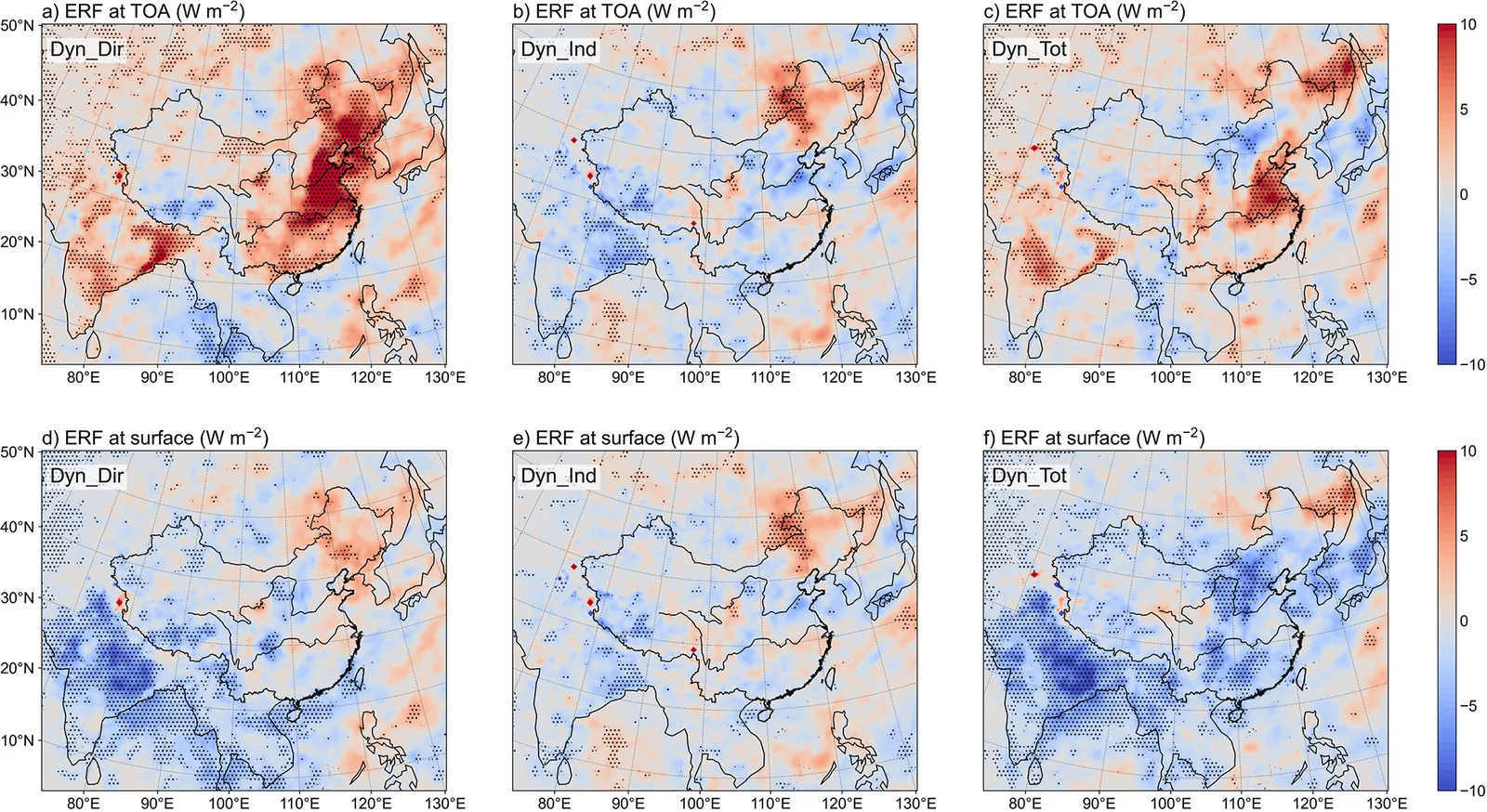
- Under dynamic aging, effective radiative forcing at the top of the atmosphere is +3.60 W m−2 for BC–radiation, -0.58 W m−2 for BC–cloud and +0.90 W m−2 for the combined effect.
- BC produces a south-wet, north-dry summer pattern, with precipitation changes of +0.13 mm d−1 in southern China and -0.09 mm d−1 in northern China. Northern China warms slightly and southern China cools slightly.
- The combined response is not the sum of the separate pathways. The interaction term can match or exceed the single-pathway responses at regional scale.
Limitations
- Direct observations of BC aging timescales, column burden and optical depth are limited. The model still underestimates BC surface concentration and optical depth, and the new scheme only partly fixes this.
- The cloud results depend on one chosen parameterization. Surface forcing from BC–cloud effects varied from -0.25 to -0.93 W m−2 when the assumed hygroscopicity was changed. Open biomass-burning emissions are not included.
- The scheme changes only the aging timescale. It does not yet include observational constraints on size distribution, mixing state or absorption enhancement.
Glossary
- BC aging: The change of fresh, water-repelling black carbon into coated, water-attracting particles through condensation and coagulation.
- Effective radiative forcing (ERF): The change in net energy flux after the atmosphere’s quick adjustments, such as clouds and circulation, are allowed to respond.
- Aerosol optical depth (AOD): A measure of how much light the particles in an air column block or absorb.
- Cloud droplet number concentration (Nd): The number of cloud droplets per cubic centimetre of air.
Original paper
Sensitivity of dynamic aging on the climate effects of black carbon aerosols over East Asia in summer
Atmospheric Chemistry and Physics · 5 October 2026
AI-generated summary of the original article; changes were made. Check the original before relying on it.