Glaciers in central and southeast Greenland sped up together from 2016 to 2020
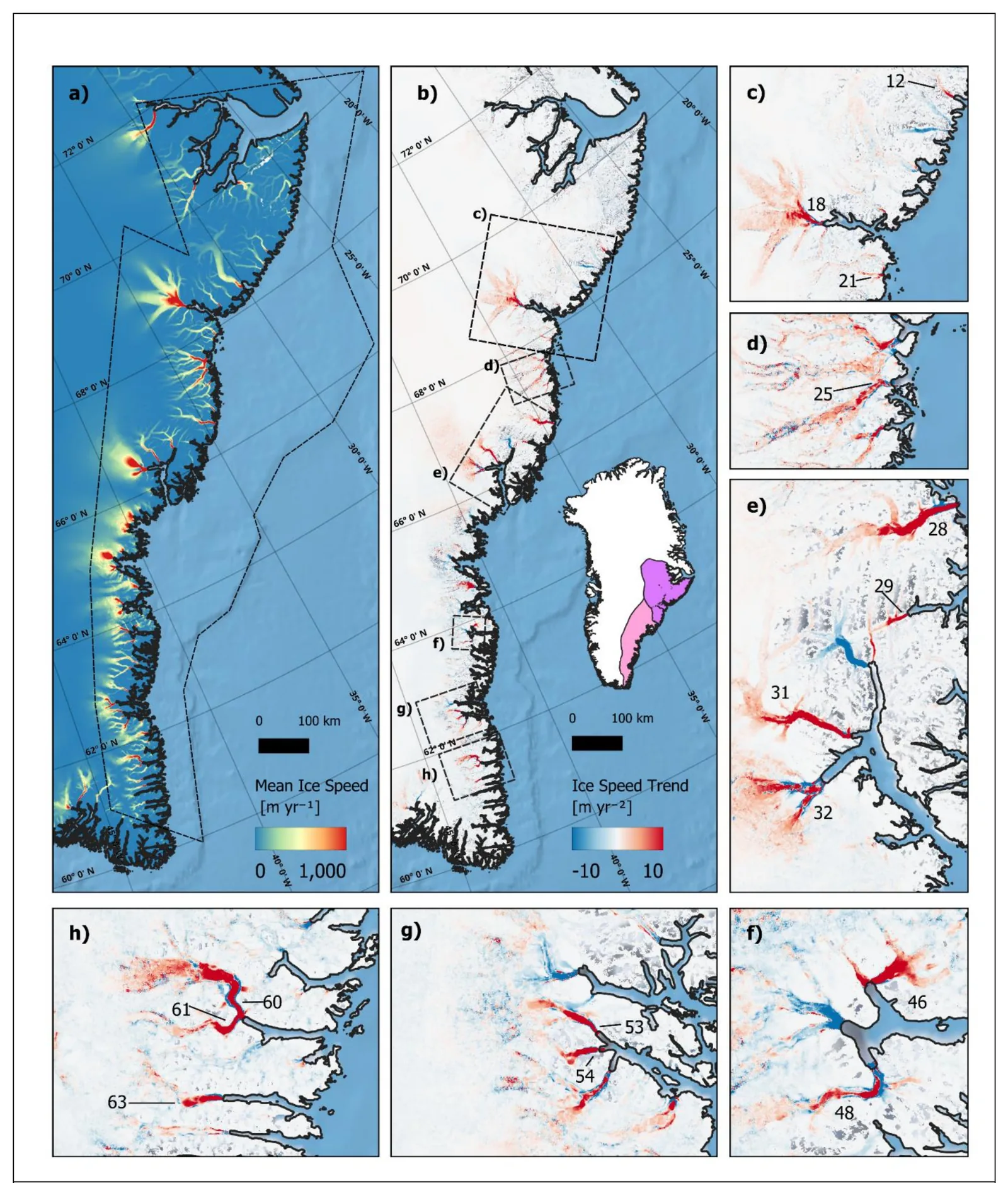
Satellite data show that most of 66 marine-terminating glaciers in central and southeast Greenland accelerated together from 2016, peaked around 2020, then slowed only partly, as warm ocean water appeared at the same time.
Why it matters
The speedup was more widespread and larger than earlier studies of single glaciers had shown. Most glaciers are still faster than before 2016, so the region’s sea level contribution has been raised for about half a decade. It is unclear whether speeds will return to earlier levels, so the authors call for continued monitoring and modelling.
What they did
The authors tracked ice speed on 66 glaciers using Sentinel-1 radar satellite images from October 2014 to August 2025. They built smoothed speed time series for each glacier and added older annual speeds from ITS LIVE. For 15 highlight glaciers they also mapped how far the calving front moved. They compared the changes with reanalysis data on ocean temperature, air temperature and sea-ice concentration.
Key findings
- From 2016 to 2020, 43 of 66 glaciers (65 %) sped up, and 6 more than doubled their speed. Accelerating glaciers gained 43.1 % on average.
- Speeds peaked around late 2019 to early 2020. On almost all glaciers the 2020 peak was the fastest since at least 2000.
- From 2020 to 2024, 45 glaciers (68 %) slowed, by 15.5 % on average. This was smaller and more gradual than the earlier speedup.
- Over the whole period, 29 glaciers showed a net speedup of 42.9 % on average, and all 15 highlight glaciers had a net retreat of their calving fronts.
- Surface ocean waters were almost +3 °C above normal in 2016, waters at 200 m depth were over +1 °C above normal in 2018, and sea-ice concentration stayed below normal from 2016 to 2021. These fit the timing of the speedup.
Limitations
- The link to ocean warming is based on matching timing, not a direct test of cause. The authors say it suggests ocean forcing played a role.
- Fjord depth and seabed shape are poorly mapped in this region, so their role cannot be quantified. The sea-ice data do not cover the small fjords.
- Four northern glaciers have only 30-50 speed measurements each, and heavy snowfall in the southeast can reduce successful tracking.
Glossary
- Feature tracking: A way to measure ice speed by following matching patterns between two repeat satellite images.
- Marine-terminating glacier: A glacier whose front ends in the ocean and loses ice by calving and melt.
- Calving front: The edge of a glacier where icebergs break off into the water.
- Mélange: A mix of icebergs and sea ice in front of a glacier that can hold the front steady.
Original paper
A Decade of Synchronous Ice Speed Change Across Central & Southeast Greenland
EGUsphere · 23 September 2026
This paper is a preprint. It has not been peer reviewed, and its results may change.
AI-generated summary of the original article; changes were made. Check the original before relying on it.