Greenland ice sheet in a coupled model tips near 2.55 °C and regrows only far below pre-industrial
In this coupled model, the Greenland Ice Sheet collapses once warming stays near 2.55 °C, and it needs about 1.3 °C of cooling below pre-industrial to fully regrow.
Why it matters
The results suggest that a lost Greenland Ice Sheet would be practically irreversible on human timescales. The authors say that sustaining today’s CO2 level in the long term could trigger the loss. They also say that ice sheet-climate feedbacks change the thresholds, so models that leave them out may give misleading answers.
What they did
The authors used an Earth system model fully coupled to ice sheet and solid Earth models. They raised and lowered CO2 very slowly over many thousands of years, starting from a pre-industrial ice sheet and from a small regrowth state. They also ran constant-CO2 simulations to pin down the tipping points. Finally, they tested whether variance and lag-1 autocorrelation could warn of the transitions.
Key findings
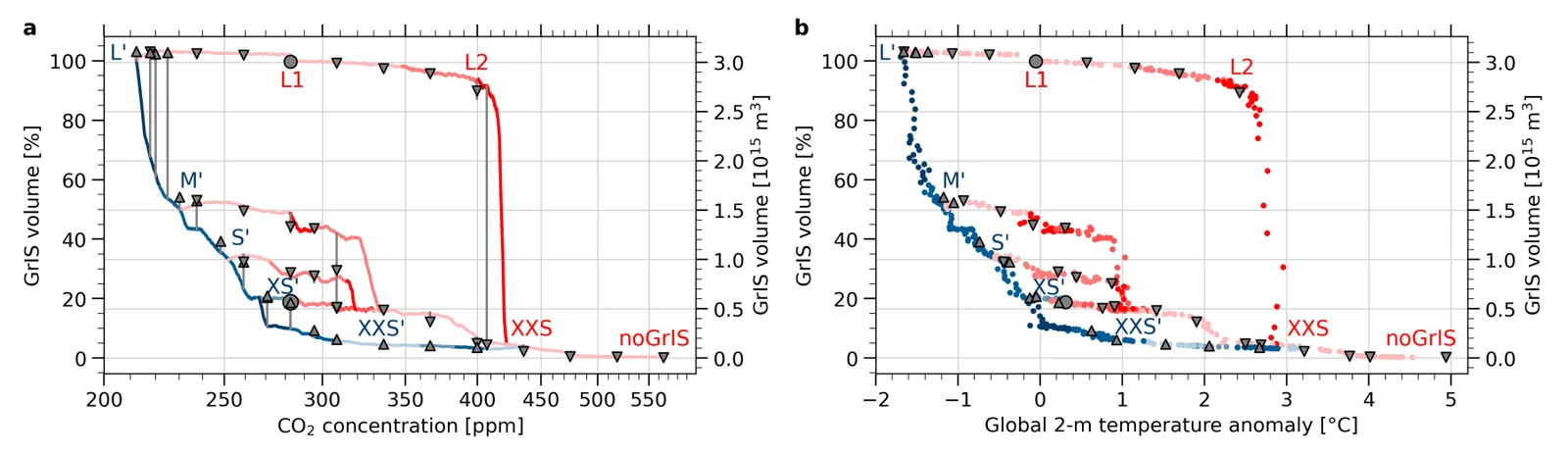
- The present-day ice sheet destabilizes at a warming of 2.55 ± 0.15 °C (403.5 ± 3.5 ppm CO2), once its volume falls to 87% of pre-industrial.
- Regrowth needs 1.3 ± 0.1 °C below pre-industrial (227 ± 2.5 ppm), much colder than earlier studies suggested.
- During regrowth the ice sheet sits stably at intermediate states of 6%, 19%, 33% and 54% of pre-industrial volume.
- Early warning signals appeared before the retreat transition but not before the regrowth transition, and they do not show how close the tipping point is.
- The Antarctic ice sheet also loses ice and needs even colder conditions to fully recover (1.7 °C below pre-industrial).
Limitations
- Thresholds depend on the single model, its parameters, coarse resolution and an equilibrium climate sensitivity of 4.1 °C. A lower sensitivity would give higher CO2 thresholds.
- CO2 changed about a thousand times slower than today’s rise, and the forcing was idealized, with other greenhouse gases and orbit held at pre-industrial values.
- The Antarctic thresholds are not pinned down because some simulations did not reach a steady state.
Glossary
- Hysteresis: A system follows a different path when forcing is reversed, so returning to the old forcing does not restore the old state.
- Bifurcation point: A threshold at which a small change in forcing makes the system shift to a different state.
- Melt-elevation feedback: As the ice surface lowers it meets warmer air, which speeds up melting.
- Early warning signals: Statistics such as variance and lag-1 autocorrelation that rise when a system slows its recovery near a tipping point.
Original paper
Multistability and hysteresis of the Greenland Ice Sheet in a fully-coupled Earth System-Ice Sheet Model
EGUsphere · 26 October 2026
This paper is a preprint. It has not been peer reviewed, and its results may change.
AI-generated summary of the original article; changes were made. Check the original before relying on it.