Lab-burned Eurasian peat and forest fuels emit mostly weakly light-absorbing brown carbon
Open burning of boreal, arctic peat and savanna fuels releases lots of organic carbon but little soot, and its brown carbon absorbs light only weakly, with dilution and aging making more of it insoluble.
Why it matters
Surface fires in Eurasia may become more common as the climate warms, and this study gives emission factors and light-absorption values that models can use. The results suggest these fires are strong sources of organic pollution but not of black carbon. Models that use one fixed BC/OA ratio miss the large spread seen across fuels and burning phases.
What they did
The team burned Finnish forest surface, several peats (Finnish, Russian, Svalbard, commercial) and South African savanna wood and grass in an open lab burner. They also added wood stove samples for comparison. They collected smoke on filters, measured organic and elemental carbon, and extracted the organics in water and methanol to measure light absorption. For some fuels they fed smoke into a 29 m3 chamber to test the effects of dilution, photochemical aging and dark aging.
Key findings
- Organic carbon emission factors of fresh smoke ranged from 1.30–89.9 g kg−1, versus 0.01–4.80 g kg−1 for elemental carbon. Smouldering gave more organic carbon and flaming gave more elemental carbon.
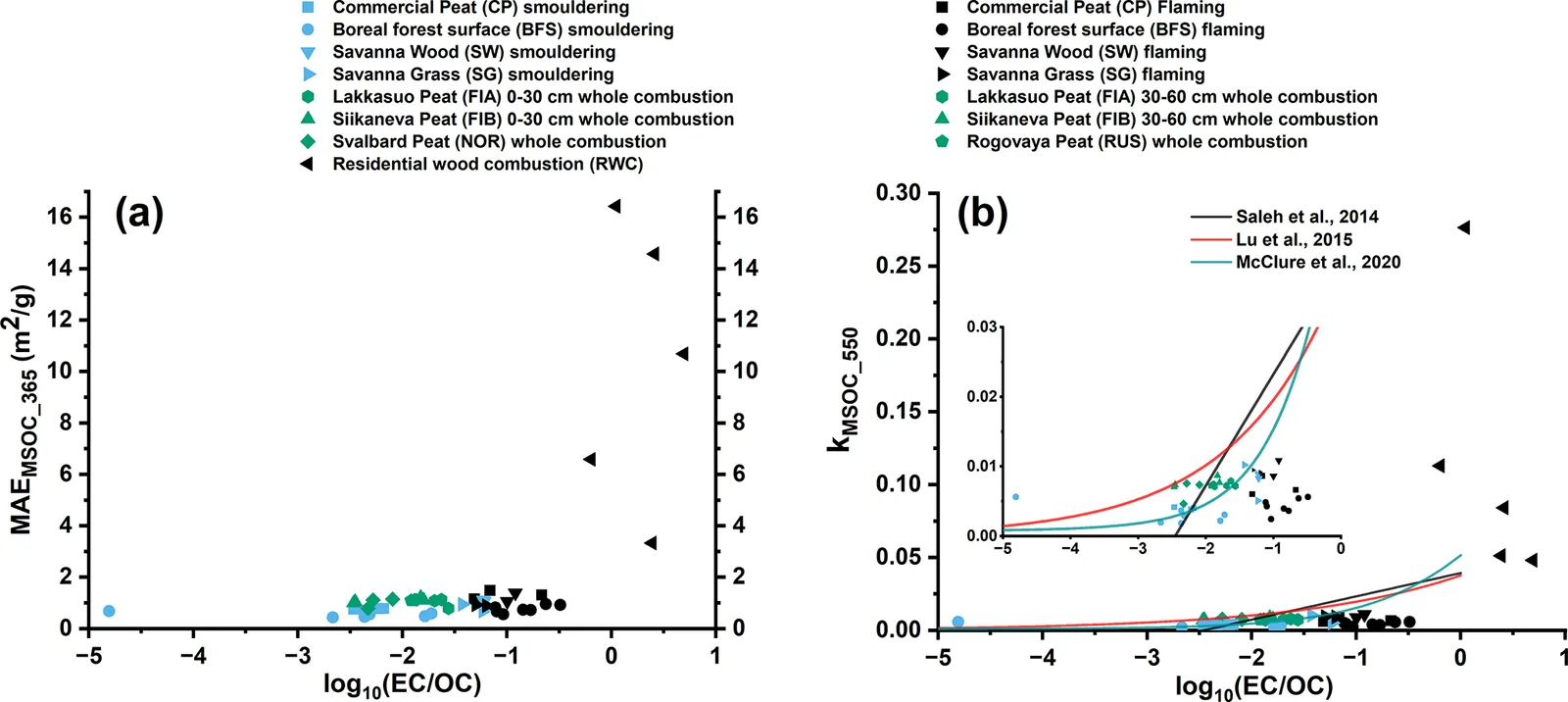
- Methanol dissolved more than 92 % of the organic carbon in fresh smoke. Its imaginary refractive index at 550 nm was 0.002–0.011, which is weakly absorbing brown carbon.
- Absorption rose with the EC/OC ratio. Wood stove emissions, from hotter burning, absorbed much more strongly than open fires.
- Dilution in the chamber evaporated the more volatile organics. The remaining organics were less volatile and less soluble in methanol, and tarball-like particles were common.
- Photochemical aging lowered the refractive index, while NOx-rich dark aging of flaming smoke raised it.
Limitations
- Solvent extraction misses insoluble, possibly strongly absorbing brown carbon, so absorption of aged smoke may be underestimated. Online measurements are needed.
- Emission factors varied a lot between replicate burns, especially smouldering ones. Some aging experiments had no repeats.
- Nitroaromatics may have broken down before filter collection, which makes the dark aging effects hard to read.
Glossary
- Brown carbon (BrC): Light-absorbing organic particles from combustion, especially at short visible and UV wavelengths.
- Modified combustion efficiency (MCE): The share of CO2 in the CO2 plus CO released, used to tell flaming from smouldering burns.
- Imaginary refractive index (k): The number climate models use to describe how strongly a material absorbs light.
- Tarball: A round, viscous, low-volatility organic particle from biomass burning.
Original paper
Brown carbon emissions from laboratory combustion of Eurasian arctic-boreal and South African savanna biomass
Atmospheric Chemistry and Physics · 25 November 2025
AI-generated summary of the original article; changes were made. Check the original before relying on it.