LightGBM sorts lidar aerosol layers into types with over 90 % scores when depolarization is used
A LightGBM model trained on labelled, high-resolution lidar data from Granada classified aerosol types well, and depolarization data mattered most for telling dust apart.
Why it matters
Lidar aerosol typing is usually done by hand, using ranges of optical properties. An automatic method could speed this up across lidar networks. The authors also suggest it could help check satellite aerosol products and choose better extinction-to-mass factors.
What they did
The authors took EARLINET multiwavelength lidar profiles from the Granada station for 2012 to 2015. They found aerosol layers and computed optical properties at high vertical resolution. They labelled 416 layers by hand as Continental Polluted, Dust, Mixed, Smoke or Unknown. Experts reviewed the labels, which were checked against back-trajectories and an aerosol model. Six ML models were trained and tested, with and without depolarization. The best model was then tried on a smoke case and a Saharan dust event, and compared with the NATALI algorithm.
Key findings
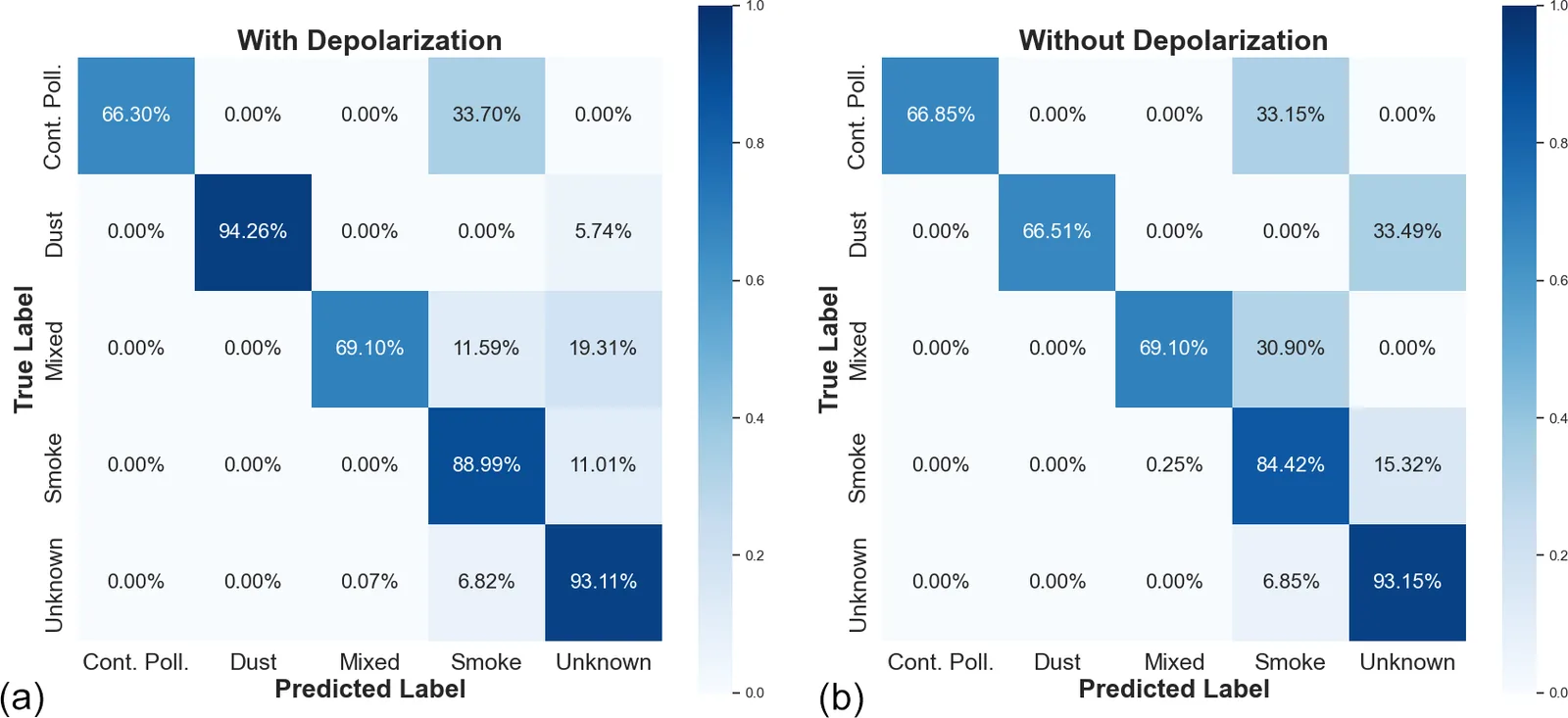
- LightGBM was the best of six models, with precision, recall and F1-score above 90 % with depolarization and close to 87 % without.
- Dust accuracy dropped by 28 % when depolarization was removed, and Smoke accuracy dropped by 4 %.
- The most important feature in both set-ups was the layer-average lidar ratio at 532 nm. Depolarization ranked second when it was available.
- Continental Polluted (66 %) and Mixed (69 %) were the hardest types to classify, often confused with Smoke or Unknown.
- On an independent Saharan dust event, 82 % of Dust samples were classified correctly. LightGBM with depolarization found the main type in 65 % of layers, against 23 % for NATALI.
Limitations
- The model is trained on one station, so it covers only the aerosol types found at Granada. Other types, such as marine, are missing.
- Labels were assigned by hand using literature ranges and expert review. Overlapping ranges blur Mixed, Continental Polluted and Smoke.
- In the dust event the bottom and top layers were often misclassified, and Mixed aerosol was often labelled Unknown.
Glossary
- Lidar ratio: The ratio of extinction to backscatter, which depends on the type of particle.
- Particle depolarization ratio: A measure of how much the particles change the laser light’s polarization, which is higher for non-spherical particles such as dust.
- EARLINET: The European Aerosol Research Lidar Network, which provides quality-checked lidar profiles.
- SHAP: A method that scores how much each input feature contributes to a model’s predictions.
Original paper
Aerosol type classification with machine learning techniques applied to multiwavelength lidar data from EARLINET
Atmospheric Chemistry and Physics · 9 October 2025
AI-generated summary of the original article; changes were made. Check the original before relying on it.