More radio occultation data improves weather forecasts in a NOAA-style system
Assimilating roughly 35 000 radio occultation profiles per day, nearly triple today's operational volume, improved forecasts of temperature, humidity and wind in a JEDI-GFS test, with no sign of saturation, though it added a bias in the lower stratosphere.
Why it matters
Space agencies and forecast centers must decide how many radio occultation profiles to buy and fly. This is the first test with a large volume of real data rather than simulations. It suggests that buying more data keeps paying off, and it flags a stratospheric bias that needs attention.
What they did
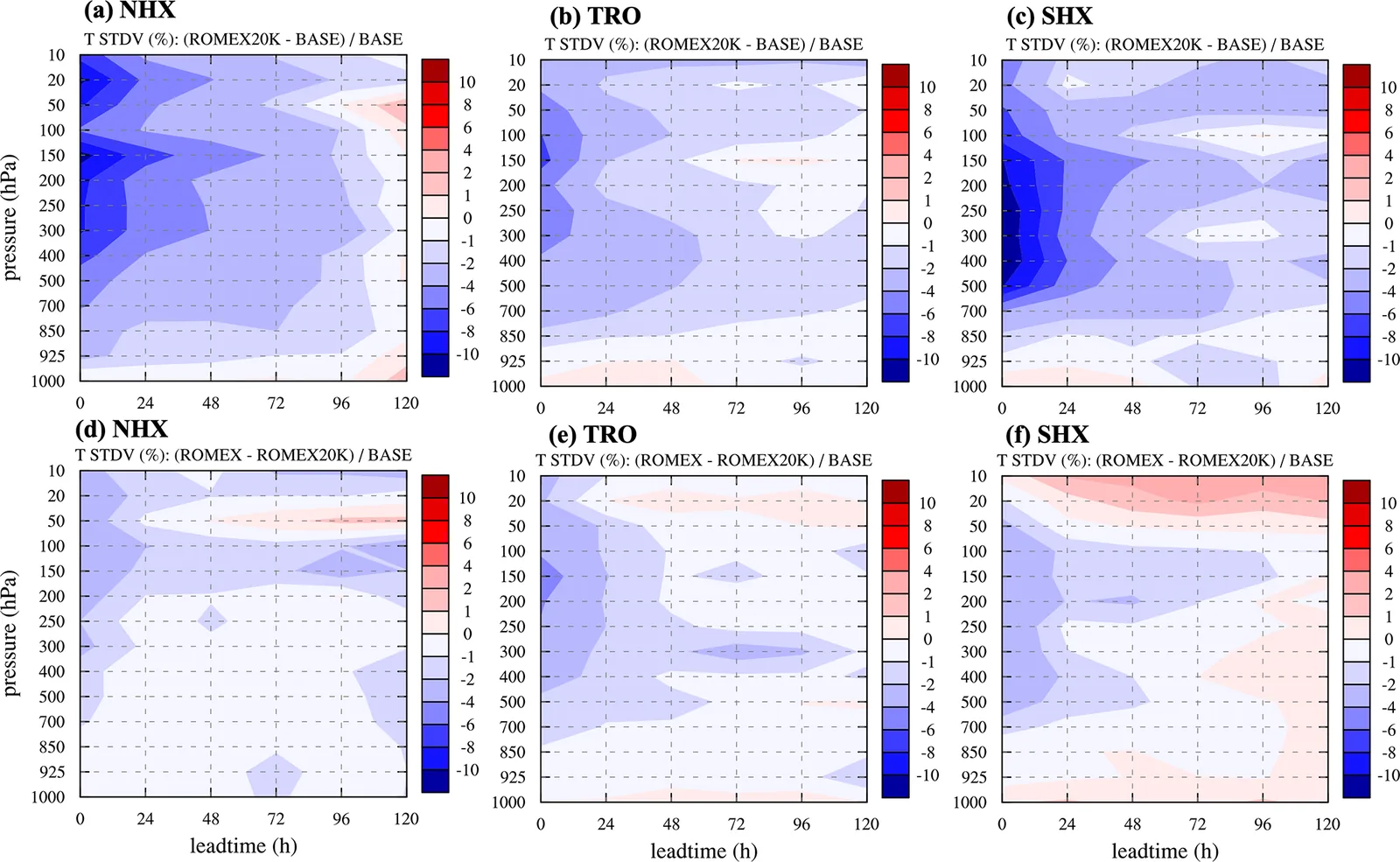
The authors ran four one-month experiments in September 2022 with the JEDI data assimilation system and the GFS atmospheric model. The experiments differed only in radio occultation volume: none, about 8000 per day (BASE), about 20 000 per day (ROMEX20K), and about 35 000 per day (ROMEX). All used the same other observations, default quality control and the same observation error model. Forecasts were checked against radiosondes, aircraft observations and ECMWF analyses, out to 5 days.
Key findings
- Forecast fit to radiosondes got better as more profiles were added. The 6 h temperature error spread at 200 hPa fell by 3.2 %, 5.3 % and 6.8 % for BASE, ROMEX20K and ROMEX, relative to no radio occultation.
- Withholding all radio occultation data made forecasts worse, with a maximum temperature error increase of about 0.4 K near 50 hPa over the tropics.
- Gains showed up in temperature, humidity and wind, and lasted up to 5 days. They faded with lead time, especially for temperature and humidity.
- The improvement grew roughly with the logarithm of profile count, and no consistent sign of saturation was found.
- Extra data cooled most of the troposphere and warmed the air above about 200 hPa. This raised temperature and geopotential height biases in the lower stratosphere.
Limitations
- Only one month was run, because of limited computing resources. The project recommended the full 3 months.
- The system lacked hyperspectral infrared sounders and geostationary radiances, so results may differ in a fully operational setup. The non-saturation finding may also depend on this system.
- Verification against ECMWF analyses, which were made with regular radio occultation volumes and may carry their own biases. The source of the stratospheric bias is still unclear.
Glossary
- GNSS radio occultation (RO): A method that measures how the atmosphere bends navigation satellite signals as they reach a low-orbit satellite, giving profiles of the atmosphere.
- JEDI: Joint Effort for Data assimilation Integration, a next-generation system for blending observations into weather models.
- STDV: Standard deviation of forecast errors, used here as a measure of forecast error spread.
- MABR: Mean absolute bias reduction, which compares the size of the bias in an experiment with that of a reference run.
Original paper
Impact Study of Increased Radio Occultation Observations during the ROMEX Period Using JEDI and the GFS Atmospheric Model
Atmospheric Measurement Techniques · 4 November 2025
AI-generated summary of the original article; changes were made. Check the original before relying on it.