Radar images from space can track emperor penguin colonies through the polar winter
Free Sentinel-1 radar images show emperor penguin colonies in winter darkness, and combined with summer optical images they reveal year-round colony movement.
Why it matters
Optical satellites cannot see penguins during the polar night, so winter behaviour has been mostly unknown. Radar fills this gap with freely available data. This could help assess how colonies respond to changing ice and weather, and help plan protection for the species.
What they did
The authors inspected Sentinel-1 radar images from winter and Landsat 8, Landsat 9 and Sentinel-2 optical images from spring and summer. They did this for three colonies, Atka Bay, Coulman Island and Cape Washington, over 2017–2024. They placed points on colonies and sub-groups by hand and measured how far they moved from their earliest winter location. A semi-automated method gave too many false detections, so they used manual tracking.
Key findings
- Colonies show up in Sentinel-1 radar on winter fast ice as brighter patches, and they were located in every year at all three sites.
- All three colonies moved less in winter than in summer, but they still moved, and the amount varied between years and colonies.
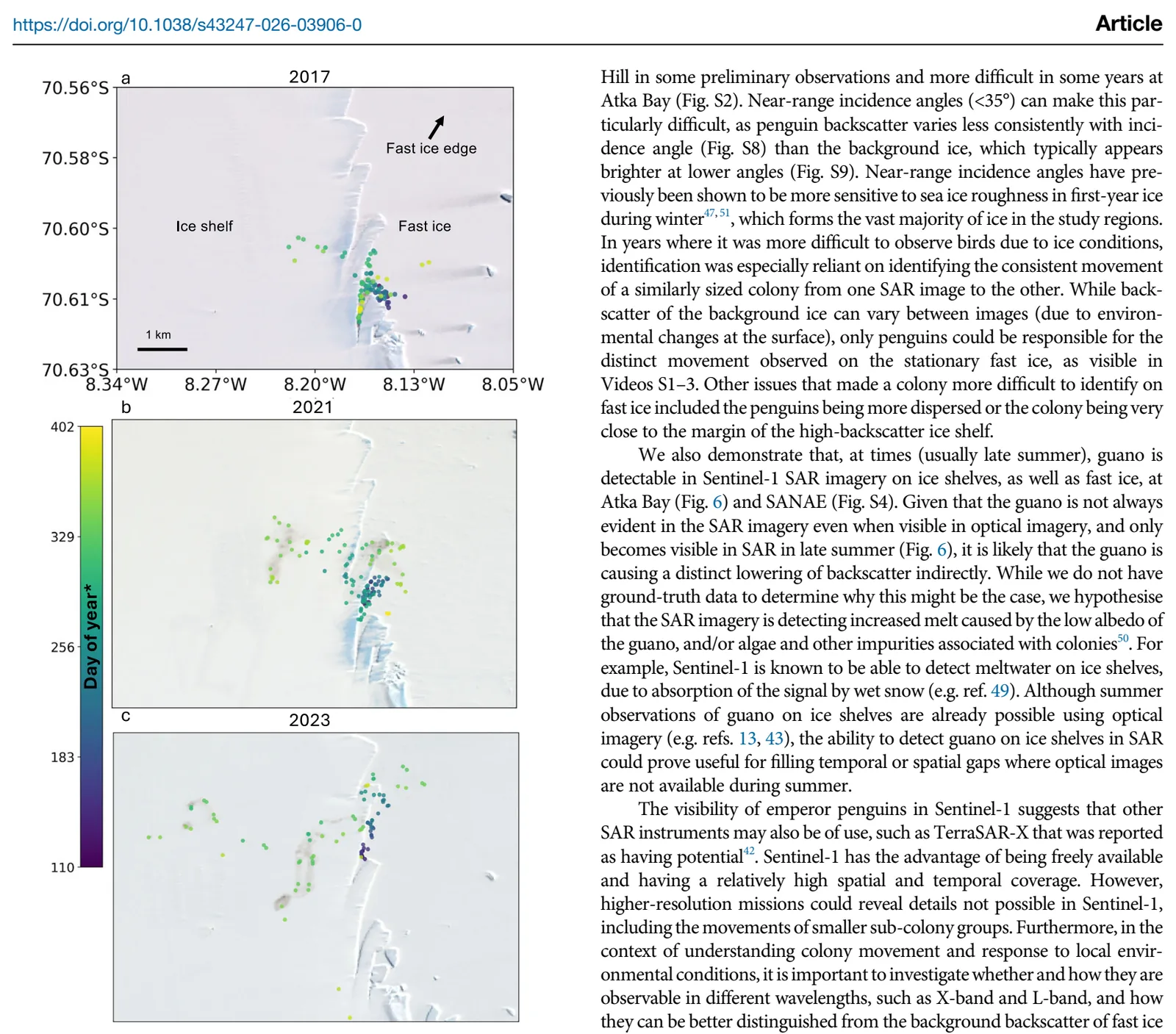
- At Atka Bay the colony moved onto the ice shelf in seven of 8 years, even though the fast ice looked stable.
- At Coulman Island and Cape Washington, several groups turned or moved away from the ice edge at the same time, with no visible change in ice conditions. The authors take this as a sign that wind may be the main driver.
- Guano on ice shelves can sometimes be seen in radar as a dark area in late summer.
Limitations
- Tracking was done by hand. Rough or old ice with bright radar returns sometimes made colonies hard or impossible to find, as at Snow Hill.
- At 10 m resolution, small groups cannot be resolved. In summer, optical images show guano rather than birds, so penguin positions are inferred.
- The authors could not confirm why penguins look bright in radar and had no ground-truth data. Their wind explanation is a hypothesis, since they did not test it against weather data.
Glossary
- Synthetic aperture radar (SAR): A satellite radar that makes images by sending microwave pulses, so it works in darkness and through cloud.
- Backscatter: The share of the radar signal that returns to the satellite; rougher surfaces usually return more.
- Fast ice: Sea ice that is attached to the coast or an ice shelf and does not drift.
- Guano: Penguin droppings, which stain the ice and can be seen from space.
Original paper
Year-round movement of emperor penguin colonies observed from space
Communications Earth & Environment · 2 September 2026
AI-generated summary of the original article; changes were made. Check the original before relying on it.