Regional model skilfully predicts Gulf of Maine bottom temperature, oxygen and acidity years ahead
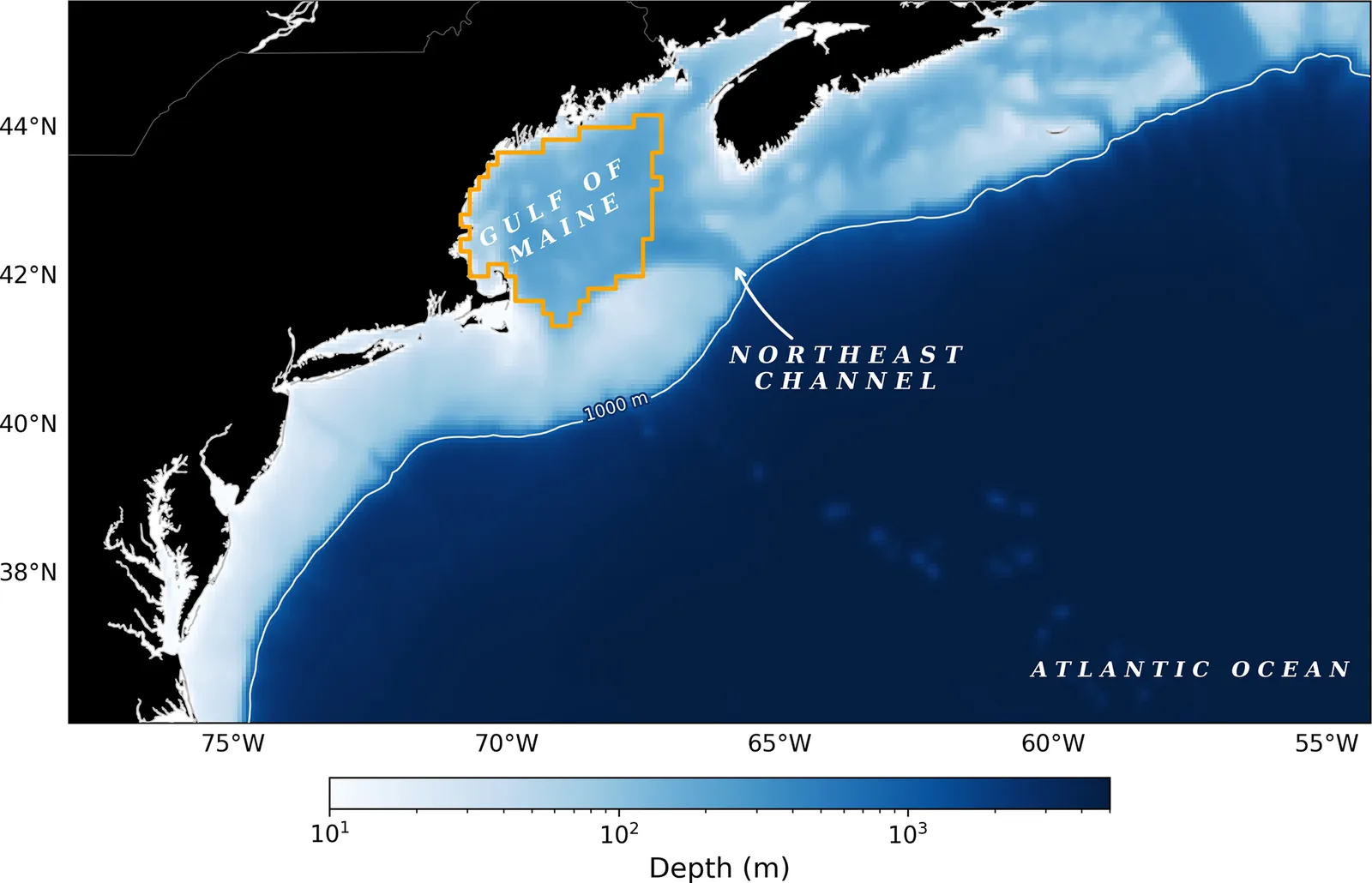
A high-resolution regional ocean model can forecast Gulf of Maine bottom conditions for several years, and it points to cooler water, more oxygen and lower pH and aragonite saturation through 2027.
Why it matters
Fisheries managers set catch limits and rebuilding plans on 1–10 year horizons, and bottom conditions matter for lobster, scallops and groundfish. The forecasts suggest that relief from rapid warming may come with faster acidification. Knowing which variables are predictable, and why, helps decide how far to trust each forecast.
What they did
The authors downscaled global SPEAR decadal predictions to a 1/12° regional ocean model with a biogeochemical component. They ran 10-member, 10-year hindcasts started each January from 1965 to 2025, about 6500 simulated years. They compared these with uninitialized climate-change runs and with persistence. Skill was measured against a regional simulation that was checked against the available observations. They also built tercile probability forecasts with extended logistic regression.
Key findings
- Bottom temperature and pH skill comes mostly from the climate-change signal, such as warming and carbon uptake. Bottom oxygen and aragonite saturation depend more on initialization because of stronger internal variability.
- Oxygen skill drops to 0 beyond 2 years. Winter mixing events that ventilate the deep basins are hard to predict.
- Aragonite saturation variability is governed mainly by alkalinity, which changes with Warm Slope Water versus Labrador Slope Water. The long-term pH decline is -0.013 per decade and is led by rising carbon.
- All four variables had ranked probability skill scores above 0 versus persistence: 0.47 for temperature, 0.46 for oxygen, 0.6 for pH and 0.51 for aragonite saturation.
- For 2025–2027 the system forecasts below-normal bottom temperature (88.3 % probability) and above-normal oxygen (92.0 %). It forecasts below-normal pH and aragonite saturation (>99 % each).
Limitations
- Skill was verified against the regional simulation used to initialize the forecasts, because continuous bottom observations are lacking. The authors say this gives an upper limit and may overestimate skill.
- Some very confident forecasts rest on few past cases, such as 1/1 hits for aragonite saturation. Raw ensembles were overconfident, and river inputs were climatological with no year-to-year variation.
- The results are for the Gulf of Maine only, and the authors call for more observations of deep biogeochemistry.
Glossary
- Aragonite saturation state (Ωar): A measure of how easily seawater lets shell-building animals form aragonite; low values mean more corrosive water.
- Labrador Slope Water / Warm Slope Water: Two source waters entering the Gulf of Maine: cold, fresh, oxygen-rich Labrador water and warm, salty, high-alkalinity water with more Gulf Stream influence.
- Hindcast: A forecast run for a past period, started from the conditions of that time, to test how well the system would have predicted.
- Ranked probability skill score (RPSS): A score for probability forecasts across categories; above 0 means better than repeating last year’s category.
Original paper
Decadal biogeochemical predictions for the changing bottom marine environment of the Gulf of Maine
Ocean Science · 5 October 2026
AI-generated summary of the original article; changes were made. Check the original before relying on it.