Snow microbes in a Japanese beech forest rose, stalled and rose again with nutrients
In this forest snowpack, microbes grew once temperatures stayed above freezing, stalled when nutrients ran out, and grew again when beech budburst brought new nutrients.
Why it matters
The study links snow microbe growth to tree leaf-out and snowmelt timing. The authors suggest that earlier snow loss or shifts in tree timing and species could change snow ecosystems. They also say the work should be extended to carbon and nitrogen cycling in snow.
What they did
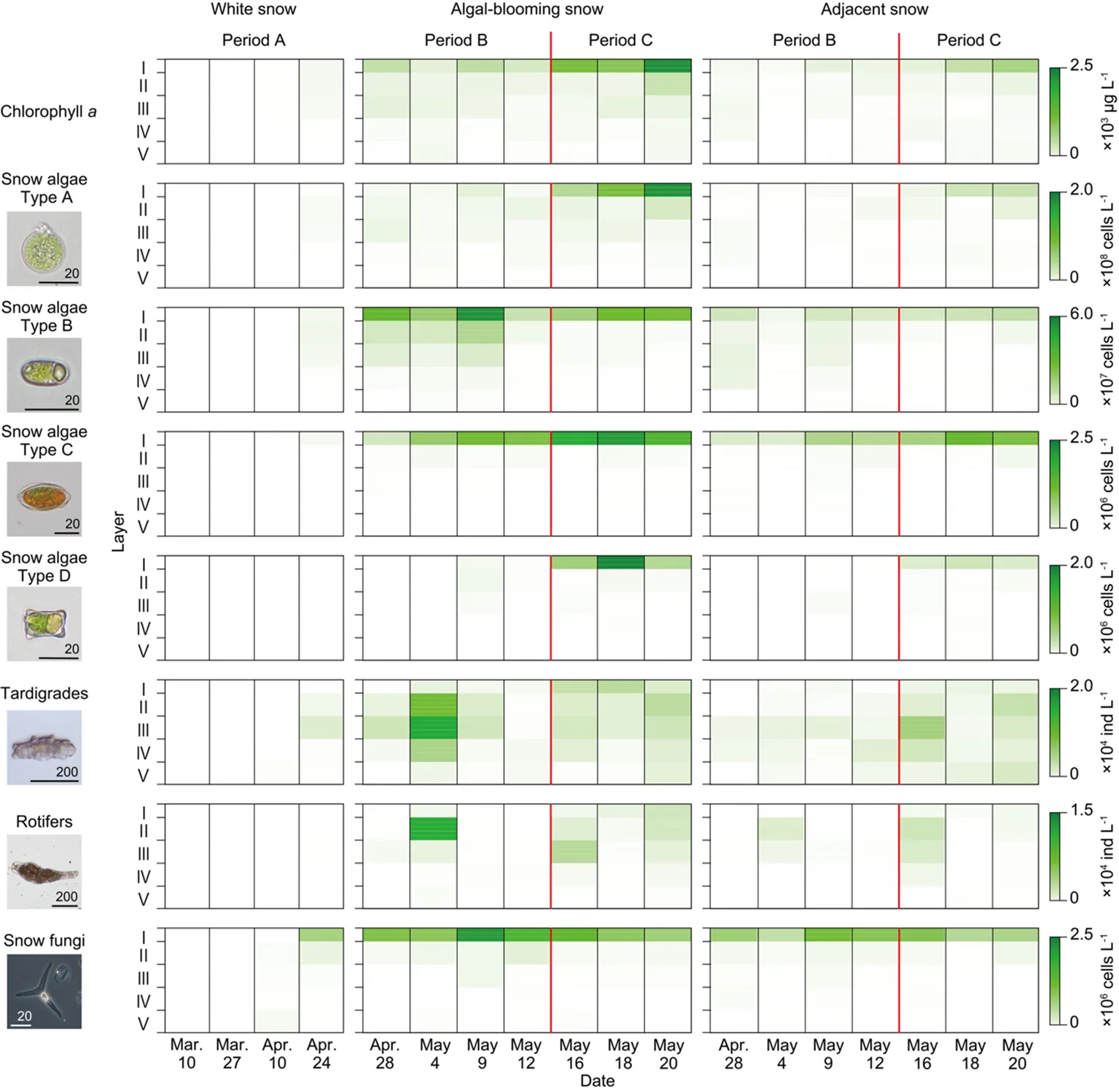
The team sampled snow on Mt. Gassan, Yamagata, Japan, 11 times from March to May 2021. They took 465 samples from five layers in snow pits and also took snow cores. They counted algae, fungi, tardigrades and rotifers, and measured chlorophyll a, dissolved ions and particles. They also collected rainwater and ran lab leaching tests on tree litter. They split the season into Periods A, B and C using air temperature and beech budburst.
Key findings
- In Period A (minimum temperature below freezing), microbes were present but stayed scarce.
- In Period B, green algal blooms appeared, and fungi and microinvertebrates rose with them. Nutrients (nitrate, ammonium, phosphate) later ran low, and growth levelled off.
- In Period C, after budburst, ammonium, phosphate and potassium rose in the surface snow, and algae and microinvertebrates increased again.
- Rainwater under trees had higher nutrient levels than in the open. Beech litter released ammonium, phosphate and potassium in lab tests.
- Algae and fungi concentrated at the surface, while microinvertebrates lived mainly in the layers just below.
Limitations
- This is a single site and a single season (2021), so the patterns may not hold elsewhere.
- Algae were sorted by shape rather than identified to species, and the life-stage links between algal types are inferred.
- Effects of leaf-out on longwave radiation and snow darkening were not tested, and the link between nutrients and growth is inferred from correlations.
Glossary
- Budburst: The time when tree buds open and leaves start to emerge.
- Chlorophyll a: A pigment used as a measure of algal biomass.
- MASS layer: The microbially active snow surface layer, the upper snow where microbes are active.
- Microinvertebrates: Tiny animals such as tardigrades and rotifers.
Original paper
Temporal and vertical changes in snow microbial communities during the melting season below canopy in Northern Japan
The Cryosphere · 20 November 2025
AI-generated summary of the original article; changes were made. Check the original before relying on it.