Snow surface roughness from suncups tracks albedo loss on alpine snow over three seasons
Over three melt seasons in the Swiss Alps, suncup roughness and impurities together lowered snow albedo by 0.03–0.1, and albedo follows a logarithmic curve with aerodynamic roughness length z0.
Why it matters
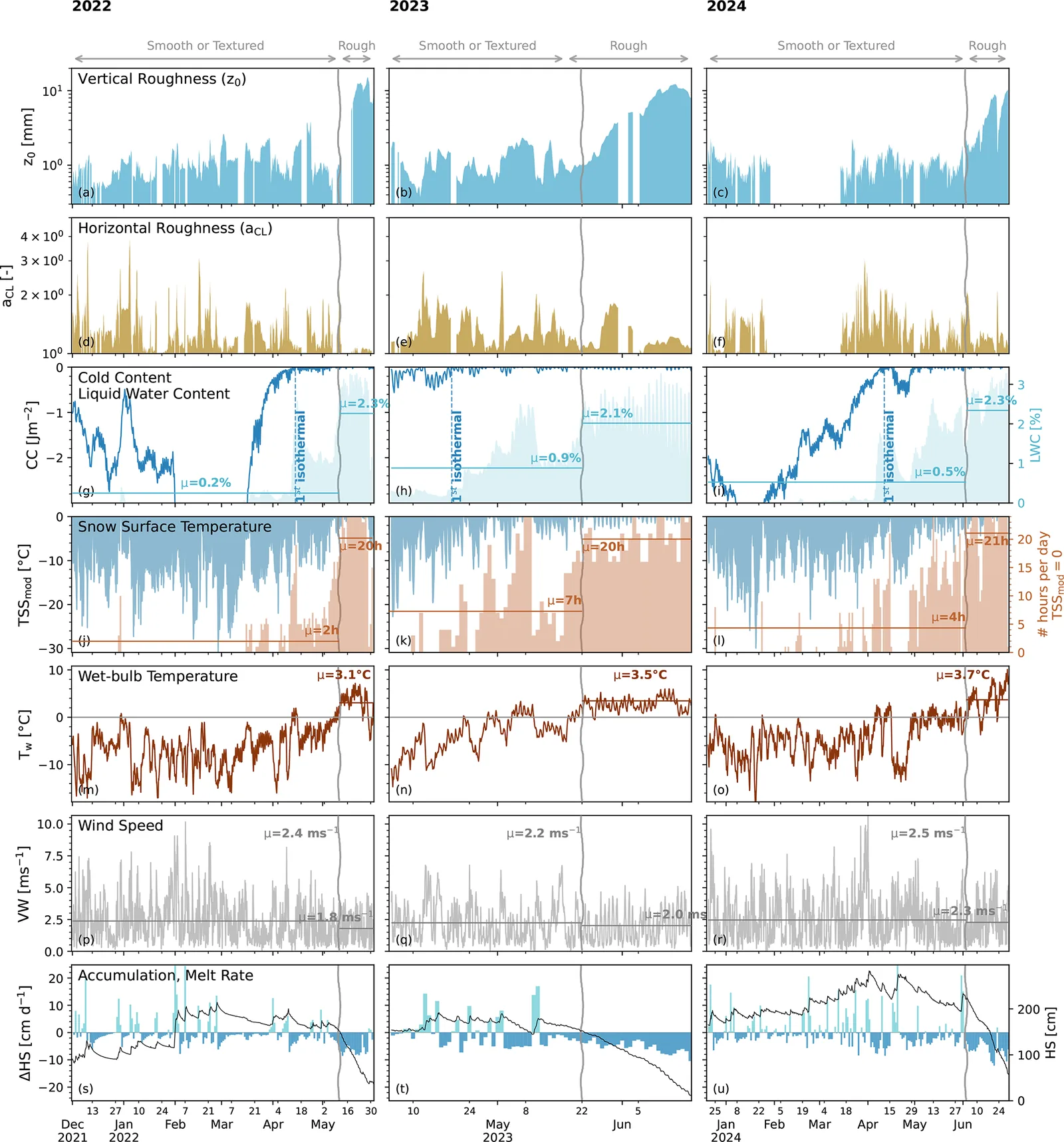
Most snow models keep z0 constant, yet here it changed by one order of magnitude during ablation. A time-varying z0 could improve turbulent heat fluxes and, through its link to albedo, the darkening from roughness and impurities. Simple station measurements could flag when suncups start.
What they did
The authors scanned about 300 m2 of snow at Weissfluhjoch (2536 m) with a fixed terrestrial LiDAR over three ablation seasons. They built surface models and computed roughness measures, including z0. They drove the SNOWPACK model with weather data and fed its snow properties into the TARTES radiative transfer model to simulate flat-surface albedo. They compared this with pyranometer albedo under five assumed impurity scenarios, since no impurity measurements were available.
Key findings
- Suncup growth began when the surface stayed at 0 °C for about 20 h per day, wet-bulb temperature stayed above zero, and wind was reduced.
- Suncups formed every year, with 170–200 per season. Depth and growth rate followed the radiative energy balance, while elongation followed wind speed and direction.
- Suncups plus impurities lowered broadband albedo by 0.03–0.1 compared with flat-surface simulations, depending on illumination and impurity load.
- Measured albedo followed a logarithmic relationship with z0 (α = -0.044·ln(z0) + 0.70), with albedo falling fastest at low z0.
- Webcam images suggest impurities are spread evenly over early suncups and later gather in the hollows.
Limitations
- No impurity measurements were available at the site, so the impurity scenarios come from the literature and may not transfer, especially the dust and algae cases.
- The roughness and impurity contributions to albedo loss could not be separated, because both grow together.
- The effective-albedo parametrization ignores multiple reflections, which likely underestimates the roughness effect, and TARTES neglects liquid water, which required an empirical bias correction.
Glossary
- Suncups: Rounded, bowl-shaped hollows separated by ridges that form on melting snow surfaces.
- Aerodynamic roughness length (z0): The height above a surface at which the extrapolated mean wind-speed profile reaches zero; it measures how rough the surface is for airflow.
- TARTES: A two-stream radiative transfer model that simulates the spectral albedo of a flat snowpack.
- Light-absorbing particles (LAPs): Impurities such as black carbon and dust that darken snow.
Original paper
Seasonal evolution of suncup roughness describes broadband albedo decay on alpine snow
The Cryosphere · 5 October 2026
AI-generated summary of the original article; changes were made. Check the original before relying on it.