Surface heat extremes form tilted ellipses, not domes, and tropical ones stay shallow
In ERA5, near-surface heat extremes are elongated ellipses with a typical equivalent radius of 800km, reaching the upper troposphere far less often in the tropics than outside it, so the "heat dome" picture misleads.
Why it matters
Knowing the size, shape and height of heat anomalies helps researchers understand how heat extremes form and what they affect. The results suggest the “heat dome” image hides large differences between regions and heights. The authors argue it should not be used in the scientific literature.
What they did
The authors used ERA5 reanalysis temperatures from 1951 to 2023. They flagged grid points above the local 95th percentile of daily mean temperature anomaly and outlined connected regions, called heat cells. They stacked cells at higher levels that overlapped a 500km search area around each surface cell’s centre. They fitted an ellipse to each cell to get its area, axis ratio and orientation, and correlated area with intensity.
Key findings
- Surface heat cells have an average area equal to a circle of about 800km radius. This is nearly constant with latitude, but varies regionally. Continental interiors are largest and mountain ranges smallest.
- Cell area and intensity fall with height, much faster in the tropics. Tropical heat extremes are mostly confined to the lower troposphere.
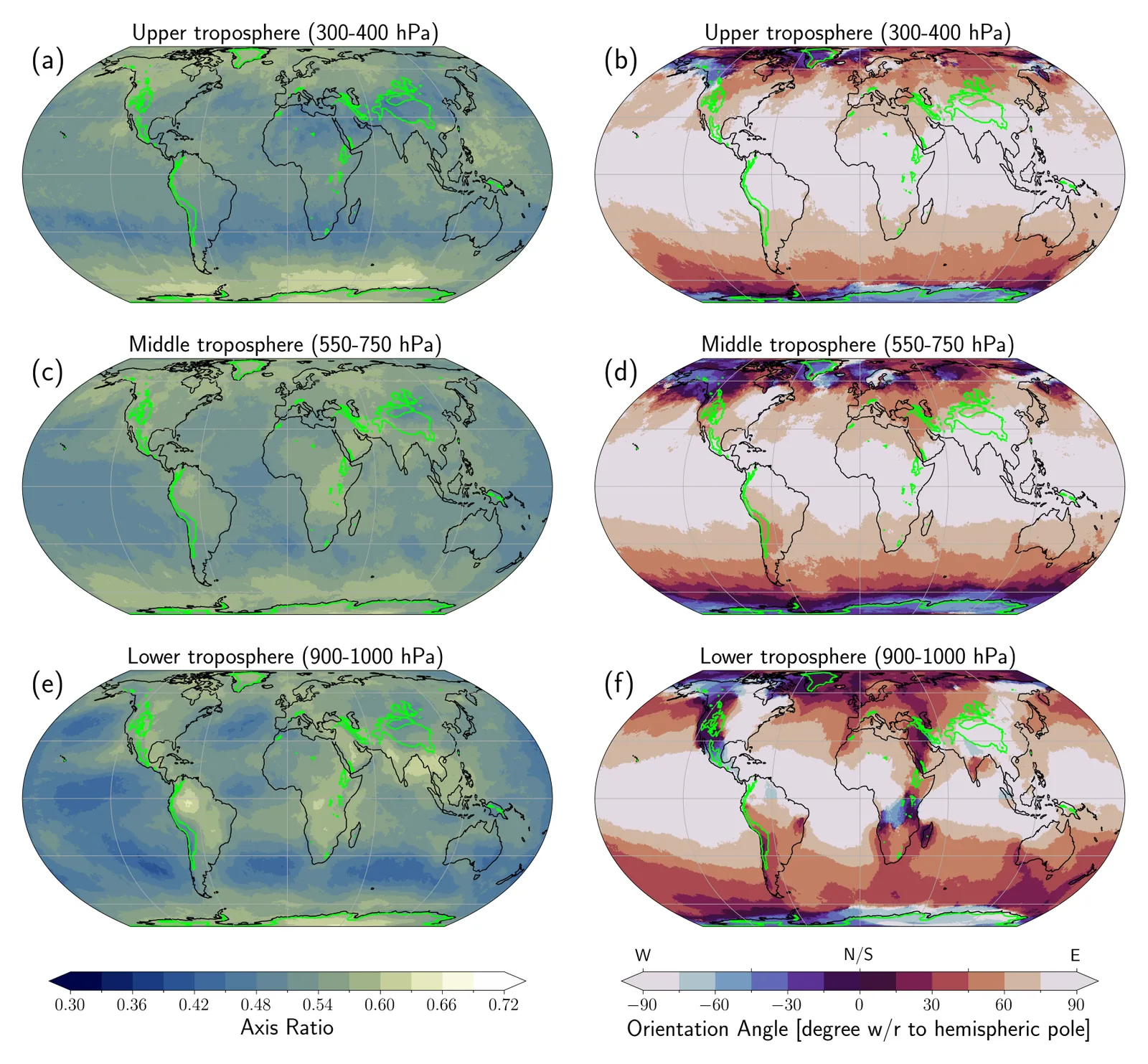
- Cells are ellipses with an axis ratio of 0.5–0.6 at all levels, and very few are near-circular. Medians at the surface are 0.57 over land and 0.51 over ocean.
- Orientation is zonal in the tropics and leans poleward in mid-latitudes, at about 60° from the pole direction, matching the direction of anticyclonic wave breaking. Near the surface, mountain ranges alter the orientation.
- Larger cells tend to be more intense, most clearly in the mid-troposphere. At the surface, the link is weaker for mean intensity and is slightly negative in western Europe.
Limitations
- Statistics at upper levels are biased towards taller, likely more intense, stacks because levels with no cell are left out, except for area. Nearby tropical anomalies can merge cells, which the authors say limits the method there.
- Results depend on choices such as the 95th percentile and the size limits. Most quantitative results are sensitive to the percentile. The authors also say the ellipse is less accurate for irregular cells.
- Explanations for tropical orientation, the topography effect and the weak surface correlation are hypotheses that the authors have not tested. This is a preprint that has not been peer reviewed.
Glossary
- Heat cell: A connected region where the daily temperature anomaly exceeds the local 95th percentile.
- Temperature anomaly: The difference between the temperature and a moving climatological average for that place, level and time of year.
- Axis ratio: Ratio of the short to the long axis of a fitted ellipse; 1 is a circle.
- Anticyclonic wave breaking: A process in which an upper-level ridge in the large-scale flow folds over, often creating persistent ridges that favor surface heat extremes.
Original paper
A global description of the three-dimensional structure of temperature anomalies during heat extremes
EGUsphere · 15 October 2026
This paper is a preprint. It has not been peer reviewed, and its results may change.
AI-generated summary of the original article; changes were made. Check the original before relying on it.