Volatile exhaust particles can greatly raise contrail ice crystal numbers in low-soot engines
In models, volatile particles formed in the exhaust plume can activate and make many more contrail ice crystals when soot emissions are low, especially with sulfur-rich particles at cold temperatures.
Why it matters
Global contrail simulations currently leave out volatile plume particles. The authors find this may underestimate ice crystal numbers and contrail warming, especially for lean-burn engines. The results also point to possible ways to cut ice crystal numbers: lower fuel sulfur, fewer organic emissions, and avoiding cooler air.
What they did
The authors added volatile plume particles to a simple contrail model (K15). They also changed a more detailed cloud parcel model (pyrcel) to simulate contrail formation, and used it as a benchmark. They compared the two models. Then they used the detailed model to test how ice crystal numbers respond to soot emissions, volatile particle properties, ambient temperature and aircraft or fuel properties.
Key findings
- The two models agree within 10 %–30 % in the soot-poor regime, but differ by up to 60 % in the soot-rich regime because they treat droplet growth differently.
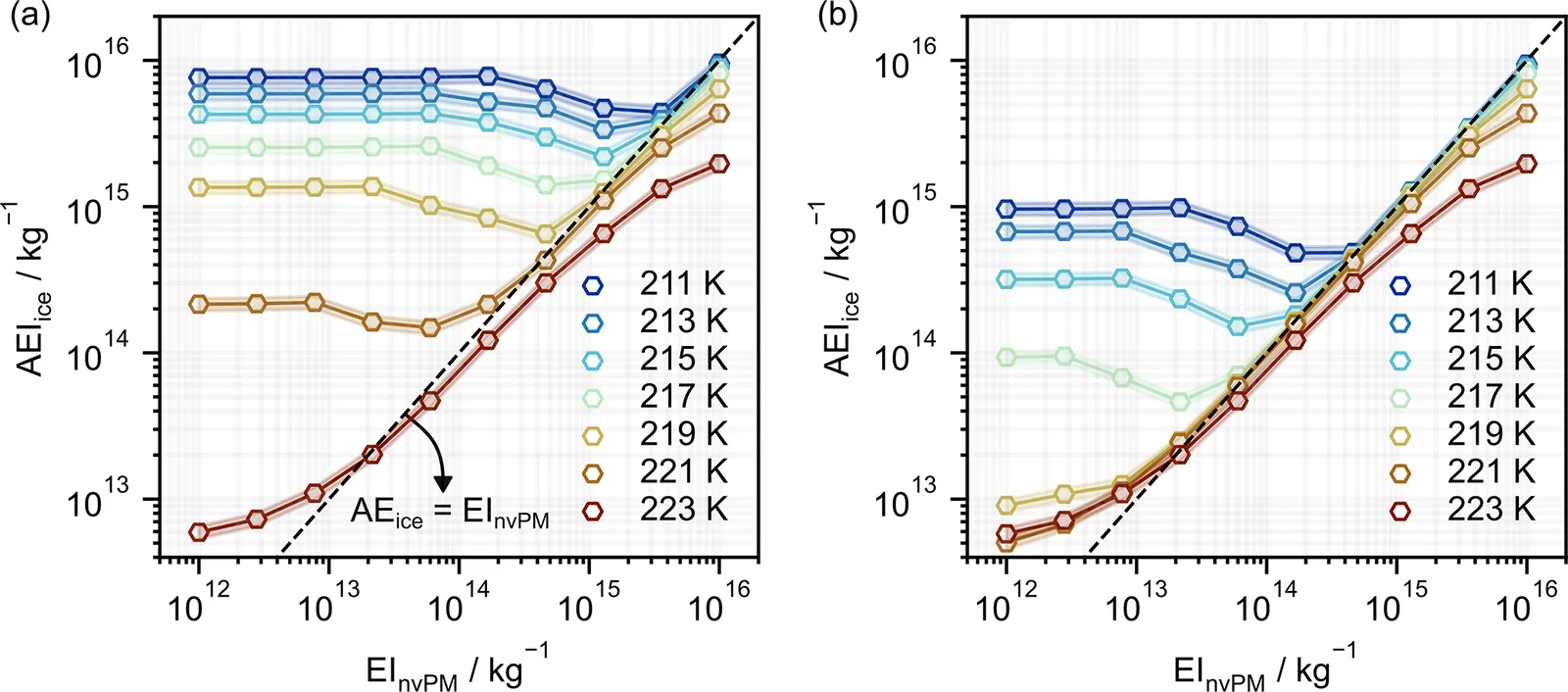
- In the soot-poor regime, including volatile particle activation could raise ice crystal emission index by up to 3 orders of magnitude.
- With sulfur-rich volatile particles and ambient temperature below 210 K, the ice crystal emission index approaches 1016 kg−1, similar to soot-rich estimates.
- The soot-rich versus soot-poor boundary is not fixed. It ranges from 1013 to 1016 kg−1 and depends on ambient temperature and volatile particle properties.
- Organic-rich volatile particles can cut ice crystal numbers by up to a factor of 100 compared with sulfur-rich ones.
Limitations
- Volatile particle properties (size, composition, hygroscopicity) are prescribed, not predicted, and are highly uncertain. A global simulation using the extended K15 model would only be a sensitivity study.
- The simple K15 model leaves out the Kelvin effect in droplet growth and the competition between particle types, so it underestimates peak supersaturation.
- Conclusions on avoiding cooler air are untested against experiments, and the models need validation with in situ data.
Glossary
- Volatile particulate matter (vPM): Liquid exhaust particles, such as sulfuric acid and organics, that evaporate when heated.
- nvPM: Non-volatile particulate matter, mainly soot, that survives heating.
- AEIice: Apparent emission index of ice crystals: ice crystals formed per kilogram of fuel burned.
- Schmidt–Appleman criterion (SAC): The rule that sets the warmest ambient temperature at which a contrail can form, based on plume mixing and water saturation.
Original paper
An updated microphysical model for particle activation in contrails: the role of volatile plume particles
Atmospheric Chemistry and Physics · 19 December 2025
AI-generated summary of the original article; changes were made. Check the original before relying on it.