A record-strength 2026/27 El Niño is about six times more likely in today's climate
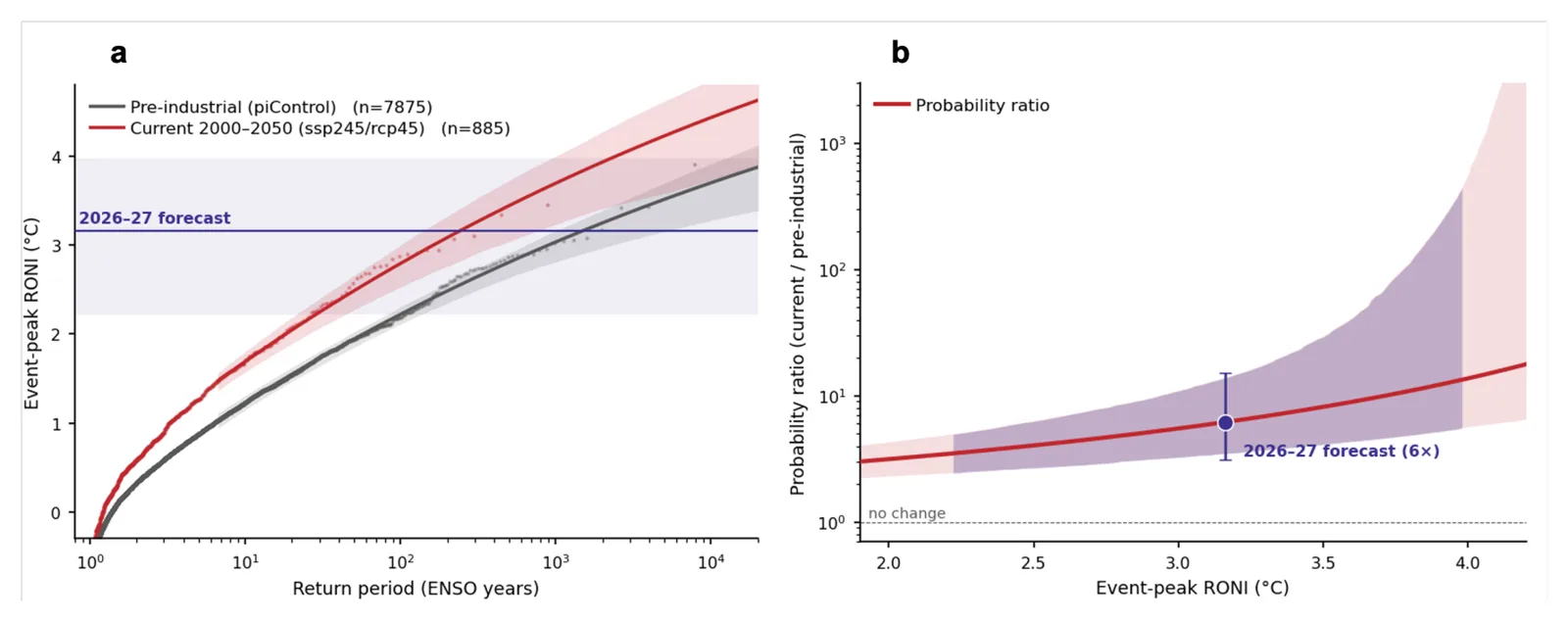
If the August 2026 forecasts are right, the 2026/27 El Niño would beat every event since 1870, and an event that strong is about six times more likely now than before industrial warming.
Why it matters
Strong El Niño events disrupt weather, farming and fisheries, and the economic losses last for years. The study applies event attribution to El Niño itself, not just to the heatwaves and floods it drives. The authors argue that planning should use a shifting baseline of El Niño risk, not a historical one.
What they did
The authors used the relative Niño3.4 index (RONI), which removes background tropical warming. They corrected August 2026 forecasts from four models (70 members) for the tendency of models to overstate El Niño strength. They then compared pre-industrial and current-climate simulations from 18 CMIP5 and CMIP6 models, chosen because they reproduce the observed skew toward strong El Niño events. They fitted generalised Pareto distributions to the annual peak values to estimate how much more likely an event of the forecast size has become.
Key findings
- The corrected forecast peaks at 3.16°C. That beats the 1982/83 record of 2.65°C (average of four datasets), and 84% of forecast members exceed it.
- An event this strong occurs about once in 1500 years in pre-industrial simulations and about once in 240 years in the current climate, a probability ratio of 6.2 (3.1–15.2).
- A comparably rare event in the pre-industrial climate would be 0.61°C weaker than the forecast event.
- A shift in the mean state accounts for roughly two-thirds of the increased likelihood, and greater variability for the remaining third.
- Most sensitivity tests give ratios between 4 and 9. Keeping only the variability increase still gives a ratio of about two.
Limitations
- Each model contributes one realisation, and the forecast magnitude lies beyond the range of simulated current-climate maxima, so the result depends on the fitted tail. A different fit (GEV) gives a ratio of 17.3.
- Observed trends show the Niño3.4 region warming more slowly than the tropical mean, unlike most models. The authors say it is unresolved whether this is model bias or internal variability.
- Models were selected only on ENSO asymmetry, which does not guarantee a realistic response of ENSO to warming. The conclusions about the 2026/27 event itself depend on the forecast being accurate.
Glossary
- RONI (relative Oceanic Niño Index): Central Pacific sea surface temperature anomaly minus the tropical-mean anomaly, which removes background warming.
- Generalised Pareto distribution: A statistical curve for modelling how often values exceed a high threshold.
- Probability ratio: How likely an event is in the current climate divided by how likely it is in the pre-industrial climate.
- Amplitude correction: Rescaling forecasts to fix the tendency of models to overstate El Niño strength.
Original paper
Climate change has intensified exceptional El Niño events like the 2026/27 forecast
EarthArXiv · 29 August 2026
This paper is a preprint. It has not been peer reviewed, and its results may change.
AI-generated summary of the original article; changes were made. Check the original before relying on it.