A warmer North Atlantic tracks rising western European heatwaves under similar weather patterns
Western European heatwave days have risen since the 1990s mainly because a warmer Atlantic background lets similar circulation patterns produce much more heat, according to this preprint.
Why it matters
The results suggest that heatwave risk can climb without any strengthening of the weather patterns that cause heatwaves. April Atlantic sea surface temperature could serve as a pre-season gauge of the background state. The authors say any forecast use would first need cross-validated skill tests against simple benchmarks.
What they did
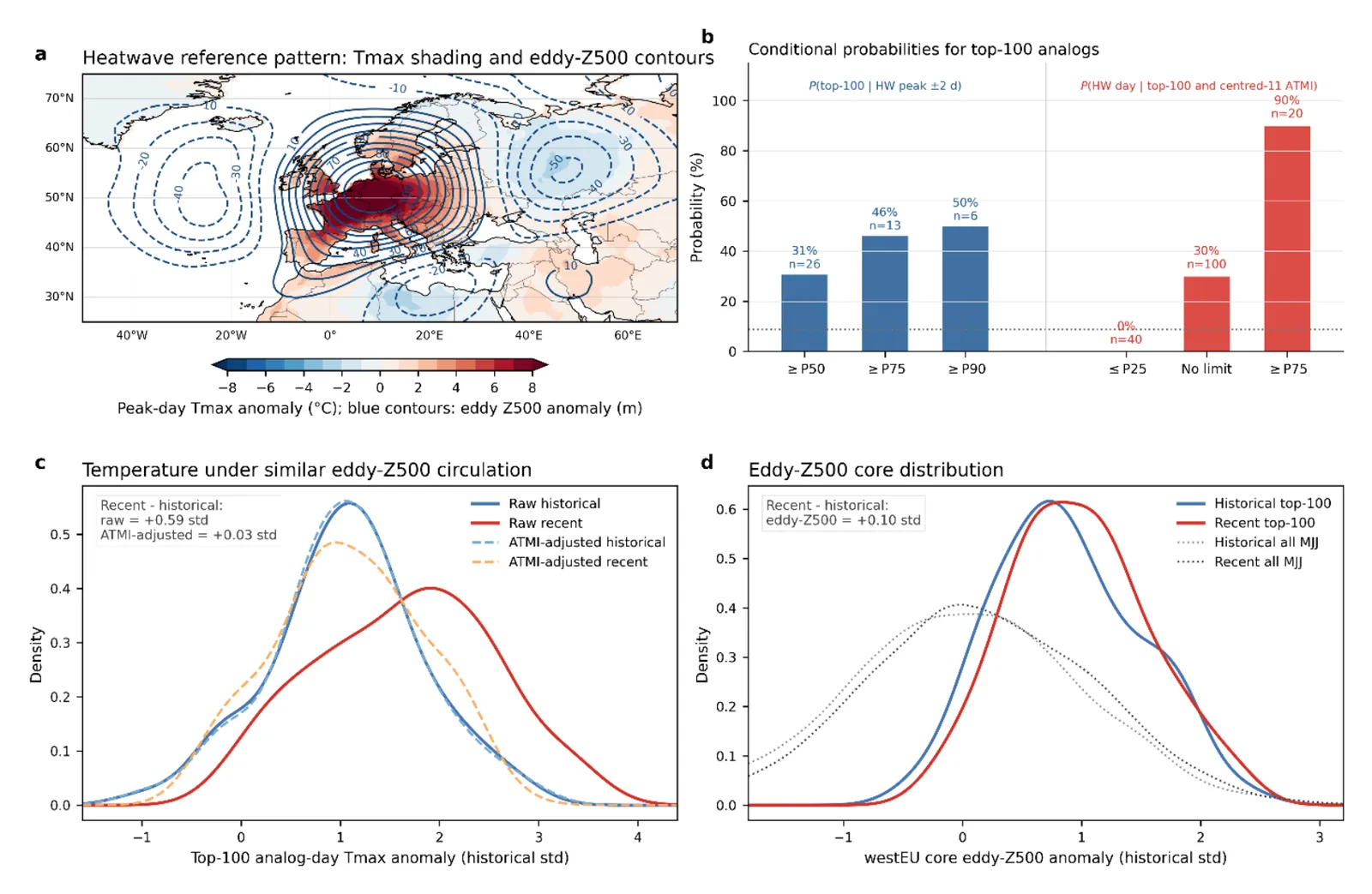
The authors used ERA5 reanalysis and NOAA ERSSTv5 sea surface temperature data for 1950–2026. They combined the two leading April North Atlantic temperature patterns into an index called ATMI. They then compared how it relates to May–July heatwave days in western Europe. To hold weather constant, they picked the 100 days closest to a typical heatwave pressure pattern in each of two periods, 1950–1990 and 1991–2026. They compared temperatures on those days and removed the ATMI-linked slow temperature component statistically.
Key findings
- May–July 2026 was the warmest on record in the region, with 45 heatwave days. April 2026 had the highest ATMI in the 77-year record, at 1.7 standardized units.
- The 11-year running mean of the ATMI correlates with heatwave-day frequency at r = 0.96. The annual correlation is r = 0.64.
- On closely matched circulation days, recent events were 1.3 °C warmer than historical ones. The ridge strength differed by only 6 m.
- Removing the ATMI-linked slow temperature component cut the 1.3 °C difference to 0.1 °C.
- Among recent matched-circulation days, 18 of 20 (90%) fell in a persistent heatwave under high-ATMI conditions, against 0 of 40 under low-ATMI conditions.
Limitations
- The study is observational and has not been peer reviewed. It cannot show whether the ocean drives the circulation or responds to it, or separate sea surface temperature forcing from wider coupled variability.
- The slow Atlantic background may mix external forcing and internal variability, and the analysis cannot separate them. The high-versus-low ATMI contrast partly reflects change across the recent period itself.
- The authors note that serial dependence, event clustering, the choice of reference pattern and overlapping slow forcings affect uncertainty. The ATMI as a forecast tool has not been tested.
Glossary
- ATMI (Atlantic Two-Mode Index): An index built from two leading April North Atlantic sea surface temperature patterns, weighted by their link to May–July western European temperature.
- EOF: Empirical orthogonal function, a method that pulls the main recurring spatial patterns out of a gridded dataset.
- Flow analogues: Days picked because their atmospheric circulation closely resembles a chosen reference pattern, so other factors can be compared.
- Z500: Height of the 500-hPa pressure level, a standard measure of mid-level atmospheric circulation. Positive anomalies mean ridging.
Original paper
A Changing North Atlantic Background Amplifies Western European Heatwaves
EarthArXiv · 7 September 2026
This paper is a preprint. It has not been peer reviewed, and its results may change.
AI-generated summary of the original article; changes were made. Check the original before relying on it.