Amazon heat and water-deficit extremes are rising much faster than average trends
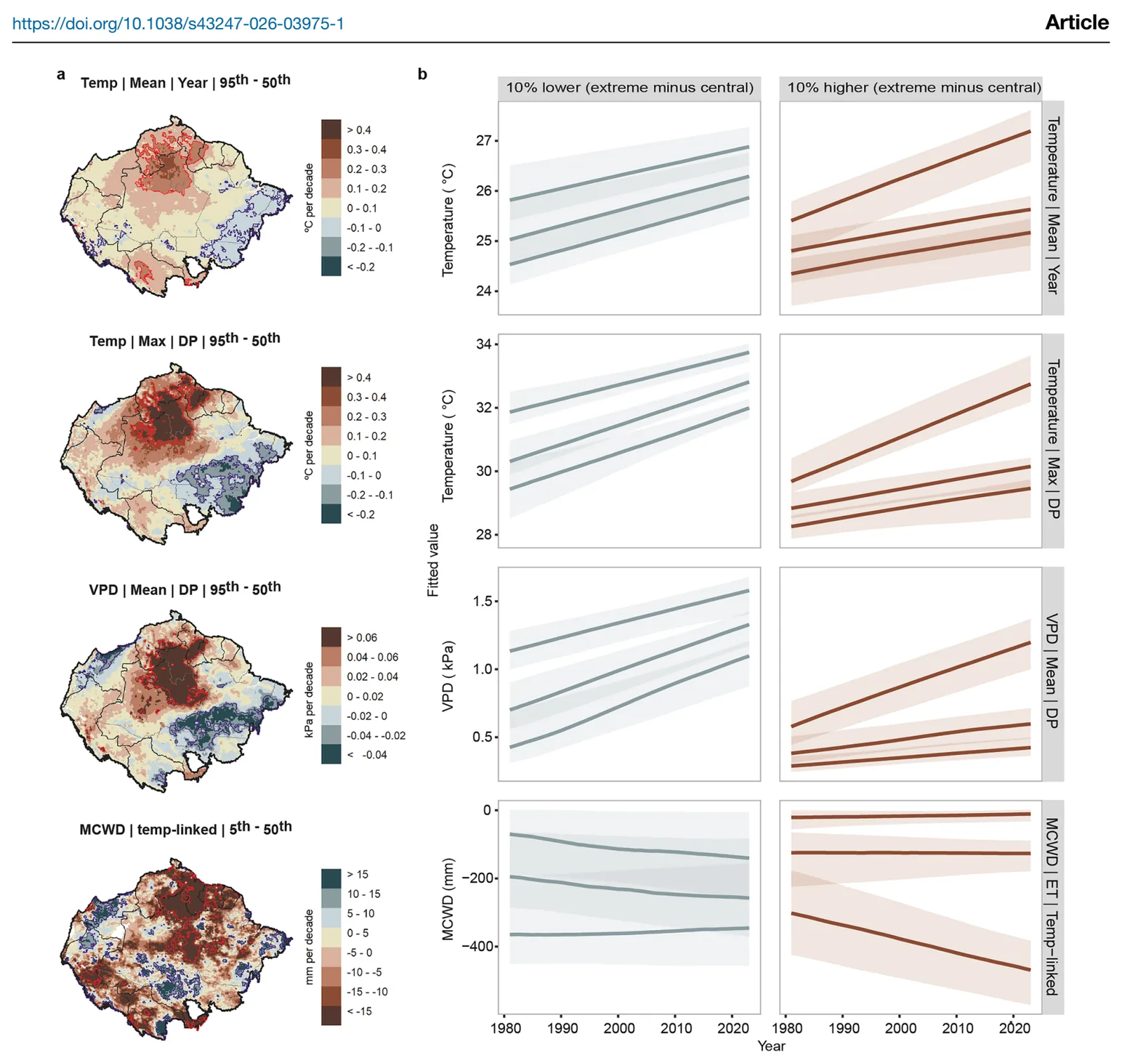
Across Amazonia from 1981 to 2023, extreme heat and temperature-linked water deficit rose much faster than average conditions, fastest in the central-north.
Why it matters
Average warming understates the change in extremes, which drive forest fire, tree death and harm to people. The fastest extreme change is in the central-north, a region rarely flagged as at risk and far from the main deforestation zone. The authors argue that adaptation must prevent further deforestation and disturbance there, and that emissions must fall.
What they did
The authors used ERA5-Land temperature and humidity data and CHIRPS rainfall data for 57,900 grid cells (11 km) over 1981 to 2023. Each cell got its own hydrological year, starting at its wettest pentad (5-day period). They fitted quantile models to get trends at the 5th, 50th and 95th percentiles. They computed water deficit two ways: with fixed evapotranspiration, and with evapotranspiration that rises with temperature.
Key findings
- Annual mean temperature rose 0.21 °C per decade, but the 95th percentile of maximum temperature in the driest period rose 0.49 °C per decade.
- Vapour pressure deficit in the driest period rose 0.08 kPa per decade at the 95th percentile, against 0.06 kPa per decade for the central trend.
- Temperature-linked water deficit at the 5th percentile changed by -12.75 mm per decade, twice the central trend; the fixed-evapotranspiration version showed no directional trend.
- Over 700,000 square kilometres in central-north Amazonia saw dry-season extreme temperature rise by at least 0.75 °C per decade.
- Rainfall did not fall broadly; it increased slightly on average. Temperature, not rainfall, drove most of the rise in water stress.
Limitations
- Results rest on reanalysis and satellite-blended rainfall data. CHIRPS correlates only 54% with rain gauges, and the two sources disagree on rainfall trends.
- The temperature-linked water deficit relies on an uncertain evapotranspiration estimate from one modelling study, and the effect of CO2 on evapotranspiration remains unresolved.
- The causes of the central-north increase are not identified and need further study.
Glossary
- Quantile (percentile) trend: The rate of change of a chosen part of a distribution, such as the 95th percentile for extremes or the 50th for the central trend.
- Vapour pressure deficit (VPD): The gap between how much water vapour the air holds and how much it could hold, a measure of how dry the air is.
- Maximum cumulative water deficit (MCWD): The largest build-up of water shortfall in a year, when evapotranspiration exceeds rainfall.
- Pentad: A 5-day period, used here to split the year into 73 slices.
Original paper
Rapid increase of climate extremes reveals new areas of concern in Amazonia
Communications Earth & Environment · 10 September 2026
AI-generated summary of the original article; changes were made. Check the original before relying on it.