Balloon profiles near Houston show cloud-seed particle counts vary by air mass and height
Over Houston, the number of particles able to seed clouds depends strongly on where the air came from and on boundary-layer depth, and weather can change both at once.
Why it matters
Studies that link aerosols to cloud changes can mislead if they ignore air-mass origin and boundary-layer dynamics. In the 6–7 September case, the same circulation changed both the weather and the aerosol. The authors say this means forecasting should first get boundary-layer circulations and cold pools right.
What they did
The team analyzed 149 tethered balloon flights in summer 2022 near Houston, part of the TRACER campaign. They sorted air masses into three groups with back-trajectories and k-means clustering. They estimated cloud condensation nuclei (CCN) from measured particle size distributions using κ-Köhler theory, with ground-level chemistry assumed to apply at all heights. They compared the profiles with radiosonde boundary-layer heights, lidar-based retrievals, particle analysis and a 6–7 September case study.
Key findings
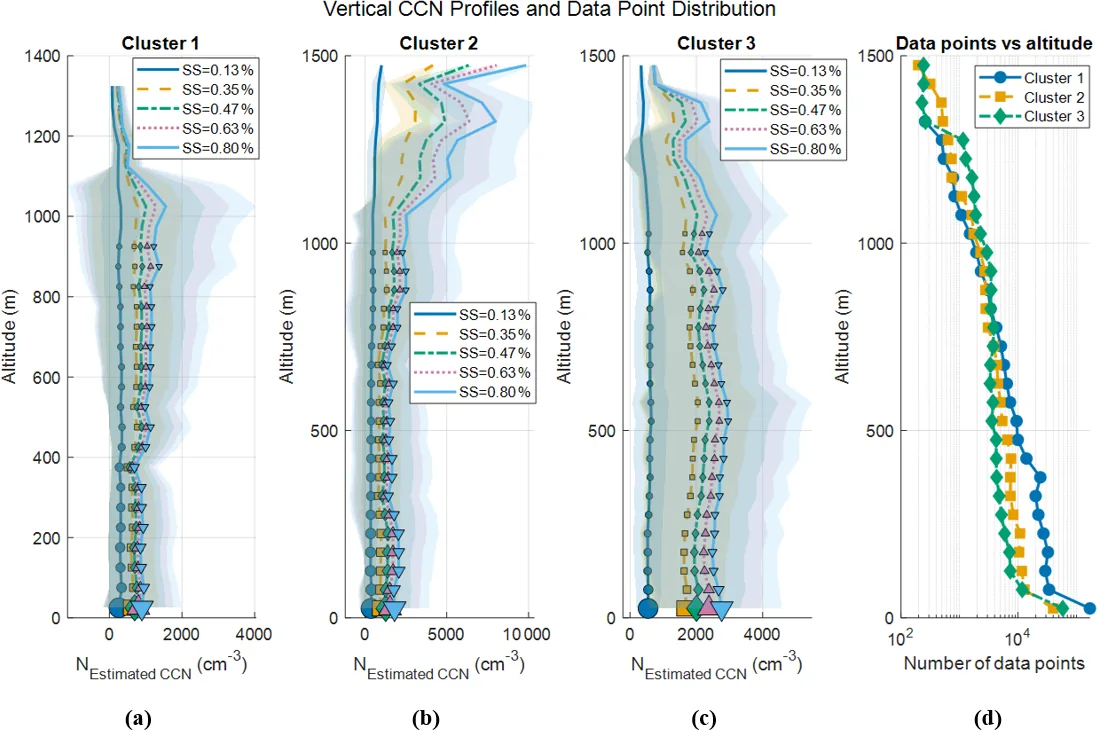
- Marine air (cluster 1) had the lowest CCN, below 1000 cm-3 at 0.8 % supersaturation, and was fairly uniform with height.
- Urban and long-range air (cluster 3) had the highest CCN within the boundary layer, reaching about 3000 cm-3 at 0.8 % supersaturation.
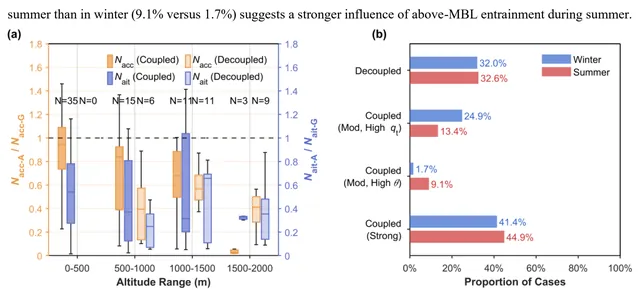
- Mixed marine–urban air (cluster 2) often showed a decoupled layer aloft, with CCN above 5000 cm-3 near the boundary-layer top.
- On 6 September the balloon sampled two stacked air masses: a recirculated coastal layer below and cleaner marine air with dust above 1000 m.
- On 7 September CCN rose 5–10 times, but the moisture, instability and lifting that brought storms arrived with the same air, so aerosol effects cannot be isolated.
Limitations
- CCN were inferred from size distributions and ground-level chemistry, not measured directly, so assumed hygroscopicity and mixing state add uncertainty.
- Few samples were collected aloft and the balloon sees only one location, so the elevated-layer results are indicative rather than definitive.
- Observations cover summer only, and back-trajectories give statistical air-mass classes, not firm source attribution.
Glossary
- Cloud condensation nuclei (CCN): Aerosol particles that water vapor can condense onto to form cloud droplets.
- Tethered balloon system (TBS): A helium balloon on a winch that carries instruments up and down to about 1.5 km to measure the lower atmosphere.
- κ-Köhler theory: A method that predicts which particles will become cloud droplets from their size and how readily they take up water.
- Back-trajectory: A modeled path showing where an air parcel came from before reaching a site.
Original paper
Synthesis of the tethered balloon system and other TRACER campaign measurements elucidates aerosol property profiles
Atmospheric Chemistry and Physics · 5 October 2026
AI-generated summary of the original article; changes were made. Check the original before relying on it.