Climate change roughly tripled smoke pollution and deaths in the July 2026 fire event
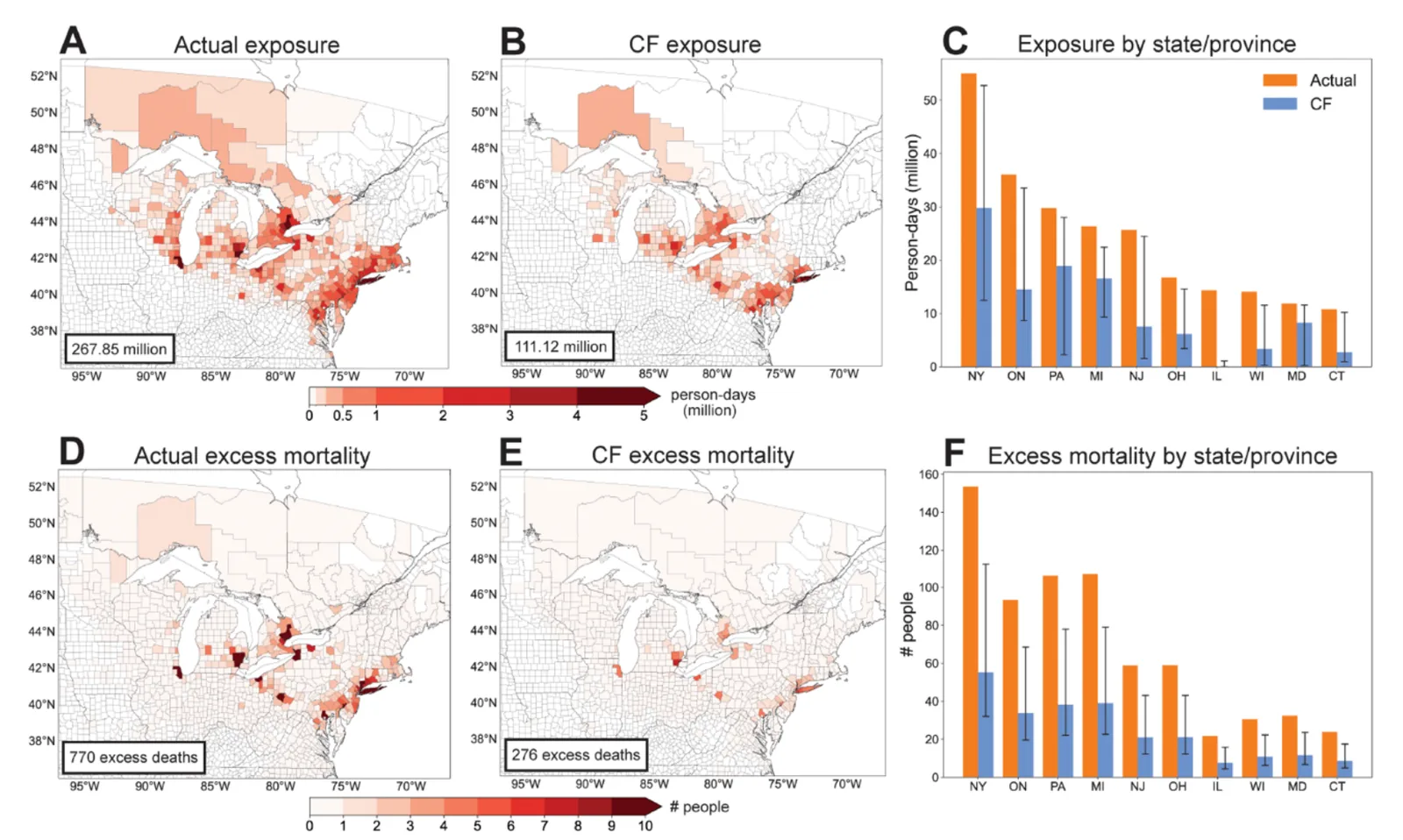
A rapid attribution study estimates that human-caused climate change made the July 2026 wildfire smoke event about three times more harmful, with 770 excess deaths versus 276 in a world without climate change.
Why it matters
The study links climate change to the health toll of one specific smoke event, not just to fire area. The authors say the approach could be reused after other smoke events. It could help place their health costs in the context of a changing climate.
What they did
The authors modeled burned area in western Ontario and northern Minnesota from fire-weather and dryness variables. They removed the human climate signal using 12 CMIP6 climate models and compared actual and counterfactual burned area. The ratio, 2.86, was used to scale down smoke PM2.5 from the HRRR-Smoke model. They then estimated exposure above 35 µg/m3 and excess deaths for 14–21 July with a concentration-response function.
Key findings
- Wildfires burned 3642 km2 during 13–16 July, the largest 4-day burned area in this region in 2001–2026.
- Climate change raised burned area and smoke PM2.5 by a factor of 2.86 (IQR: 1.38–4.97).
- Exposure above 35 µg/m3 totaled 267.85 million person-days, of which 157 million are attributed to climate change.
- The estimate is 770 excess deaths, against 276 (IQR: 160–564) in the counterfactual.
- New York was hit hardest, with 55 million person-days of exposure and an estimated 153 excess deaths.
Limitations
- Smoke is scaled linearly with burned area instead of simulating emissions, chemistry and transport. Possible climate effects on the large-scale winds that carried the smoke are not explored.
- The burned-area models are simple linear models and may miss complex processes tied to fuels, ignition and fire behavior.
- Death estimates depend strongly on the concentration-response function: 393–1410 in the actual case, depending on the function. This is a non-peer-reviewed preprint, and the study covers short-term deaths only.
Glossary
- Rapid attribution: A fast analysis that estimates how much climate change altered a specific recent event.
- Counterfactual: A model world without human-caused climate change, used for comparison.
- PM2.5: Fine airborne particles small enough to be breathed deep into the lungs.
- Concentration-response function: A formula linking a pollution level to the added risk of death.
Original paper
The July 2026 North American wildfire smoke event was three times deadlier due to climate change
EarthArXiv · 13 October 2026
This paper is a preprint. It has not been peer reviewed, and its results may change.
AI-generated summary of the original article; changes were made. Check the original before relying on it.