Droughts grow more frequent in Mediterranean and southern Africa, fewer in Central Africa
Climate models project more frequent, longer droughts over the Mediterranean, Southern Africa and Madagascar as warming rises, with different physical causes in each region, and limiting warming to 1.5 °C would avoid much of the impact.
Why it matters
Planners need to know where droughts will worsen and why. The regional drivers differ, so adaptation should be region-specific. The results also put numbers on the people and economic output exposed at each warming level, and on the benefit of holding warming to 1.5 °C.
What they did
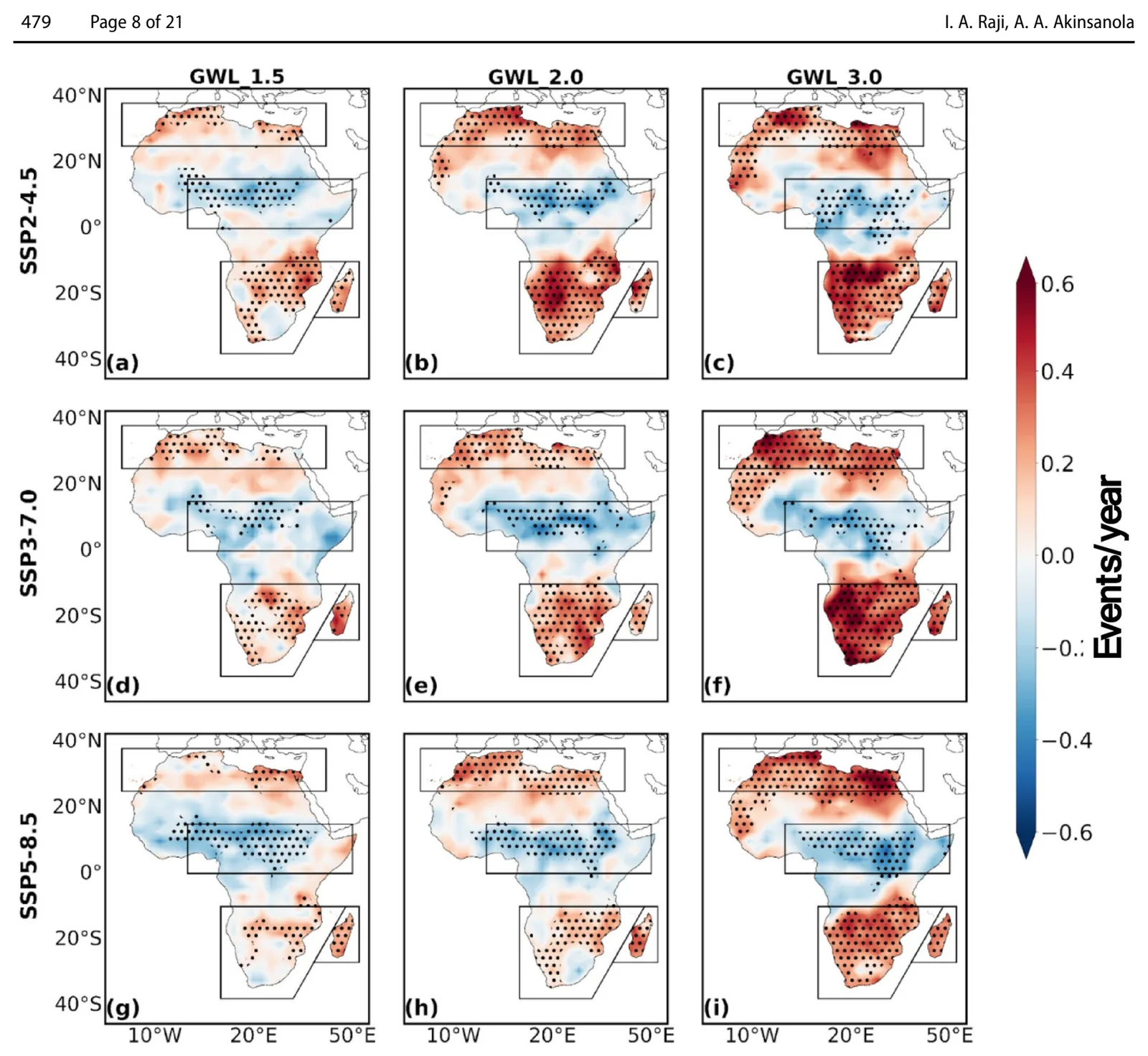
The authors used 31 CMIP6 climate models, with historical runs for 1965–2014 and three emission scenarios to 2099. They found droughts with a 3-month drought index (SPEI below −1.5) at 1.5, 2 and 3 °C of global warming. They split model uncertainty from scenario uncertainty and internal variability, and estimated when the signal emerges from natural variability. A moisture-budget breakdown separated circulation effects from moisture effects. They combined drought frequency with population and GDP data to estimate exposure.
Key findings
- Drought frequency and duration rise robustly over the Mediterranean, Southern Africa and Madagascar at all warming levels and scenarios, and fall over Central Africa.
- Drought intensity generally rises, but most of these changes are not robust because models disagree.
- Model uncertainty is the largest source of uncertainty, at over 60% of total variance by the end of the century.
- The drivers differ by region. Mediterranean drying is linked to the vertical thermodynamic term. Southern Africa is linked to reduced evaporation. Madagascar is linked to reduced evaporation plus vertical circulation.
- At 3 °C, more than 200 million people and USD 30 billion in GDP are exposed across the three regions, and limiting warming to 1.5 °C could avoid about 70% of these impacts.
Limitations
- Model disagreement is large, so the intensity changes and the Central Africa precipitation response during droughts are not robust.
- The main drought index uses a temperature-based evaporative demand estimate (Hargreaves), which leaves out radiation, humidity and wind. A Penman-Monteith check gave stronger drought increases, especially over the Mediterranean.
- Models were treated as equally plausible and not weighted, and only one ensemble member per model was used.
Glossary
- SPEI: Standardized Precipitation Evapotranspiration Index, a drought measure that weighs rainfall against the atmosphere’s demand for water.
- Global warming level (GWL): A fixed amount of global temperature rise above pre-industrial, such as 1.5 °C, used to compare outcomes regardless of year.
- Time of emergence: The first year when the climate-change signal in a measure becomes larger than natural variability.
- Moisture budget: An accounting of rainfall change into parts from winds and vertical motion, from air moisture content, and from evaporation.
Original paper
Dynamic and thermodynamic drivers of regional drought changes in Africa under different global warming levels
Climate Dynamics · 26 October 2026
AI-generated summary of the original article; changes were made. Check the original before relying on it.