Event-scale checks show WRF-HAILCAST reproduces hail swaths in about half of 1,502 events
When hail is judged at the scale of whole storm events rather than single cells, WRF-HAILCAST matches observed hail swaths in 50.87% of events, and most errors trace to storm placement, storm core development and hail growth rather than to CAPE or shear.
Why it matters
Cell-by-cell checks punish a model heavily when a storm is slightly misplaced, so they can understate its skill. The event-scale approach shows where in the model chain errors arise. That points developers to specific fixes, such as hail growth for very large hail.
What they did
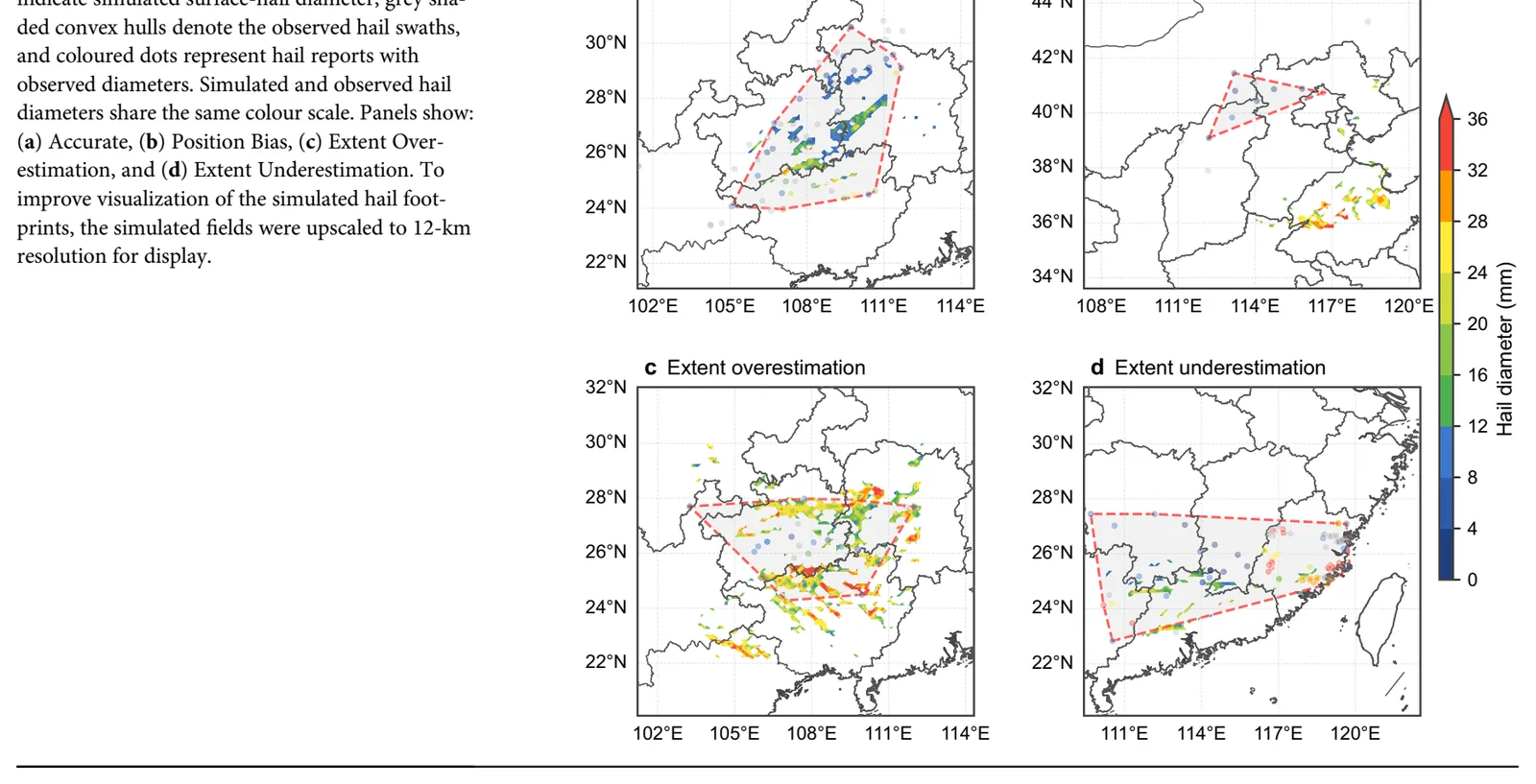
The authors grouped more than 110,000 surface hail reports in China (1980–2021) into 1,502 hail events with a clustering method. They simulated each event, plus 1000 hail-free controls, with WRF v4.5.1 coupled to HAILCAST at 3 km grid spacing, driven by ERA5. They sorted each simulated hail footprint into Accurate, Position Bias, Extent Overestimation or Extent Underestimation. They then compared hail-size distributions and storm conditions across these groups.
Key findings
- 20.51% of events were Accurate and 30.36% showed Position Bias, so 50.87% reproduced the swath shape. Median displacement in Position Bias cases was 206 km.
- Among the analysed events, 43.8% had hail sizes consistent with observations. 16.3% were clearly underestimated, mostly for hail above 40 mm. Median surface hail was 14.5 mm in the model versus 9.0 mm observed.
- Extent overestimation (9.45% of events) was not mainly due to a prolonged hail lifecycle: 69.0% of out-of-swath hail occurred while in-swath hail was active.
- Extent underestimation (29.89% of events) tracked hail activation and growth more than CAPE or shear. Correlations with coverage ratio were 0.64 for column-hail coverage and 0.74 for hail-growth intensity.
- Only 2.9% of the 1000 hail-free controls produced surface hail.
Limitations
- Without radar data, the authors cannot tell whether strong simulated convection outside the observed swath was real or a model error.
- The boundary between Accurate and Extent Underestimation is not physically sharp and depends on the chosen coverage threshold.
- Observations come from surface stations, which are sparse and can miss hail that fell between them.
Glossary
- HAILCAST: A hail growth scheme run on top of WRF storm fields to estimate hailstone size reaching the ground.
- Coverage ratio (CR): The fraction of the observed hail swath that is covered by simulated surface hail.
- CAPE: Convective available potential energy, a measure of the buoyant energy available to storms.
- DBSCAN: A clustering method that links nearby points into groups and treats isolated points as noise.
Original paper
A new event-scale evaluation framework suggests underestimated skill of WRF-HAILCAST model in climatological hail simulations
npj Climate and Atmospheric Science · 16 September 2026
AI-generated summary of the original article; changes were made. Check the original before relying on it.