Fewer low clouds and weaker cloud–radiation effects drove the 2022 ozone jump in eastern China
In the Yangtze River Delta, the sharp rise in summer ozone in 2022 came mainly from fewer low clouds and more sunlight, which outweighed the gains from cutting emissions.
Why it matters
Cutting ozone precursor emissions may not be enough in years with clear skies and strong sunshine. Warming projections point to fewer clouds and more sunlight, which could make ozone harder to control. The authors say forecasts of ozone pollution should track low cloud and sunlight, and emission cuts should be stricter when cloud effects are weak.
What they did
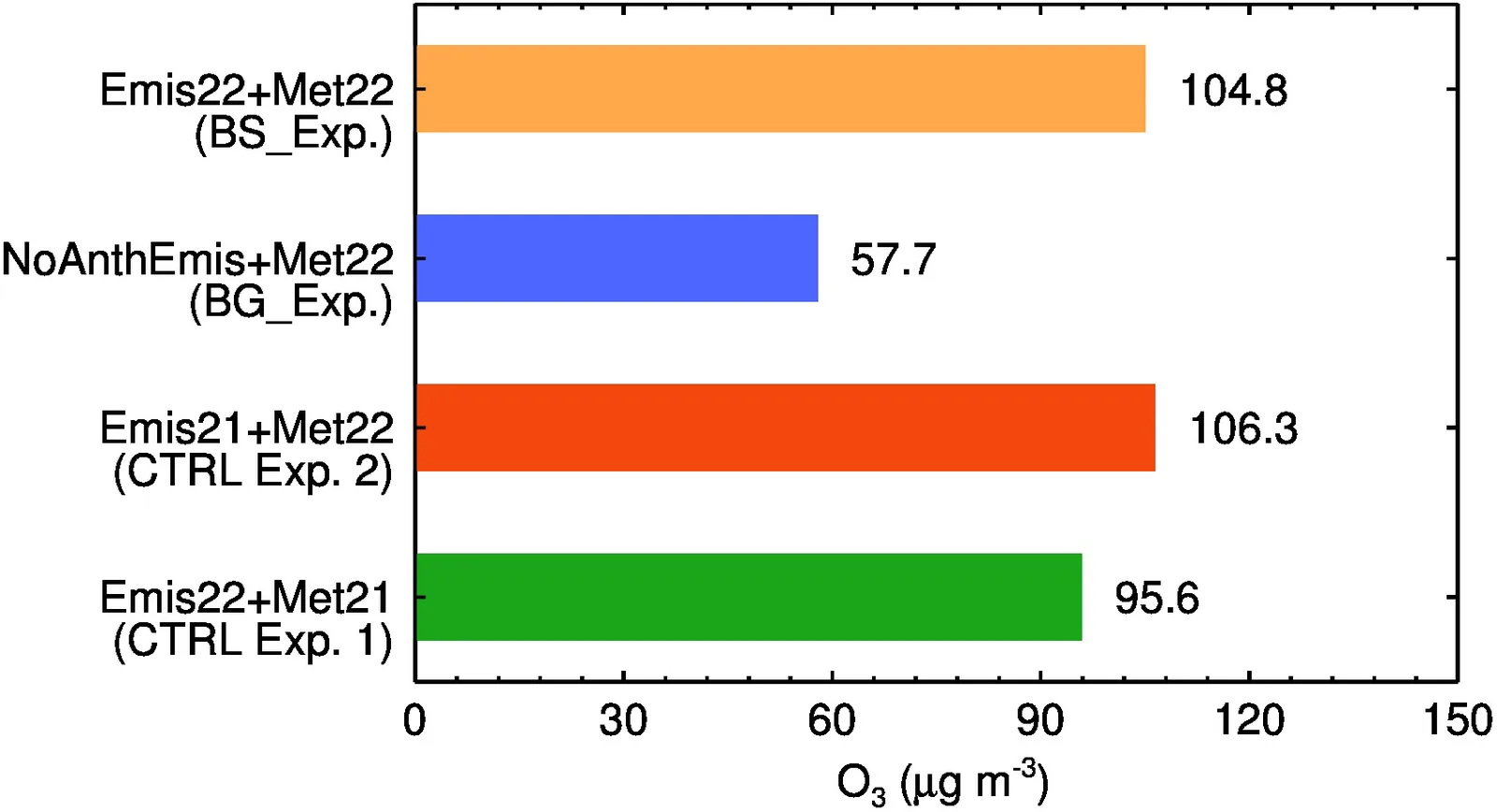
The authors compared 10 years of ground ozone measurements with ERA5 reanalysis data on low cloud cover and surface sunlight. They then ran the WRF-Chem regional model for July 2022 and July 2021. Runs with and without cloud effects on photolysis, and with different emissions and weather, separated the causes of the ozone change. They also looked at 41 CMIP6 climate models under three emission scenarios to see how sunlight and cloud might change.
Key findings
- Observed warm-season daytime ozone correlates positively with surface sunlight (r=0.85) and negatively with low cloud cover (r=-0.90) over the past decade.
- In July 2022, low cloud cover fell by 63.6 % and surface sunlight rose by 16.7 % compared with July 2021.
- Weather differences raised ozone by 9.2 µgm-3, while the 2022 emission cuts lowered it by only 1.5 µgm-3.
- A weaker cloud–radiation interaction alone added 2.9 µgm-3, which is 31.5 % of the weather-driven rise.
- CMIP6 models show rising sunlight under all three scenarios, and fewer clouds under SSP2-4.5 and SSP5-8.5, which would weaken the cloud effect on ozone.
Limitations
- The model cannot separate the separate effects of low cloud cover and sunlight, so the authors studied the combined cloud–radiation effect instead.
- Climate projections are highly uncertain and differ from the ERA5 data in year-to-year variability. The future ozone effects are inferred, not directly simulated.
- The emission-cut estimates for 2030 and 2060 use simple linear extrapolation. The authors note that real reductions will probably be less perfect and that ozone responds nonlinearly.
Glossary
- Cloud–radiation interaction (CRI): How clouds reflect and scatter sunlight, which cuts the light reaching the ground and slows ozone-forming reactions.
- SSRD: Surface downward shortwave radiation, the sunlight reaching the ground.
- Photolysis rate: How fast sunlight breaks gas molecules apart, starting the chemistry that makes ozone.
- Ozone precursors: Gases such as nitrogen oxides and volatile organic compounds that react in sunlight to form ozone.
Original paper
Cloud–radiation interactions amplify ozone pollution in a warming climate
Atmospheric Chemistry and Physics · 9 October 2025
AI-generated summary of the original article; changes were made. Check the original before relying on it.