Methane-to-CO2 ratio over Los Angeles showed no significant trend from 2011 to 2025
Fifteen years of mountaintop sunlight measurements show the methane-to-CO2 excess ratio over Los Angeles has stayed flat, so methane has fallen no faster than CO2 and no methane-specific policy effect is visible.
Why it matters
The ratio needs no emission inventory, so it gives a simple, observation-only way to check whether methane rules change a city’s emissions. A flat ratio does not mean methane stayed constant. It means methane fell no faster than CO2-linked activity. The authors say this supports targeting leaks in the gas distribution network and landfills.
What they did
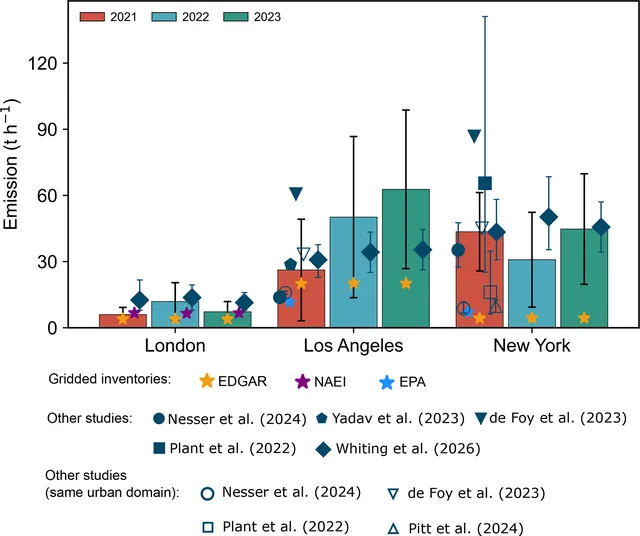
The authors extended the CLARS-FTS record, an instrument on Mt. Wilson that reads reflected sunlight over the Los Angeles Basin, through July 2025. They subtracted a free-troposphere background from in-basin CH4 and CO2 columns and tracked the excess ratio over time. They also compared station-level methane with monthly Southern California Gas Company natural-gas use by customer class. They checked the methane retrieval against the TCCON site in Pasadena.
Key findings
- The excess ratio has no significant trend over 2011–2025 (−0.005±0.006yr −1, p = 0.84). It averages about 5.1 ppb ppm −1.
- Excess CH4 and CO2 are strongly correlated (R = 0.93). The ratio peaks in winter and is lowest in summer.
- The relative pattern of methane hotspots is almost unchanged and sits near landfills and the eastern industrial corridor.
- Methane co-varies most with residential natural-gas use (R2 up to 0.43) and negligibly with commercial and industrial use.
- Both CH4 and CO2 excess signals declined by comparable relative amounts, so the changes cancel in the ratio.
Limitations
- Leftover aerosol scattering could bias the retrieved ratio, and a constant bias in the absolute slope cannot be ruled out. The CO2 comparison with TCCON is left for future work.
- The hotspot maps rest on only 9 stations and a fixed slant-path view, so the persistence may partly reflect the fixed viewing footprint.
- The ratio would miss local super-emitters that are not tied to CO2. Derived absolute emissions depend on a CO2 inventory and a biospheric correction.
Glossary
- CLARS-FTS: A spectrometer on Mt. Wilson that views reflected sunlight from 33 points across the Los Angeles Basin.
- ΔXCH4/ΔXCO2: The ratio of the methane excess to the CO2 excess in the air column over the basin, relative to the background.
- Tracer–tracer method: A way to estimate one gas’s emissions by scaling a known emission of another gas by the observed ratio between them.
- TCCON: A global network of ground-based spectrometers that measure greenhouse gas columns using direct sunlight.
Original paper
A Stable Column ΔXCH₄/ΔXCO₂ Ratio over Los Angeles (2011–2025): An Inventory-Independent Test of Urban Methane Policy
EarthArXiv · 5 October 2026
This paper is a preprint. It has not been peer reviewed, and its results may change.
AI-generated summary of the original article; changes were made. Check the original before relying on it.