Flood warning systems in northwestern Europe improved after 2021 but still differ widely
Five years after the deadly July 2021 floods, warning systems in Germany, Luxembourg, the Netherlands and Belgium have improved, but warning levels and colours still differ and impact-based forecasts are rare.
Why it matters
The 2021 flood caused more than 200 fatalities, and many people were not warned or did not act. The study points to gaps between forecast and action that matter for cross-border rivers. Its four recommendations give agencies a list of where to focus next.
What they did
The authors interviewed 14 experts from forecasting and crisis-management agencies and universities across the region. They used a questionnaire built around five warning-system pillars: data collection, forecasting, communication, decision making and response. They added reports and articles from interviewees and a non-systematic literature review.
Key findings
- All regions now use cell broadcasting for phone alerts, and all have flood emergency plans.
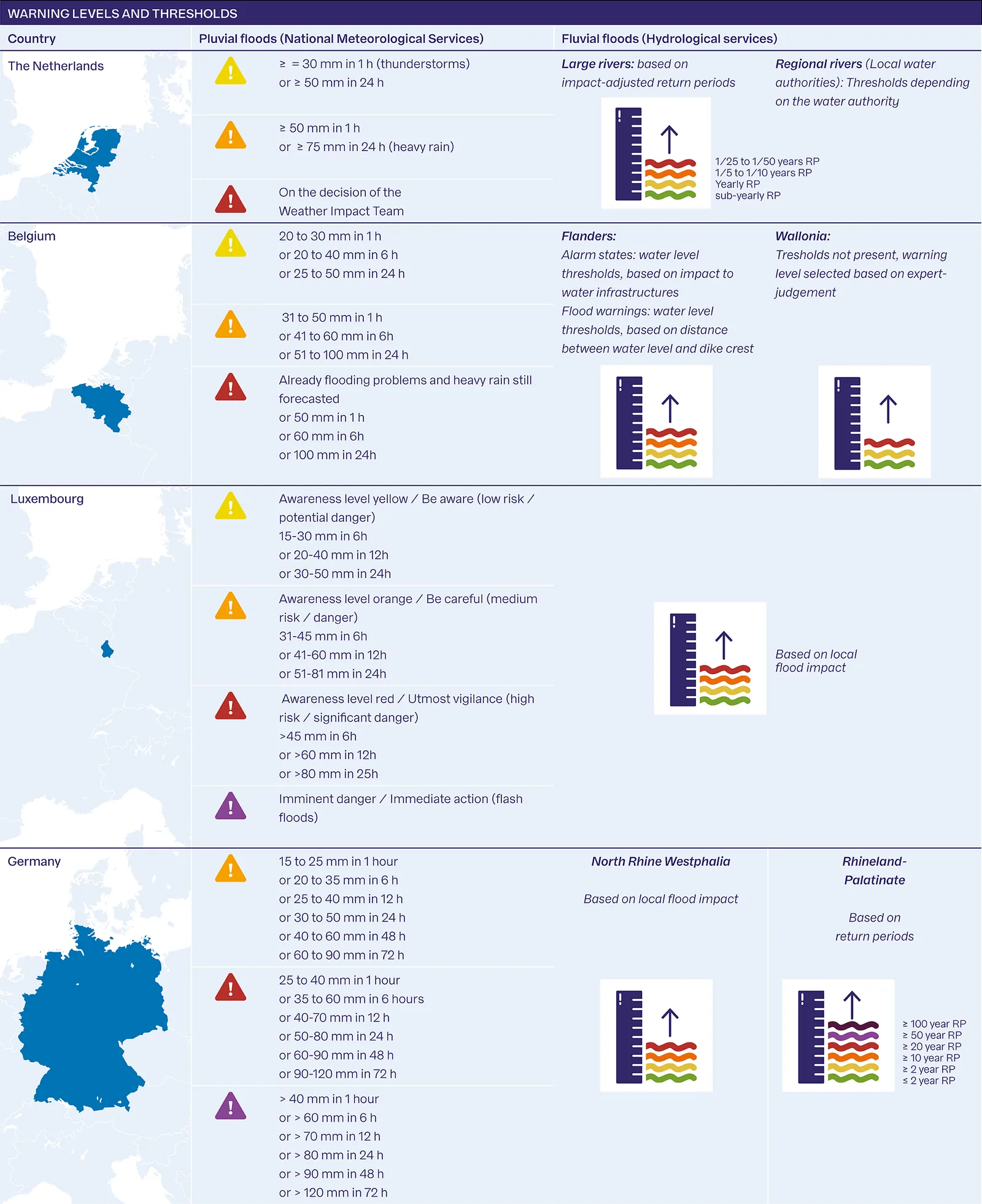
- Several regions improved thresholds. The Rhineland-Palatinate region added a dark purple level, and Luxembourg added a purple level for immediate danger.
- Warning levels, colours and threshold definitions differ between and within countries. In Wallonia, thresholds still rest on expert judgement.
- Flanders is the only region that runs flood inundation forecasts operationally.
- Interviewees reported weak communication between forecasters, crisis managers and first responders, and said the forecasts often lack impact and action information.
Limitations
- The findings rest mainly on 14 expert interviews and a non-systematic literature review, so they reflect those experts’ views.
- The authors say more research is needed to decide whether harmonizing warning levels is desirable, and it is still debated whether more warning levels help communication.
- It is not yet clear whether adding flooded-area information to warnings leads to better protective behaviour.
Glossary
- Impact-based forecast: A forecast that says what a hazard will do, such as which areas or buildings will flood, not just how much rain or water is expected.
- Cell broadcasting: A way to send alert messages to all mobile phones in an area without needing an app.
- Ensemble forecast: A set of many model runs with slightly different inputs, used to estimate how likely an event is.
- Return period: The average time between floods of a given size, such as a 100-year event.
Original paper
Comparing flood forecasting and early warning systems in northwestern Europe
Natural Hazards and Earth System Sciences · 24 March 2026
AI-generated summary of the original article; changes were made. Check the original before relying on it.