Global dust conversion factors for lidar CCN and INP profiles vary by region
A new dataset of dust conversion factors from 198 AERONET sites lets lidar profiles be turned into cloud-nucleating particle estimates, and the two retrievals compared agree within an order of magnitude.
Why it matters
Lidar can show where dust sits in the air, but cloud studies need the number of dust particles that seed droplets and ice. Region-specific conversion factors make this step more realistic than one global value. The comparison also shows that a fixed dust size distribution in a satellite retrieval gives higher CCN counts than regional factors.
What they did
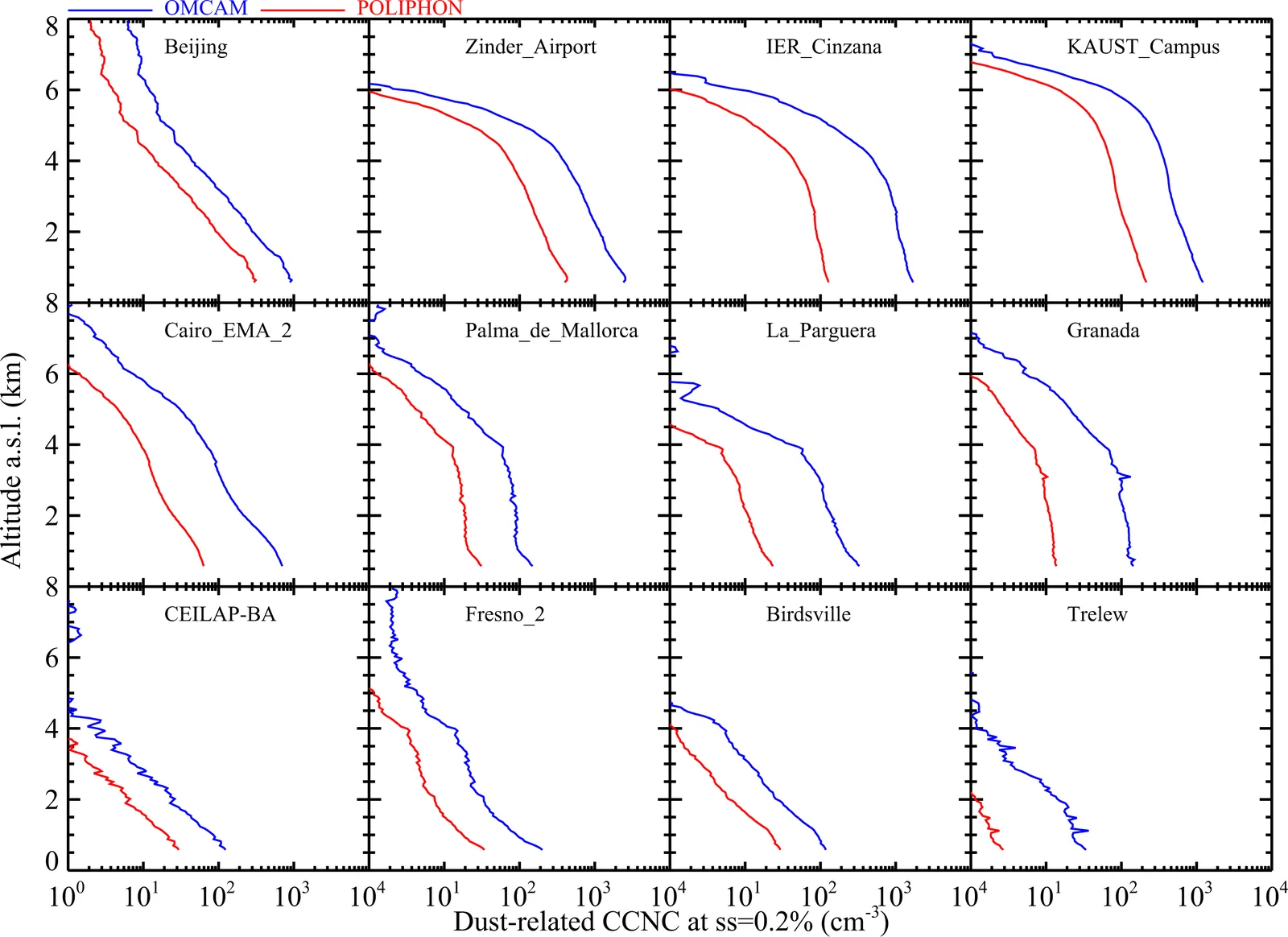
The authors used sun photometer data from 198 AERONET sites. They picked out dust cases where the column dust ratio from the 1020 nm depolarization was at least 80 %. From the size distributions and optical depths they computed conversion factors at 532 nm. They then used these factors with CALIOP dust extinction to get CCN profiles at 12 sites. They compared these with profiles from the OMCAM retrieval, which uses one fixed dust size distribution.
Key findings
- Factors for dust mass and INP were obtained at 137 sites, and factors for CCN at 123 sites. Each site needed at least 15 dust data points.
- The extinction-to-volume factor cv,d generally falls with distance from dust sources.
- The INP factors c250,d, cs,d and cs,100,d are lower near deserts and higher downstream. c250,d rises along the Saharan path toward northern Europe.
- The CCN factors c100,d and χd vary from site to site with no clear regional pattern, so region-specific values are needed.
- OMCAM CCN values were generally larger than POLIPHON values, by less than 1 order of magnitude. This is within the stated uncertainties.
Limitations
- Dust cases at 80 % dust ratio may still contain local non-dust particles, and sites far from deserts rest on few, occasional dust events that may not be representative.
- A gridded global dataset was not possible because sites are few and unevenly spread, so users should take values from the nearest site.
- The factors have not yet been checked against independent in situ, model or co-located profile data. Only CCN profiles were compared, with one other retrieval.
Glossary
- POLIPHON: A method that combines polarization lidar and sun photometer data to estimate particle-type-specific CCN and INP concentration profiles.
- CCN: Cloud condensation nuclei, particles on which cloud droplets form.
- INP: Ice-nucleating particles, particles that start ice formation in clouds.
- OMCAM: A retrieval that derives CCN concentrations from CALIPSO lidar data using one fixed size distribution per aerosol type.
Original paper
Extended POLIPHON dust conversion factor dataset for lidar-derived cloud condensation nuclei and ice-nucleating particle concentration profiles
Atmospheric Measurement Techniques · 21 October 2025
AI-generated summary of the original article; changes were made. Check the original before relying on it.