Hot and low-productivity ocean years raise the odds of extreme low fish catches
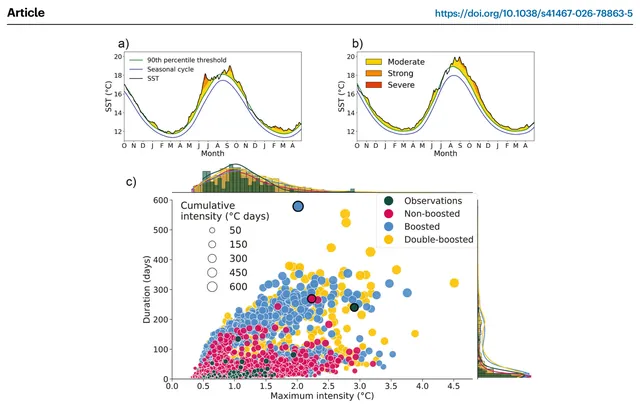
Across three decades of global data, years of extreme ocean heat and low ocean productivity, especially together, are linked to higher odds of very low local fish catches, and this risk is projected to grow by mid-century.
Why it matters
Extreme ocean events are tied to sharp local catch drops, mostly in tropical and subtropical regions and in socio-economically vulnerable countries. The projected rise looks similar under low and high emissions, so the authors argue adaptation is needed soon. They call for monitoring, early warning, adaptive harvest rules and diversified fishing.
What they did
The authors combined reconstructed catch records for 1246 species across 254 regions with ocean temperature and net primary production data from 1993 to 2019. They defined extreme years from yearly anomalies and an extreme low catch as the lowest tenth of catch anomalies. Logistic regression gave odds ratios for extreme low catch, for each extreme alone, lagged and combined. They then applied the fitted models to three Earth system models under two emissions scenarios to 2060.
Key findings
- Extreme high temperature and extreme low productivity each raised the odds of extreme low catches, and compound events had the strongest effects.
- Two consecutive years of extreme heat raised the odds of an extreme low catch by 40%. Lagged heat with concurrent record-low productivity gave odds ratios up to 1.8.
- Hotspots included eastern boundary upwelling systems, the tropical eastern Pacific, small island nations and semi-enclosed seas. Many mid- and high-latitude shelf seas showed no significant effect.
- Sharks and rays, small pelagics and commercial invertebrates were among the most sensitive groups, with median catch drops exceeding 40% during extreme events.
- The share of stocks with extreme low catches in vulnerable regions is projected to rise from about 11% in the early 1990s to almost 16% by the mid-21st century, with similar paths under both emissions scenarios.
Limitations
- The models show associations, not mechanisms. Reconstructed catch also reflects economic and management influences, and it is not a direct measure of fish biomass.
- Projections assume the historical link between extremes and catches stays stable, and they stop at 2060. Overfishing, habitat loss and deoxygenation were not included.
- Catch data quality varies by region and taxon. Fishing effort data were available only for a subset of the stocks.
Glossary
- Odds ratio: How much the odds of an event change under a condition compared with normal conditions. A value of 1.5 means 50% higher odds.
- Compound event: Two extremes, such as high temperature and low productivity, occurring together or in sequence.
- Net primary production (NPP): The amount of new plant-like biomass that ocean algae make, which feeds the food web.
- Exclusive Economic Zone (EEZ): The sea area out to a set distance from a country’s coast, where that country controls fishing rights.
Original paper
Large fisheries declines linked to compound and extreme climate events
Nature Communications · 1 September 2026
AI-generated summary of the original article; changes were made. Check the original before relying on it.