Land memory gave Amazon drought forecasts skill 1 to 3 months ahead, partly inflated by bias
A 5 km land and river forecast system captured the 2024 Amazon drought up to 3 months ahead, but part of its streamflow skill came from a routing scheme that held dry anomalies too long.
Why it matters
Early warning of drought, low rivers and fire risk matters for river transport, hydropower and fire management in the Amazon. The study shows that soil moisture carries forecast skill beyond the reach of weather forecasts. It also warns that high skill scores can hide model flaws, so routing and soil memory need correction before operational use.
What they did
The authors built the Amazon-LDAS. It runs the Noah-MP land model and the HyMAP river routing scheme at 5 km. A retrospective run since 2001 supplies the baseline and the starting states. NASA GEOS-S2S weather forecasts were downscaled with En-GARD and used to drive 6-month forecasts started on May 1, June 1 and July 1. They tested the July-September 2024 drought against persistence forecasts using correlation and probabilistic skill scores. They also measured hydrologic memory with e-folding time and integrated autocorrelation, and they tested fire-risk proxies against MODIS burned area.
Key findings
- The May 1 forecast (3-month lead) had the highest probability of detection of exceptional drought (0.75) but overestimated its area (frequency bias 1.42). The July 1 forecast had the lowest false alarm ratio (0.33) and the highest critical success index (0.48).
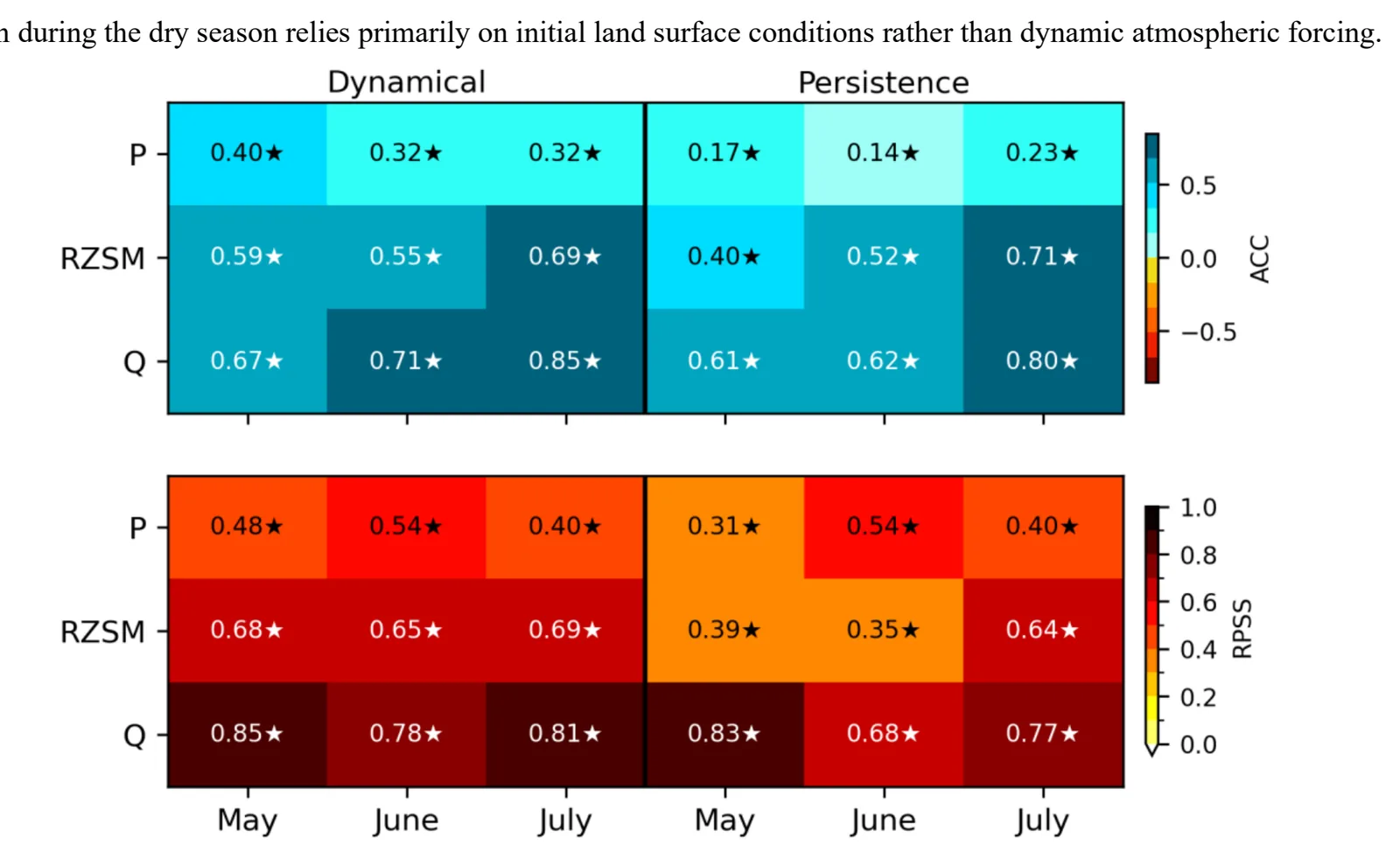
- For root zone soil moisture at the 3-month lead, probabilistic skill rose from 0.39 for persistence to 0.68 for the dynamical forecast. Precipitation forecasts were the least skilful.
- Streamflow skill was high (RPSS 0.78–0.85), but the dynamical forecast was barely better than persistence. At the 1- and 2-month leads the gain was not significant.
- The forecast model held dry streamflow anomalies longer than the baseline, by more than two months in some headwater tributaries. This inflated apparent streamflow skill.
- A soil moisture proxy for fire risk detected more elevated fire risk than a temperature and precipitation proxy (0.75 vs 0.31 in August, 0.70 vs 0.38 in September). Both had false alarm ratios above 0.75.
Limitations
- Evaluation is against the model’s own retrospective run and ERA5 indices, not directly against observed streamflow or soil moisture. Before 2017 the hindcasts have only one ensemble member.
- Static soil, rooting-depth and land-cover inputs, plus the memory biases, limit how far the forecasts can be trusted. The fire proxies cover only fuel moisture, not ignition or fuel load, which gives many false alarms.
- The October 2026 outlook is not yet validated. This is a preprint that has not been peer reviewed.
Glossary
- Root zone soil moisture (RZSM): Water held in the soil layer reached by plant roots.
- Persistence forecast: A simple forecast that assumes the anomaly at the start date stays the same.
- Ranked probability skill score (RPSS): A score for tercile probability forecasts, where 1 is perfect and 0 is no better than climatology.
- E-folding time: The time for an anomaly’s autocorrelation to fall to 1/e (0.368), used here as a measure of memory.
Original paper
Subseasonal-to-seasonal predictability of the 2024 El Niño-induced Amazon drought
EGUsphere · 25 October 2026
This paper is a preprint. It has not been peer reviewed, and its results may change.
AI-generated summary of the original article; changes were made. Check the original before relying on it.