Luxembourg's 2021 flood warnings were held back by rules, not by poor forecasts
Strong forecast signals for the July 2021 Luxembourg flood existed days ahead, but warning rules built on single-station deterministic thresholds left them unused.
Why it matters
Better forecasts alone do not guarantee earlier action. Warning systems also need procedures that can use probabilistic and cross-border information. The authors argue that such rules, joint interpretation and flexible coordination would let authorities act while risk is still emerging.
What they did
The authors applied a value chain questionnaire, used in warning research, to the July 2021 flood. They built it retrospectively from public records, official bulletins, institutional documents, media and forecast data. They rebuilt a timeline of forecasts, alerts and decisions. From this they developed the Waterdrop Model, a conceptual picture of how warning systems filter information.
Key findings
- ECMWF ensemble forecasts signalled extreme rain from early in the week before. The Extreme Forecast Index passed 0.5 by 9 July and 0.8 by 11 July.
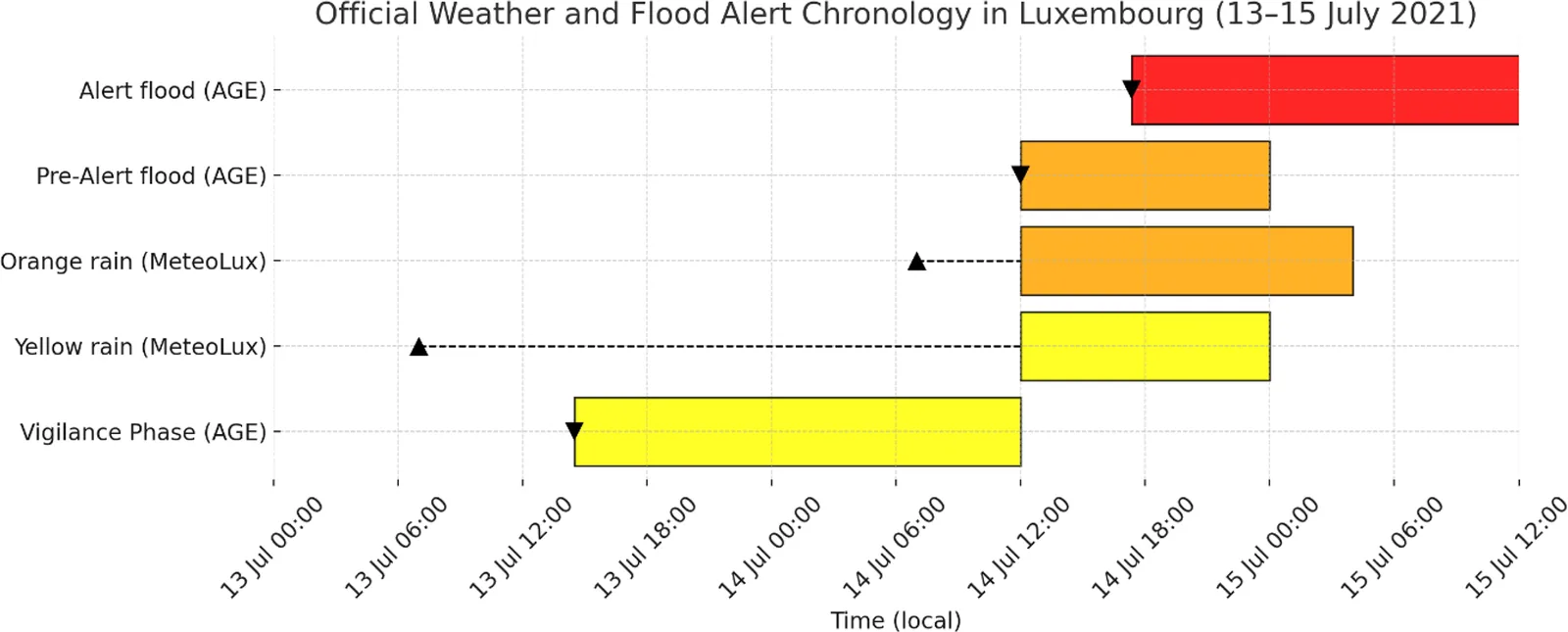
- National alerts relied on deterministic forecasts and thresholds at one station, Findel. Ensemble products, EFAS notices and other stations’ data had no formal role.
- The Godbrange station recorded 105.8 mm in 24 h, but it was not part of the official protocol. No red weather alert was issued.
- The flood alert reached red at 17:20 UTC on 14 July, when flooding was already under way. The Crisis Unit first met at midnight, and the GouvAlert mobile app sent no message.
- Luxembourg did not commission an independent post-event review, unlike its neighbours.
Limitations
- The analysis uses only public records and documented procedures. Informal decisions and internal deliberations are not captured.
- It stops at alert issuance. Public understanding and behaviour are not studied.
- The Waterdrop Model is diagnostic and came from reflection on this one case, so findings are specific to Luxembourg.
Glossary
- Extreme Forecast Index (EFI): An ECMWF measure of how far an ensemble rainfall forecast departs from the model’s usual climate; values near 1 mean a very unusual event.
- Ensemble forecast: A set of forecast runs from slightly different starting conditions, used to show uncertainty.
- EFAS: The European Flood Awareness System, which sends flood alerts for large river basins.
- Value chain: A view of warning systems as a chain from forecast to protective action, with each step adding value.
Original paper
Signals without action: a value chain analysis of Luxembourg's 2021 flood disaster
Natural Hazards and Earth System Sciences · 20 January 2026
AI-generated summary of the original article; changes were made. Check the original before relying on it.