Machine learning is advancing ozone forecasting, chemistry emulation and satellite estimates
Machine learning has made real progress on short-term ozone forecasts, fast chemistry emulators and satellite-based ozone estimates, but it still needs shared benchmarks, better long-run stability and more explainable models.
Why it matters
Ozone harms health and plants and is hard to simulate. Chemistry solvers are costly, and ozone measurements are sparse in many regions. ML could cut computing costs and fill data gaps, but only if the field builds common benchmarks and tests models on long runs, extremes and new regions.
What they did
This is a perspective and review from the ML4O3 working group of the second Tropospheric Ozone Assessment Report. The authors survey published work on ML for ozone in three areas: station-based short-term forecasting, emulation of atmospheric chemistry in models, and satellite-based retrieval and gap filling. They then discuss shared challenges and suggest future directions.
Key findings
- Ozone forecasting with neural networks goes back to 1996. Recent work uses more complex architectures and multi-country data from the TOAR database.
- ML chemistry solvers inside 3-D models have given speedups, for example a factor of five and an eight-time speedup in two studies. Many tests are short, and some show error growth over weeks or in remote ocean regions.
- ML models trained on satellite data and other inputs can estimate surface ozone, and ML can speed up retrievals and blend satellite products.
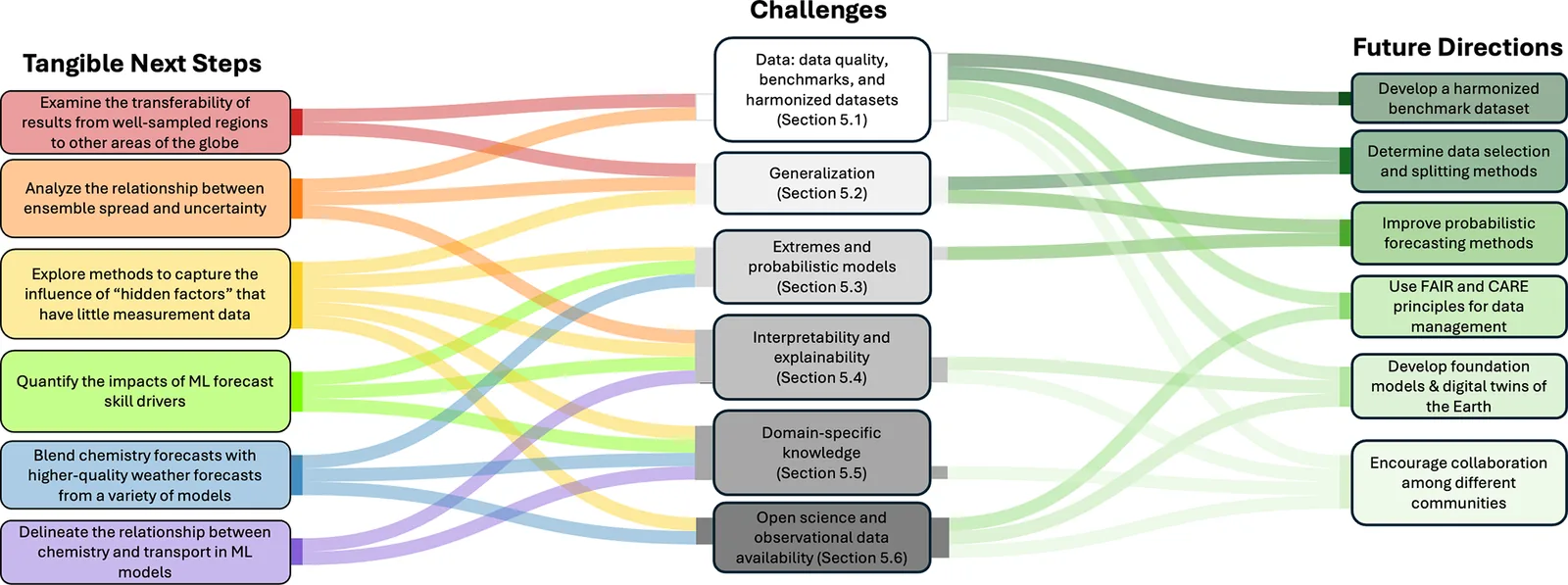
- Main obstacles are the lack of ozone benchmark datasets, poor generalization to new regions, weak handling of extremes, and limited explainability.
- The authors suggest foundation models, probabilistic forecasts and testing the effect of poorly observed precursors such as VOCs.
Limitations
- It is a narrative perspective, not a systematic or quantitative comparison, so the studies reviewed are not directly ranked.
- Few ML chemistry emulators have been run online in full models over long periods, so stability beyond a year is unknown.
- Whether ML can improve process-level understanding of ozone drivers and generalize to unseen climate scenarios is left as an open question.
Glossary
- Emulator: An ML model trained to reproduce the calculations of a part of a physical model, usually much faster.
- Chemical transport model (CTM): A numerical model that simulates how gases are emitted, moved and chemically changed in the atmosphere.
- Foundation model: A large model trained on broad data that can be fine-tuned for many tasks.
- Concept drift: Loss of ML accuracy over time because the relationship between inputs and outputs changes.
Original paper
Applications of Machine Learning and Artificial Intelligence in Tropospheric Ozone Research
Geoscientific Model Development · 20 November 2025
AI-generated summary of the original article; changes were made. Check the original before relying on it.