Models show Hunga eruption lowered southern ozone, with chemistry and dynamics equally important
In four-model simulations, the 2022 Hunga eruption reduced ozone in the southern mid- and high latitudes, with chemical and dynamical causes about equally large, but natural variability makes the signal hard to detect.
Why it matters
The results support a role for Hunga in the unusually low southern mid-latitude ozone seen in 2022. They also show that models disagree on how big and how lasting the Antarctic loss is. Because natural variability is large, the effect is hard to pin down from observations, and the upper stratosphere offers the clearest signal.
What they did
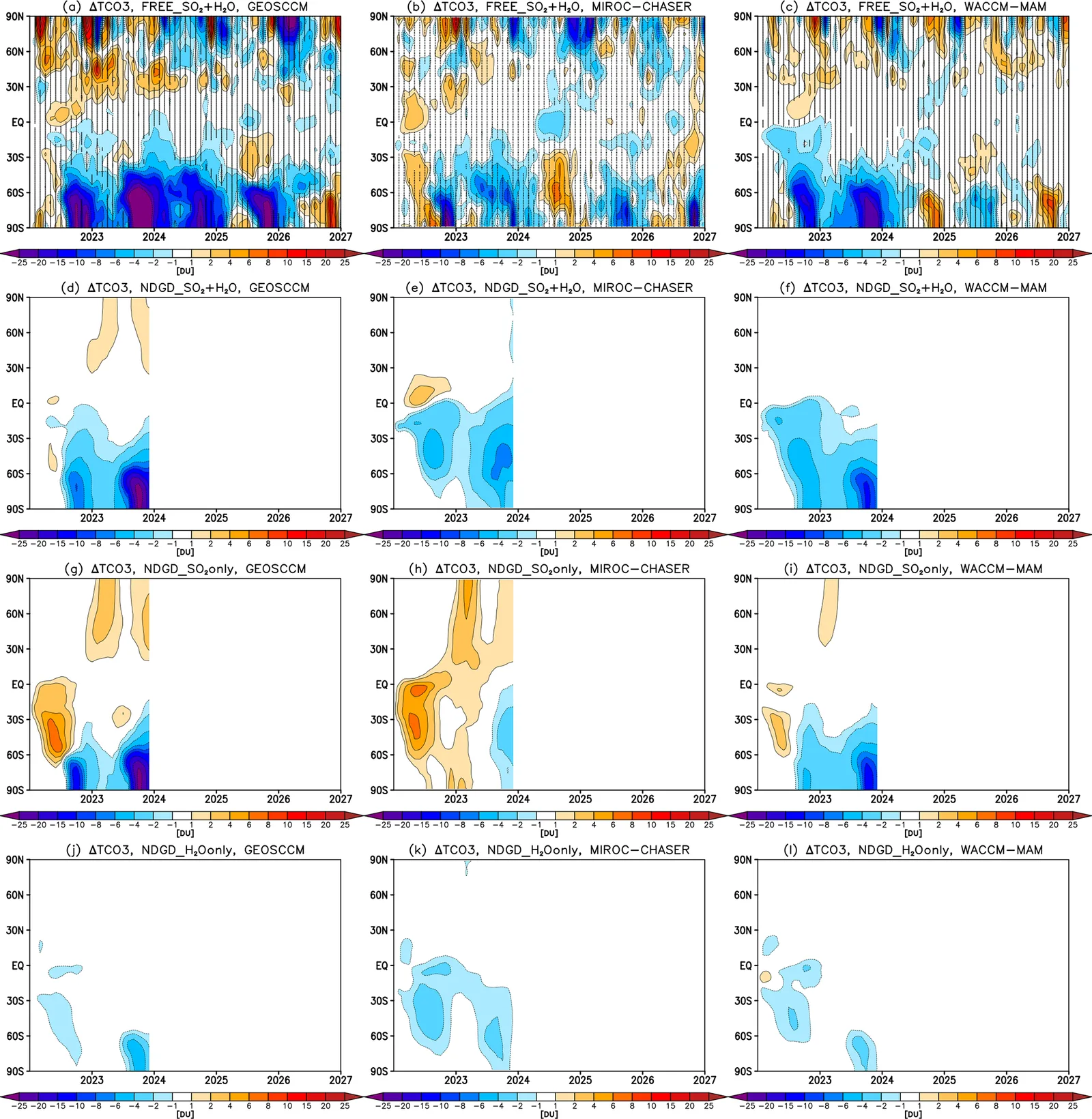
The authors used three chemistry-climate models that ran free-running and nudged experiments, with Hunga injections of 0.5 Tg SO2 and about 150 Tg H2O. Nudged runs force the weather to match reanalysis, so they isolate direct chemical effects. Free-running runs add changes in temperature and circulation. Free-running ensembles had 10 members in two models and 30 in WACCM-MAM. Separate H2O-only runs from three models, including a 2D model, tested the effect of water-driven cooling.
Key findings
- All three models simulate total column ozone losses in the southern mid-latitudes and in Antarctic spring. Antarctic losses in late 2023 range from not significant in MIROC-CHASER to up to about 50 DU in GEOSCCM.
- Nudged runs (chemistry only) capture a large share of the free-running response. In late 2023 over Antarctica, GEOSCCM shows about 50 DU free-running against about 25 DU nudged, and WACCM-MAM about 20 DU against about 10 DU.
- In the lower stratosphere, the aerosol from SO2 drives most of the chemical loss, through more active chlorine and bromine. Reduced nitrogen oxides raise middle-stratosphere ozone.
- Weaker transport and a stronger southern jet cut the flow of ozone into the troposphere. Ozone losses of a few percent reach 500 hPa until at least 2024.
- In the upper stratosphere, extra water vapor reduces ozone by up to about 2 %–4 %, and this fades by around 2028. This is the most robust signal.
Limitations
- Models differ widely in the size and persistence of the ozone response, especially over Antarctica, partly because they remove Hunga water and aerosol at different rates.
- Natural variability is large. Small ensembles give responses of either sign, so the forced signal is unlikely to be detectable in the single observed record.
- Nudged runs omit chemical effects of water-driven cooling, and the water and SO2 effects are not strictly additive.
Glossary
- Nudged (specified-dynamics) simulation: A model run where winds and temperatures are pushed toward reanalysis data, so only direct chemical effects of the eruption show up.
- Surface area density (SAD): The total surface area of aerosol particles per unit volume of air, which sets how fast reactions on aerosols proceed.
- ClOx and BrOx: Groups of reactive chlorine and bromine species that destroy ozone.
- O3S: A model tracer for ozone that came from the stratosphere, used to follow it into the troposphere.
Original paper
Multi-model assessment of impacts of the 2022 Hunga eruption on stratospheric ozone and its chemical and dynamical drivers
Atmospheric Chemistry and Physics · 12 August 2026
AI-generated summary of the original article; changes were made. Check the original before relying on it.