Nudging a physical weather model toward FuXi forecasts improves large-scale skill and typhoon tracks
Pulling the large-scale flow of the CMA physical model toward a machine learning forecast gave the ML model's large-scale skill and track accuracy while keeping the physical model's rain and storm intensity.
Why it matters
Machine learning forecasts handle large-scale flow well but smooth out small scales and weak storms. Physical models keep fine detail but lag on large scales. Combining them online offers a route to better medium-range forecasts without retraining the physical model’s physics.
What they did
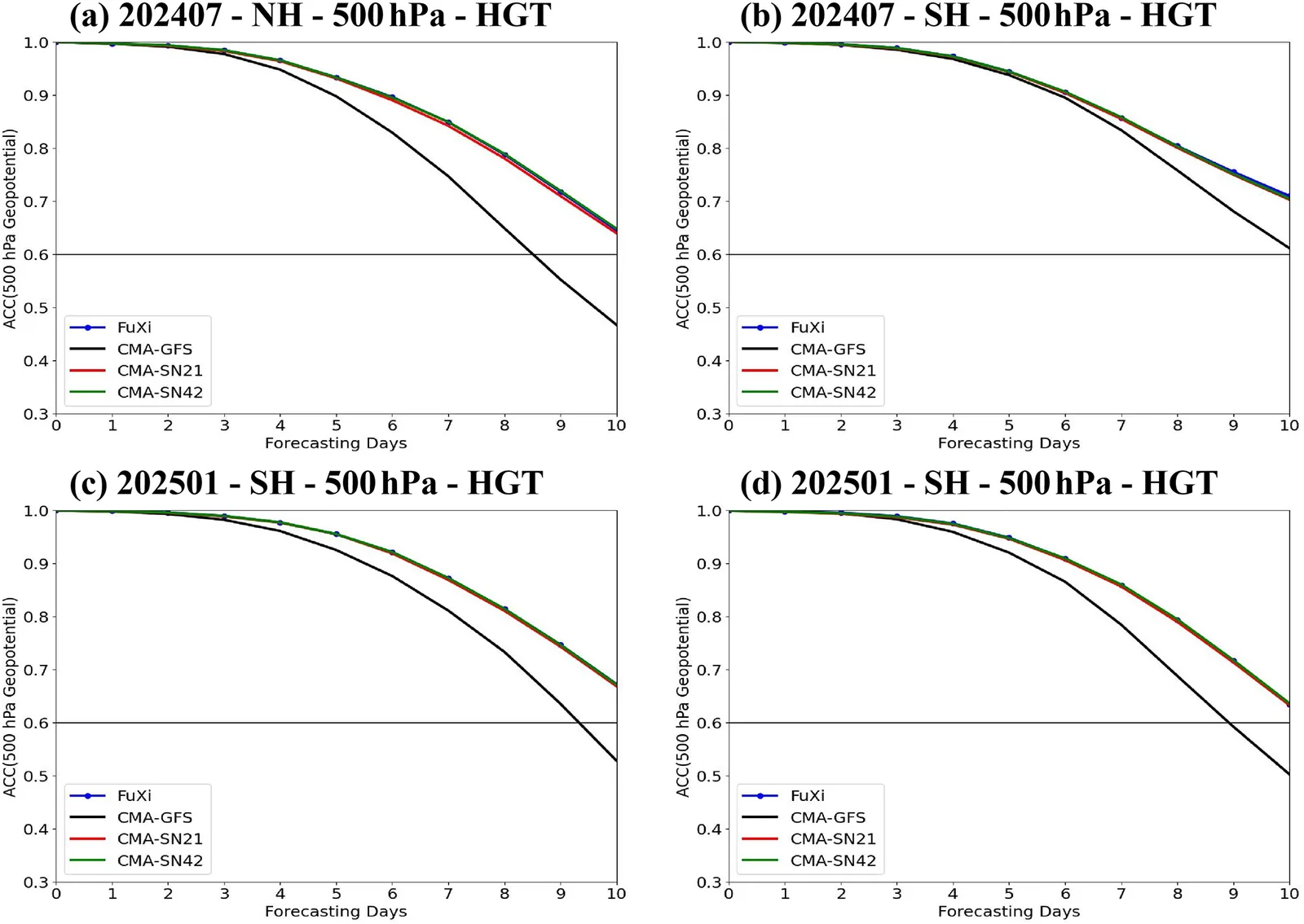
The authors added a spectral nudging term to the CMA-GFS physical model. It pushes only the large scales of temperature, pressure and winds toward forecasts from the FuXi ML model, mainly between about 600 and 200 hPa. Both models started from ERA5 data. They ran daily 10-day forecasts for July 2024 and January 2025, a heavy rain case, and 10 typhoons from 2024. They compared two cutoff scales, wavenumbers 21 and 42, and chose 21.
Key findings
- The hybrid system’s 500 hPa geopotential height skill was largely consistent with FuXi’s, which led CMA-GFS by about 2 d in July and about 1.5 d in January.
- Day-5 skill stayed within a narrow range, while CMA-GFS had sharp drops on some days.
- Precipitation scores improved at all thresholds, and the gain grew with lead time.
- Typhoon track error was about 30%-40% lower than CMA-GFS and close to FuXi’s, at a day-5 CMA-GFS error of about 365 km.
- Typhoon intensity stayed similar to CMA-GFS, which was better than FuXi, and was even better at longer lead times.
Limitations
- All runs started from ERA5 data, so this does not represent a real-time operational system. FuXi performs worse when started from CMA-GFS analyses.
- Nudging is limited to the middle and upper troposphere because FuXi has only 13 pressure levels. Low-level geopotential height biases were generally more negative than in CMA-GFS.
- Geopotential height got worse above 10 hPa, and the reasons need further analysis. Only two months and 10 typhoons were tested.
Glossary
- Spectral nudging: A method that gently pulls only the large-scale part of a model’s fields toward a reference forecast.
- ACC: Anomaly correlation coefficient, a score of how well forecast departures from normal match the real ones.
- Kinetic energy spectrum: A plot of how wind energy is spread across spatial scales, used to detect over-smoothing.
- ETS: Equitable threat score, a measure of rain forecast skill at given thresholds that discounts correct forecasts by chance.
Original paper
An online spectral nudging-based correction system: improving physical model forecasts by incorporating large-scale circulations derived from machine learning models
Geoscientific Model Development · 17 September 2026
AI-generated summary of the original article; changes were made. Check the original before relying on it.