Smoke above clouds shrinks droplets most when the air is unstable
In the Southeast Atlantic, cloud droplets respond to smoke just above cloud top mainly when the lower atmosphere is unstable, while in stable air the below-cloud aerosol matters more.
Why it matters
Studies of aerosol-cloud interactions that ignore where aerosol sits vertically, or how stable the air is, may get the strength of the effect wrong. Lumping all conditions together hid the pattern here. The method uses only remote sensing, so it could be applied to satellite data.
What they did
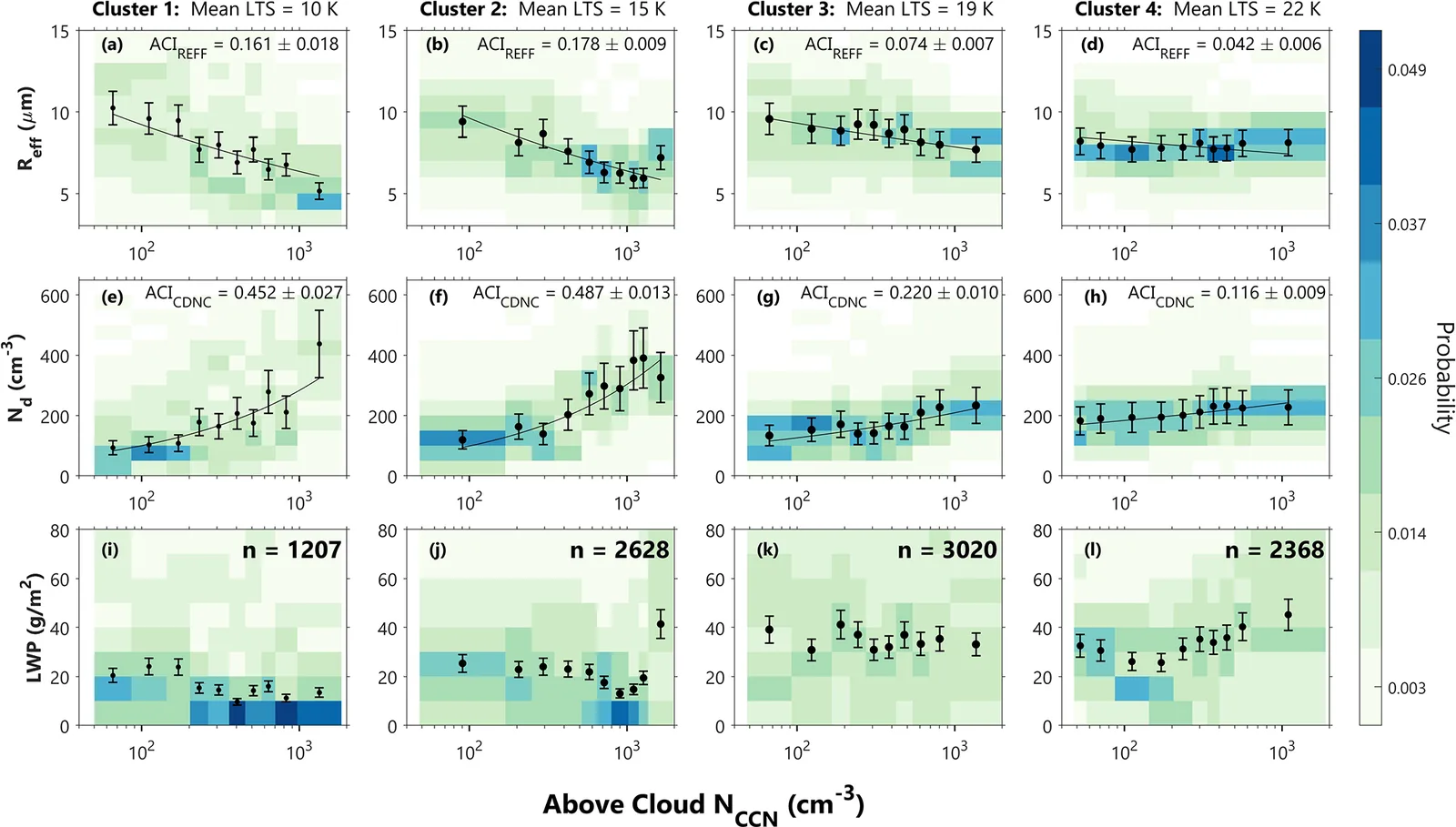
The authors used aircraft data from three ORACLES campaigns (2016, 2017, 2018). A machine learning method turned lidar profiles into cloud condensation nuclei (CCN) concentrations above and below cloud. A polarimeter gave droplet size, droplet number and liquid water path. They paired clear-sky lidar profiles beside clouds with cloudy ones, and assumed below-cloud CCN stays constant over 5 km. They grouped the data into four clusters by lower tropospheric stability (LTS) and measured how cloud properties changed with CCN.
Key findings
- More CCN in the 100 m above cloud top went with smaller droplets (lower Reff) and more droplets (higher Nd), across all data.
- As LTS rose from 10 to 22 K, ACIREFF fell from 0.161 to 0.042 (-73.9 %) and ACICDNC fell from 0.452 to 0.116 (-74.3 %).
- Below-cloud CCN showed the opposite trend: its link to cloud properties grew as LTS increased.
- Above-cloud relationships were similar at cloud edge and cloud center, and for clean and polluted boundary layers, though slightly weaker when the boundary layer was polluted.
- Cloud edge cases had a median LWP of 7.3 g m−2, against 28 g m−2 for all above-cloud cases.
Limitations
- Cloud edge cases mostly fall in low-LTS conditions, which masks the stronger below-cloud effect under stable conditions when all edge cases are pooled.
- Below-cloud CCN is extrapolated from a neighboring clear profile, which adds uncertainty. Cloud center cases have no below-cloud CCN.
- The ML-CCN retrieval has a mean relative error of 19.9 %, and Reff and COT are retrieved quantities with assumed 10 % uncertainty. The small reversals at very high or low CCN are only hypotheses.
Glossary
- CCN (cloud condensation nuclei): Aerosol particles on which cloud droplets can form.
- LTS (lower tropospheric stability): The potential temperature difference between 800 and 1000 hPa. Higher values mean a more stable lower atmosphere.
- ACI (aerosol-cloud interactions): How changes in aerosol amount change cloud properties such as droplet size and number.
- HSRL-2: An airborne lidar that measures aerosol backscatter and depolarization, used here to estimate CCN.
Original paper
Evidence of cloud sensitivity to above-cloud CCN as a function of environmental stability in the Southeast Atlantic based on remote sensing observations
Atmospheric Chemistry and Physics · 19 August 2026
AI-generated summary of the original article; changes were made. Check the original before relying on it.