Wildfires after flash droughts in the US spread faster early than other fires
Fires that start during rapid root-zone soil drying burn through nearby land faster early on, while background dryness without rapid onset shows a weak or inconsistent link.
Why it matters
Fire danger systems mostly track how dry fuels are, not how fast the soil dried. The results suggest that tracking drops in root-zone soil moisture over days to weeks before ignition could add early warning of fast fires. This could help most in grasslands and croplands. The authors say the predictive skill of such an indicator still needs testing.
What they did
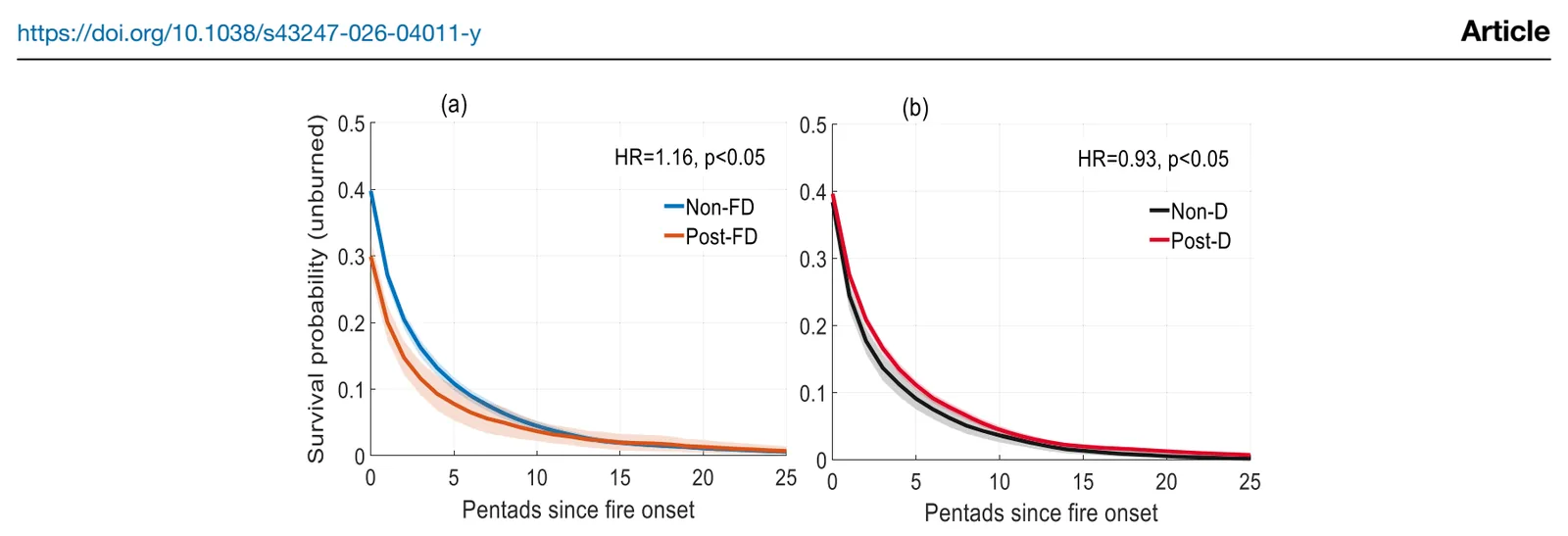
The authors used ERA5 reanalysis soil moisture and MODIS burned-area and land-cover data on a 0.25° grid with 5-day steps over the conterminous US, 2001-2024. They defined flash drought as a fast fall in root-zone soil moisture from above the 40th to below the 20th percentile. Fires were grouped into spatio-temporal clusters and labelled post-flash-drought or not. They compared how fast grid cells burned after ignition using Kaplan–Meier survival curves and Cox hazard ratios, by land-cover type. They also compared this with conventional drought, meaning persistently low soil moisture without rapid onset.
Key findings
- Post-flash-drought fires burned grid cells faster early on in all six land-cover types studied, with hazard ratios above one.
- Hazard ratios were highest in open shrublands (about 1.84), then grasslands (about 1.45), croplands (about 1.33), savannas (about 1.22), deciduous broadleaf forests (about 1.19) and woody savannas (about 1.17).
- Conventional drought gave weak or inconsistent changes in spread, with curves that largely overlapped and hazard ratios near or below one.
- Post-flash-drought fires were not consistently smaller, so smaller final size does not explain their faster burning.
- In several ecosystems the fastest-burning 10% of fires had larger soil-moisture deficits in the 20 days before ignition.
Limitations
- The work is observational, so the results are statistical associations rather than proof of cause. Weather, fuels, terrain, ignition source and suppression are not fully controlled.
- Burned-area data were aggregated to a 0.25° grid and 5-day steps, which may smooth fire boundaries and affect spread estimates, especially for small fires. Cropland and grassland burns may include managed burning.
- Proportional-hazards checks suggested possible violations in four of six land-cover types. The alternative evaporative-stress flash-drought definition showed no clear difference in spread.
Glossary
- Flash drought: A drought that sets in quickly, here a fast drop in root-zone soil moisture over days to weeks.
- Root-zone soil moisture (RZSM): Water held in the soil layer reached by plant roots, here the top 1 m.
- Kaplan–Meier survival curve: A curve showing the share of grid cells still unburned as time since ignition passes.
- Hazard ratio: The relative rate at which unburned cells burn in one group compared with another; above 1 means faster.
Original paper
Rapid soil moisture depletion during flash droughts accelerates wildfire spread in the United States
Communications Earth & Environment · 4 September 2026
AI-generated summary of the original article; changes were made. Check the original before relying on it.