Oceans · Other
New weather and climate research on oceans whose main contribution is a finding rather than models and methods, observations or AI and machine learning, one page per paper.
All summaries
-
 Oceans
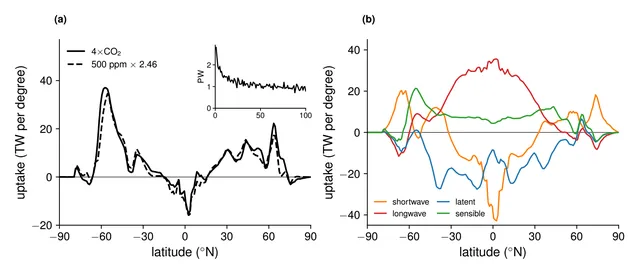
Preindustrial ocean circulation alone drives over half of modeled Southern Ocean heat uptake
In one climate model, the Southern Ocean's heat uptake under 4×CO2 is mostly set by the old circulation, with upwelling fixing its size and along-isopycnal diffusion fixing its slow decline.
-
 Oceans
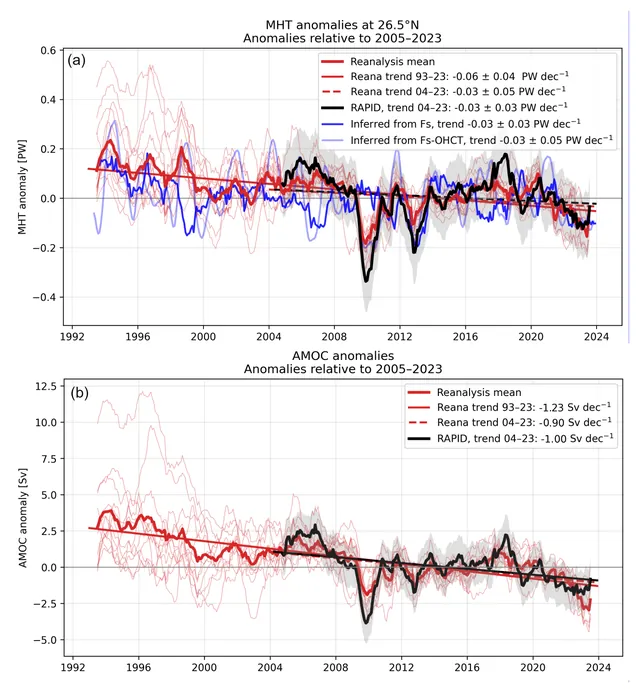
Ocean reanalyses show Atlantic heat transport falling since 1993, but with wide uncertainty
Seventeen ocean reanalyses roughly match observed Atlantic heat transport, mostly run low in the mean, and point to a decline since the early 1990s whose size is uncertain.
-
 Oceans
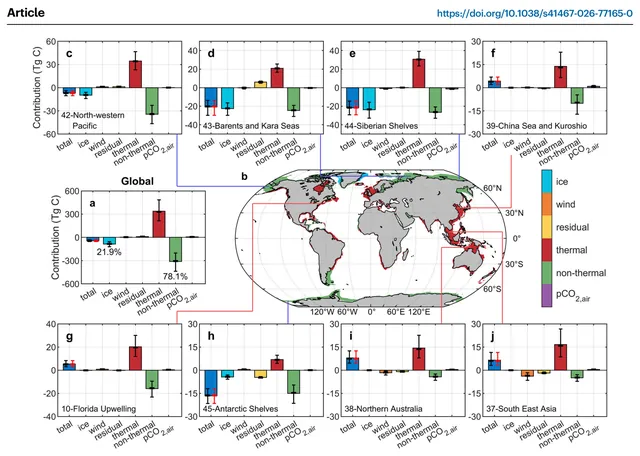
Marine heatwaves boost net CO2 uptake in global shelf seas, driven by polar regions
Across shelf seas worldwide, marine heatwaves raise net CO2 uptake by 11.0 ± 1.6%, because sea-ice loss and lower dissolved carbon in polar and subpolar waters outweigh weaker uptake in warmer regions.
-
 Oceans
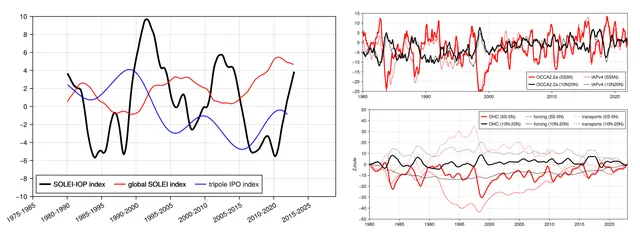
Ocean heat transport, not air-sea flux, drives regional warming in the top 200 m
In the upper 200 m of the ocean, heat piles up where currents carry it, while air-sea heat exchange mostly acts as a regional brake.
-
 Oceans
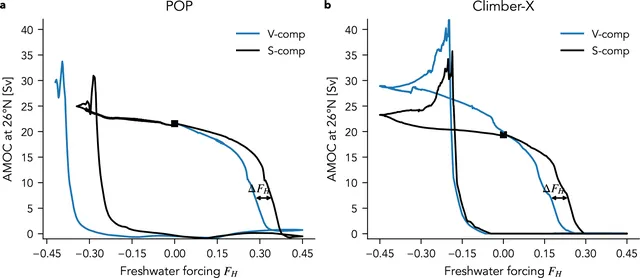
Adding salt at the surface delays modeled AMOC tipping versus spreading it through the ocean
In two models, compensating freshwater hosing with surface salt pushes the AMOC tipping point to higher forcing than volume compensation, so past thresholds may be too high.
-
 Oceans
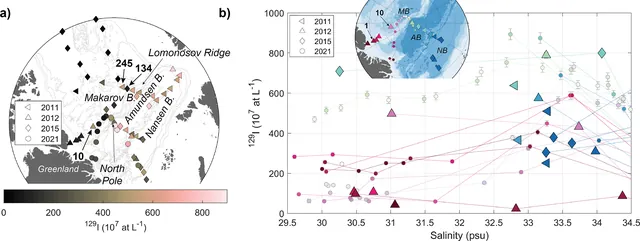
Iodine-129 and uranium-236 track Atlantic and Pacific water shifts in the central Arctic
Two radionuclide tracers show that in 2021 Pacific-influenced surface water met Atlantic-origin water at the Lomonosov Ridge, that this front moved from the Makarov Basin toward the ridge between 2011/2012 and 2015, and that Atlantic layer ages rose from 2015 to 2021 in several regions.
-
 Oceans
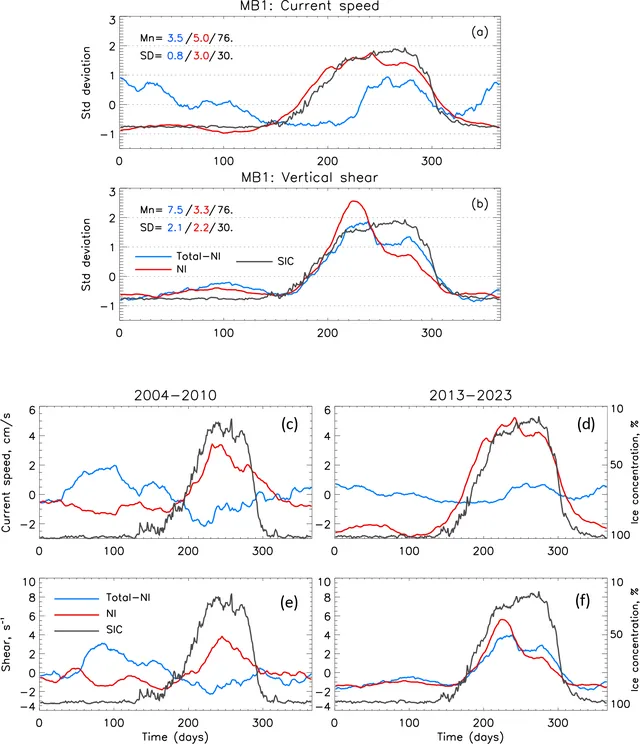
Siberian Arctic upper-ocean currents now follow sea ice and stratification more tightly
Over 2013–2023 the upper Siberian Arctic Ocean showed no trend in current speed or shear, but its seasonal cycle strengthened and now tracks sea ice closely, with near-inertial currents dominating in summer.
-
 Oceans
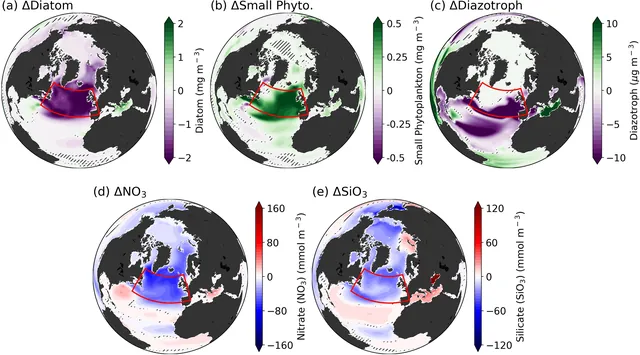
Subpolar North Atlantic plankton stay smaller even after CO2 returns to its starting level
In a climate model, removing CO2 back to its starting level does not bring back large diatoms in the Subpolar North Atlantic, because weaker ocean circulation keeps surface nutrients low, and this cuts carbon export.
-
 Oceans
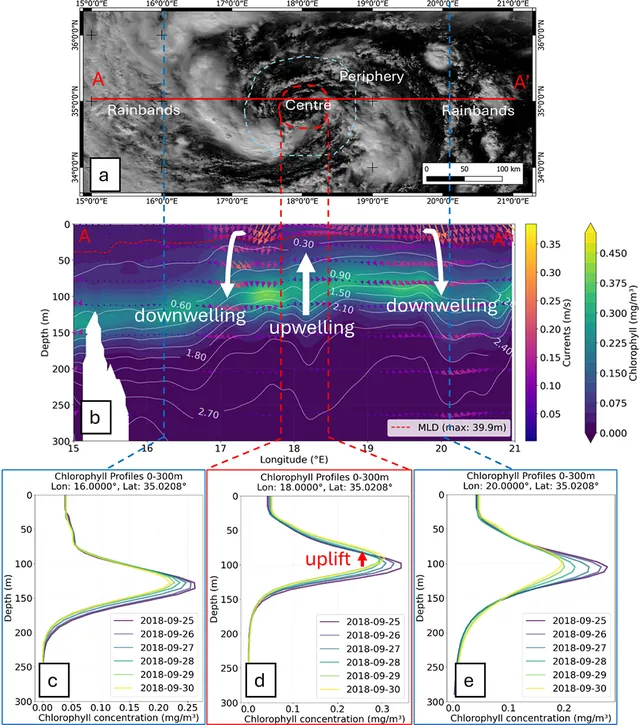
Slow-moving Mediterranean cyclones lift the deep chlorophyll maximum by tens of metres
Intense Mediterranean cyclones that move slowly and lose a lot of heat pull the deep chlorophyll layer upward, while nearshore chlorophyll rises mainly from runoff and currents.
-
 Oceans
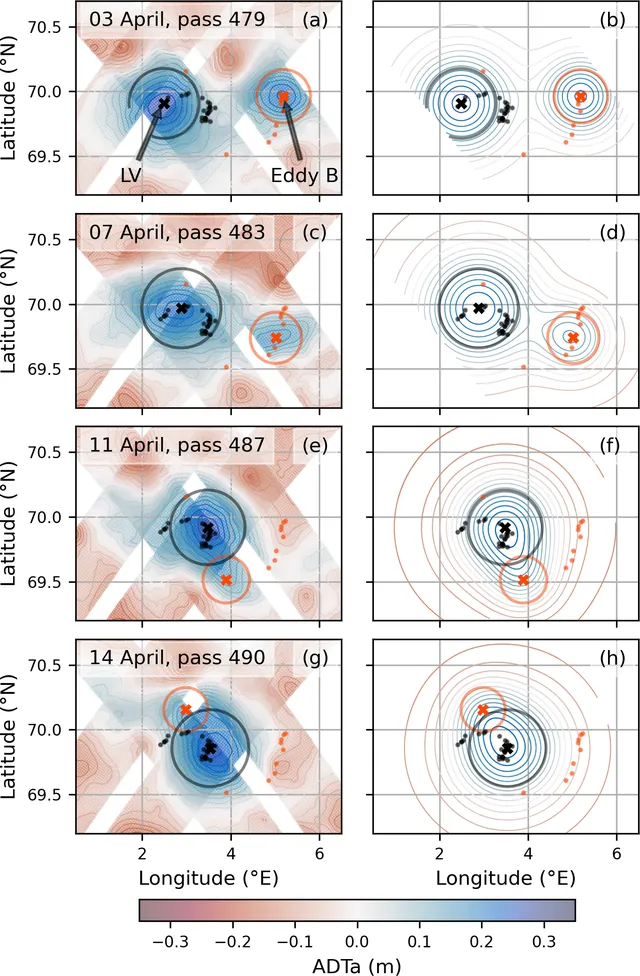
Glider and SWOT satellite watch a smaller eddy merge into the Lofoten Vortex
Combining a glider with SWOT altimetry, researchers saw a smaller, stronger eddy approach, co-rotate with and merge into the Lofoten Vortex in April 2023, spinning it up.
-
 Oceans
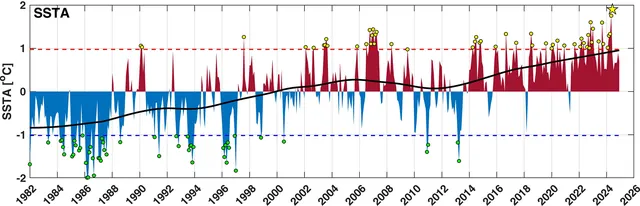
North Sea marine heatwaves rose mainly because average sea surface temperature climbed
Over 1982–2024, rising mean sea surface temperature, not changes in variability, drove most of the increase in North Sea marine heatwaves, with a clear step up after 2013.