Clouds and aerosols · Other
New weather and climate research on clouds and aerosols whose main contribution is a finding rather than models and methods, observations or AI and machine learning, one page per paper.
All summaries
-
 Clouds and aerosols
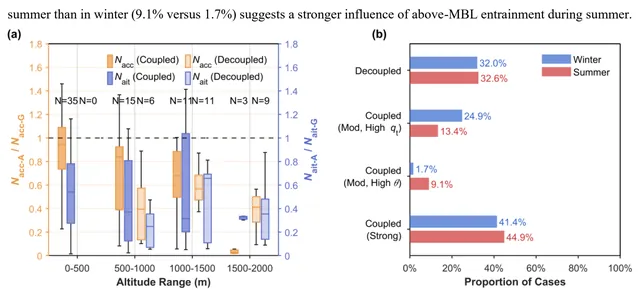
Accumulation-mode aerosol drives summer cloud droplet counts; winter also depends on Aitken particles
Over the Azores, summer cloud droplet numbers track accumulation-mode particle numbers, while in the cleaner winter air small Aitken-mode particles also matter, and decoupled boundary layers cut the aerosol that reaches cloud.
-
 Clouds and aerosols
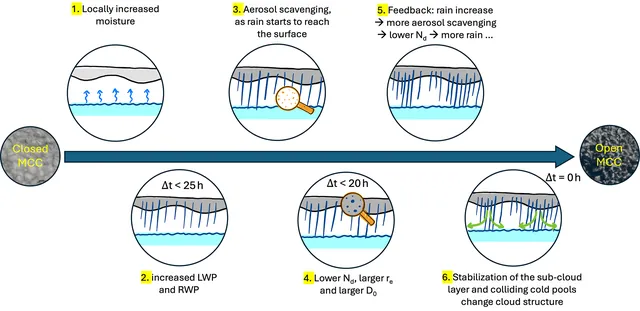
Rain and falling droplet counts build up about 25 hours before stratocumulus clouds break into open cells
EarthCARE and GOES data show that in stratocumulus, liquid water and rain rise first, then droplet numbers fall, over about 25 hours before closed cells turn into open cells.
-
 Clouds and aerosols
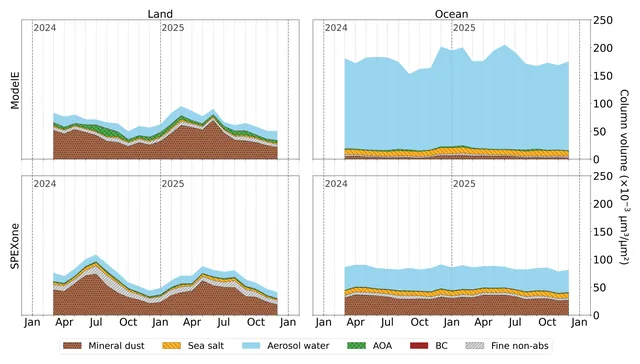
PACE satellite aerosol data and ModelE agree on fine aerosol but split on coarse dust and water
The first comparison of PACE SPEXone aerosol composition with a climate model finds good fine-mode agreement over land, but a large ocean mismatch in mineral dust and aerosol water that the authors trace partly to retrieval assumptions and partly to the model.
-
 Clouds and aerosols
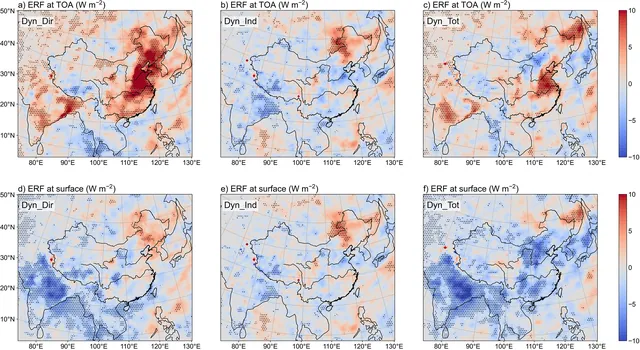
Faster black carbon aging in a regional model shifts East Asian summer climate effects
Letting black carbon aging speed vary with local pollution, instead of fixing it at 1.15 days, lowers BC column burden, raises near-surface BC in parts of eastern China, and changes the simulated radiative forcing and the summer north-dry, south-wet pattern.
-
 Clouds and aerosols
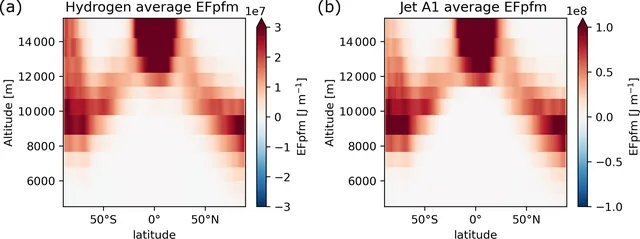
Hydrogen aircraft contrail cirrus forcing is modelled as 66 % lower than for jet fuel
In a model, hydrogen-powered aircraft make contrail cirrus with much less warming than jet fuel aircraft in most cases, but lubrication oil droplets could erase the benefit.
-
 Clouds and aerosols
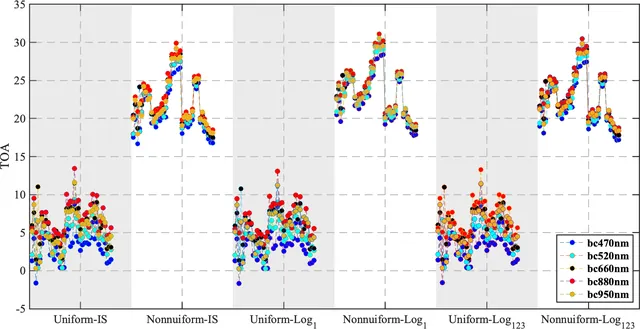
Realistic particle size and mixing shift black carbon radiative forcing in a coal region
In an industrial coal region of Shanxi, using the observed three-peak particle size and internal mixing, instead of simple standard assumptions, changes estimated absorption and radiative forcing by amounts comparable to local greenhouse gas forcing.
-
 Clouds and aerosols
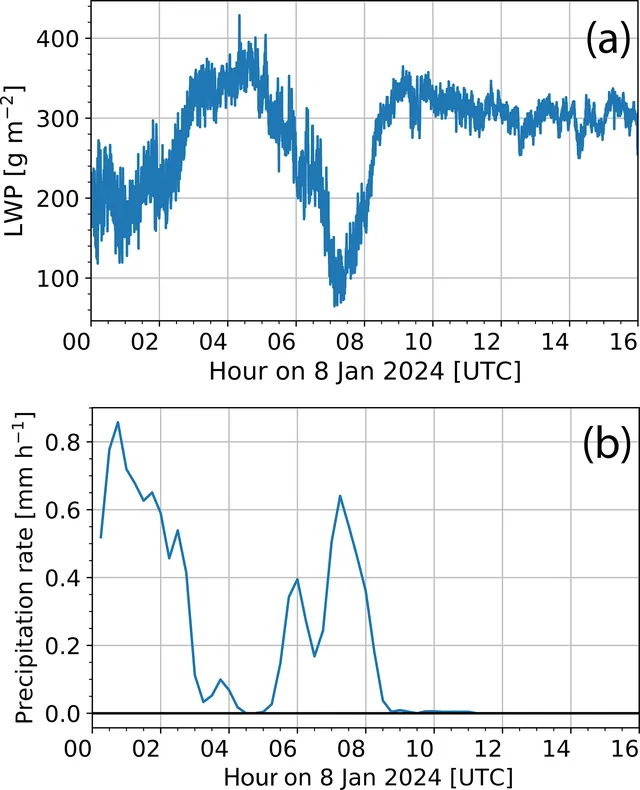
Ice falling into a supercooled stratus layer boosted precipitation in a Swiss case
On 8 January 2024 over the Swiss Plateau, ice crystals from an upper cloud fell into a low supercooled liquid cloud, rimed heavily and raised surface precipitation, which the operational ICON-D2 model seemed to underestimate.
-
 Clouds and aerosols
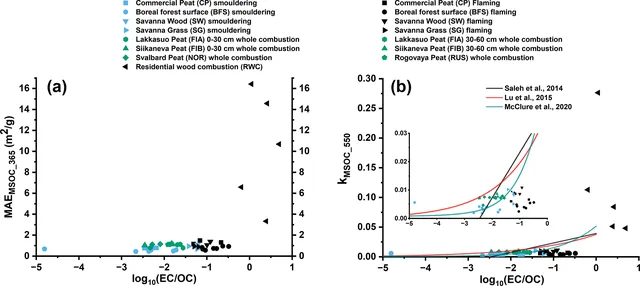
Lab-burned Eurasian peat and forest fuels emit mostly weakly light-absorbing brown carbon
Open burning of boreal, arctic peat and savanna fuels releases lots of organic carbon but little soot, and its brown carbon absorbs light only weakly, with dilution and aging making more of it insoluble.
-
 Clouds and aerosols
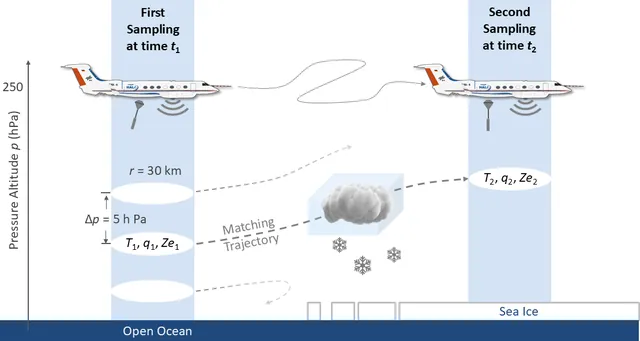
ICON model matches Arctic warm and cold airmass changes well, with errors near the surface
Aircraft that re-sampled the same air parcels showed the ICON model reproduces temperature and humidity changes in Arctic warm air intrusions and cold air outbreaks fairly well, with the biggest misses close to the surface.
-
 Clouds and aerosols
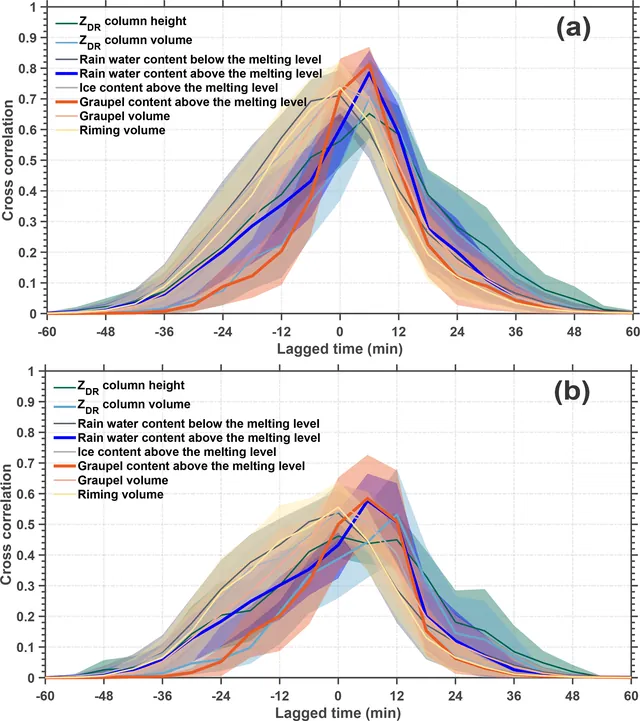
Graupel and supercooled rain predict lightning better than ZDR columns at 6 minutes
In 15 isolated South China thunderstorms, graupel and supercooled rain content gave the best 6-minute lightning forecasts, while ZDR column volume looked better at 12 minutes.
-
 Clouds and aerosols
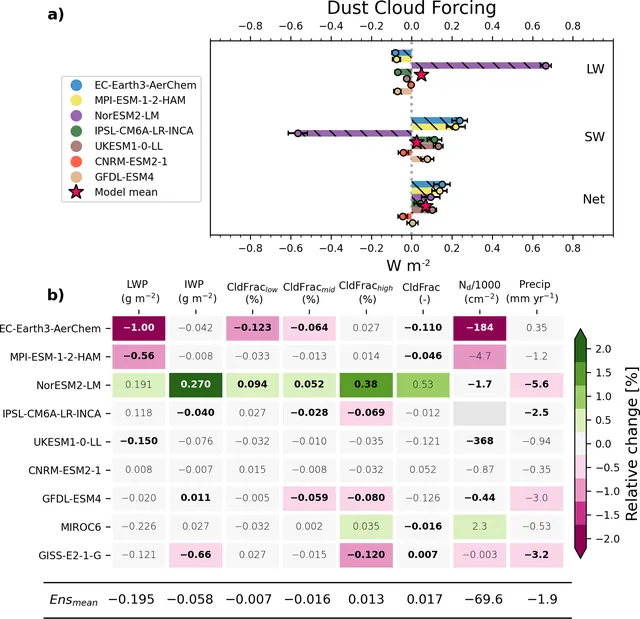
Nine climate models disagree widely on dust forcing, but agree dust cuts precipitation
When nine CMIP6 models double dust emissions, they differ a lot in how much energy dust adds or removes, yet eight of nine show less precipitation.