Cryosphere · Other
New weather and climate research on cryosphere whose main contribution is a finding rather than models and methods, observations or AI and machine learning, one page per paper.
All summaries
-
 Cryosphere
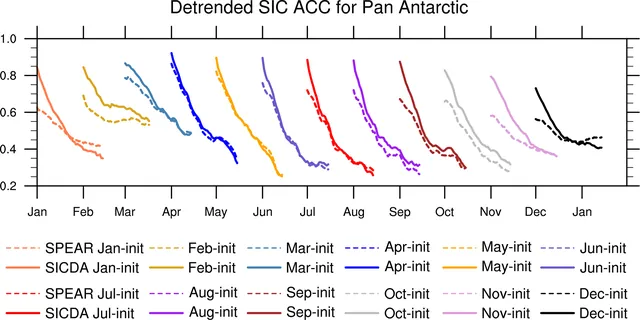
Assimilating sea ice concentration improves subseasonal Antarctic sea ice forecasts
Feeding satellite sea ice concentration into the starting state of GFDL's SPEAR forecast system gives better Antarctic sea ice forecasts out to 45 days, with bigger gains than in the Arctic.
-
 Cryosphere
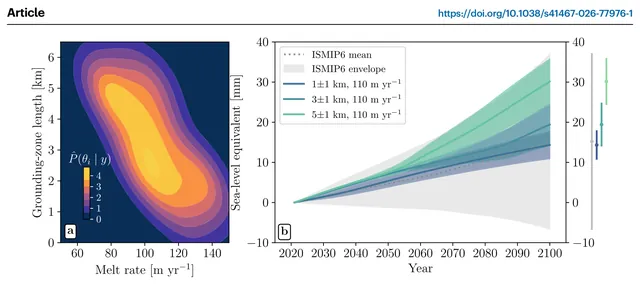
Melting grounding zones let a model match Thwaites' retreat and double its sea-level share
When an ice-sheet model lets seawater melt ice several kilometers inland of the grounding line, it matches 27 years of Thwaites observations and projects about twice the earlier sea-level contribution by 2100.
-
 Cryosphere
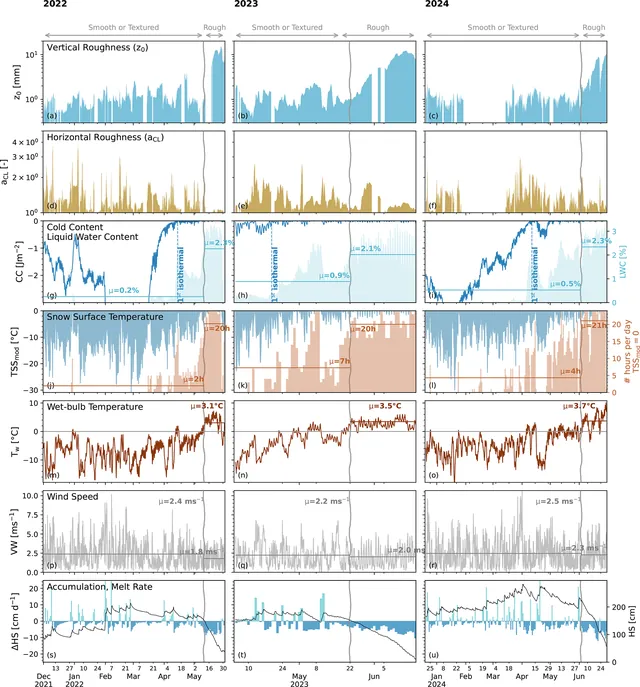
Snow surface roughness from suncups tracks albedo loss on alpine snow over three seasons
Over three melt seasons in the Swiss Alps, suncup roughness and impurities together lowered snow albedo by 0.03–0.1, and albedo follows a logarithmic curve with aerodynamic roughness length z0.
-
 Cryosphere
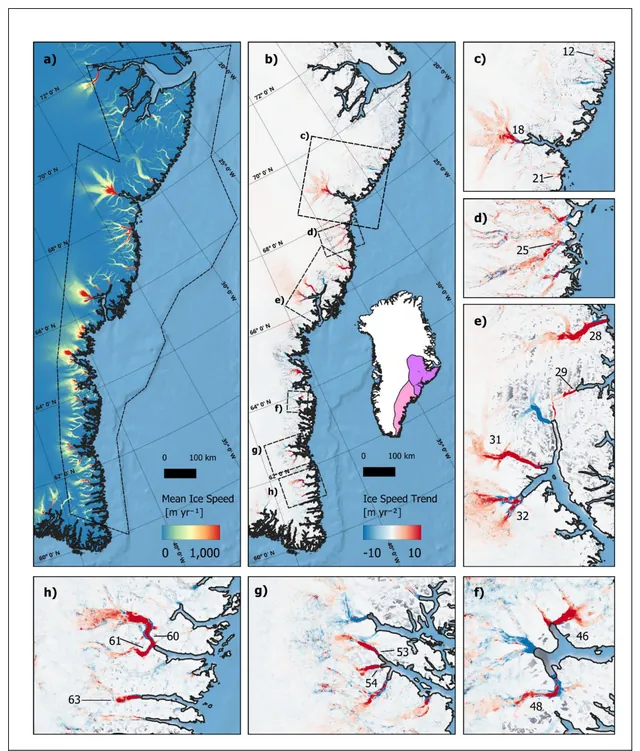
Glaciers in central and southeast Greenland sped up together from 2016 to 2020
Satellite data show that most of 66 marine-terminating glaciers in central and southeast Greenland accelerated together from 2016, peaked around 2020, then slowed only partly, as warm ocean water appeared at the same time.
-
 Cryosphere
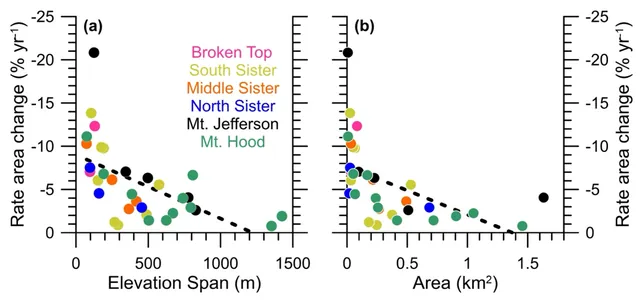
Oregon central Cascade glaciers lost about 20 % of their area from 2018/20 to 2023
Glaciers on five Oregon volcanos are shrinking 4.5 to 6.1 times faster than before 2018/20, and the smallest glaciers are shrinking fastest, which the authors link to warmer summers.
-
 Cryosphere
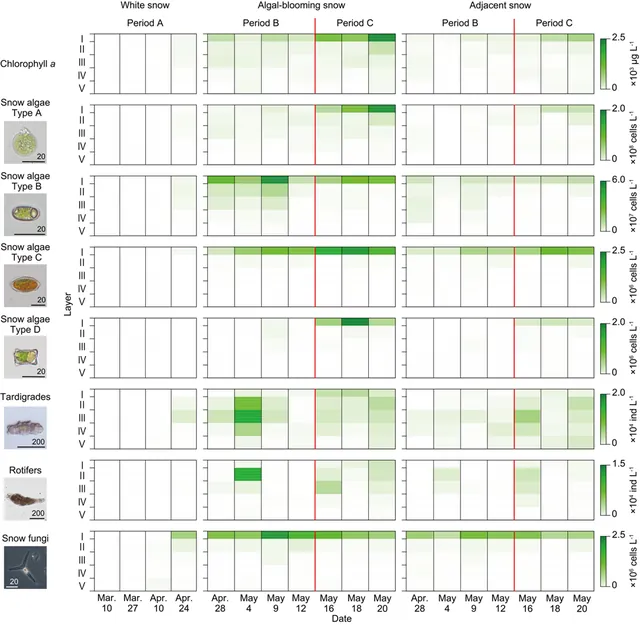
Snow microbes in a Japanese beech forest rose, stalled and rose again with nutrients
In this forest snowpack, microbes grew once temperatures stayed above freezing, stalled when nutrients ran out, and grew again when beech budburst brought new nutrients.
-
 Cryosphere
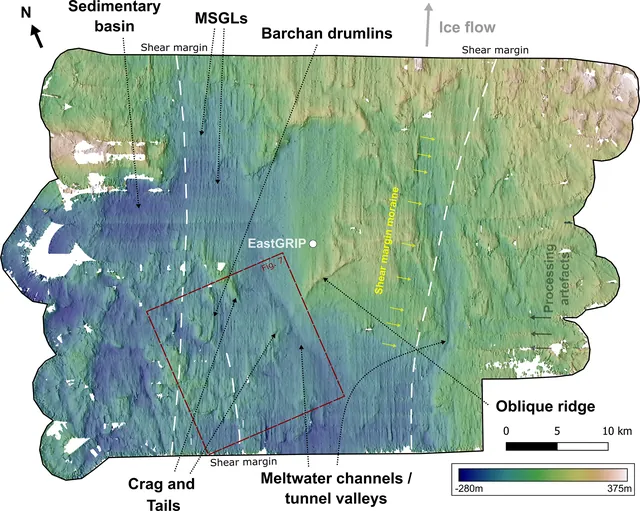
Streamlined bed landforms found under slow ice at the start of the NE Greenland Ice Stream
Swath radar shows long, streamlined bed ridges (mega-scale glacial lineations) beneath ice moving only about 60 m per year near the Northeast Greenland Ice Stream onset, which challenges the idea that they need fast flow.
-
 Cryosphere
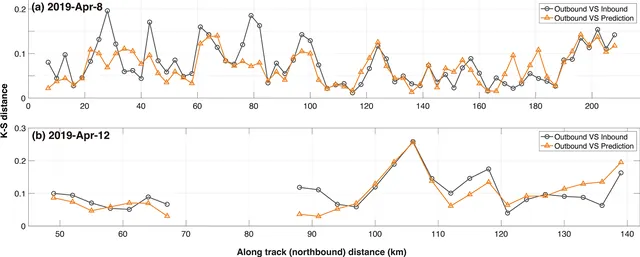
Radar backscatter from Sentinel-1 tracks sea ice freeboard and helps upscale altimetry
In two April 2019 case studies, C-band radar backscatter correlated with sea ice freeboard, and this link let the authors predict the spread of freeboard values away from altimeter tracks.
-
 Cryosphere
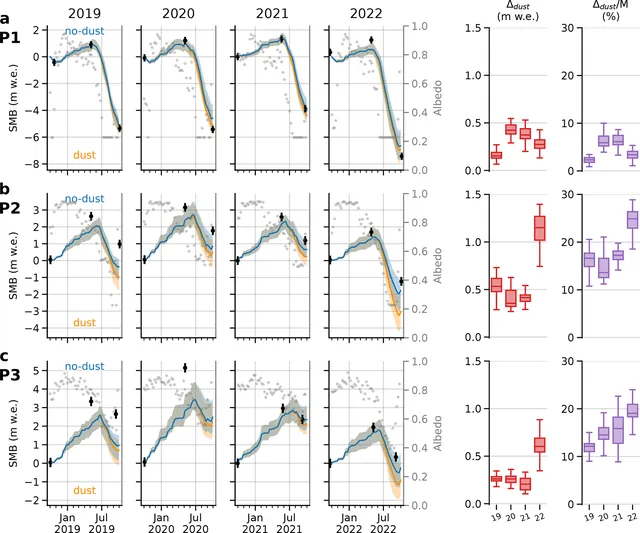
Saharan dust cut Argentière Glacier's 2022 mass balance by 0.63 m w.e., double earlier years
In a snow model of Argentière Glacier, mineral dust lowered annual surface mass balance by 0.31 to 0.45 m w.e. in 2019–2021 and by 0.63 m w.e. in 2022, most strongly just above the previous summer's snowline.
-
 Cryosphere
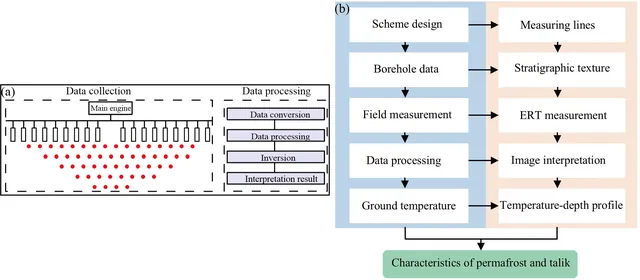
Thermokarst lakes on the Tibetan Plateau thaw permafrost and form through-taliks beneath them
In a Tibetan Plateau lake basin, ground resistivity surveys and borehole temperatures showed that three small thermokarst lakes have thawed the permafrost below them all the way through.
-
 Cryosphere
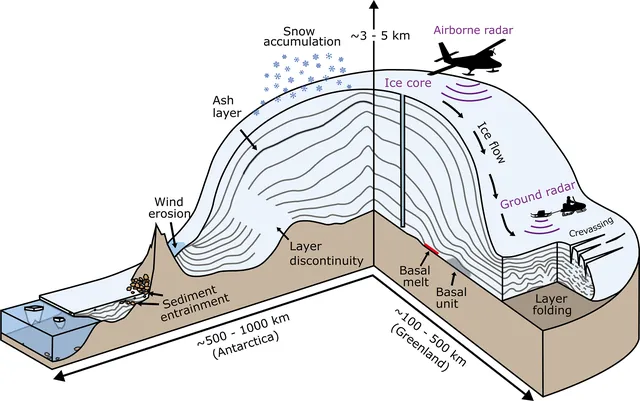
Radar-imaged ice layers could be built into a continent-wide age–depth model of Antarctica
Six decades of radar surveys have recorded dated layers inside Antarctic ice, but only a small part has been traced, and a community effort is needed to turn it into a continent-wide age model.
-
 Cryosphere
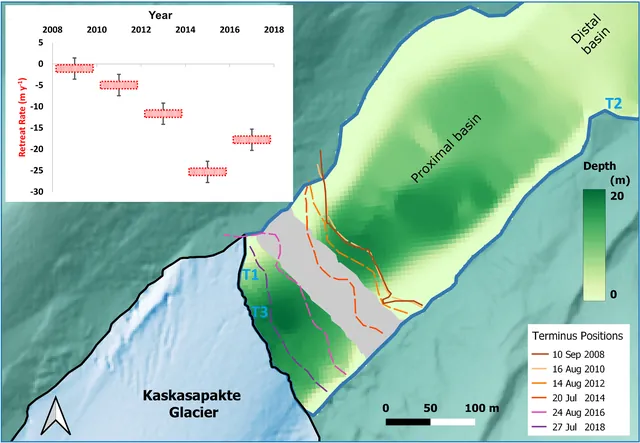
Warm lake water above 4 °C helped an Arctic Swedish glacier retreat quickly
At Kaskasapakte Glacier in Arctic Sweden, lake water warmer than 4 °C carved notches into the ice front and drove calving, and ice lost at the front made up about 30% of volume loss from 2015 to 2019.